Thank you for visiting SNEWPapers!
Sign up free
Phenix Gazette
Alexandria, Virginia
What is this article about?
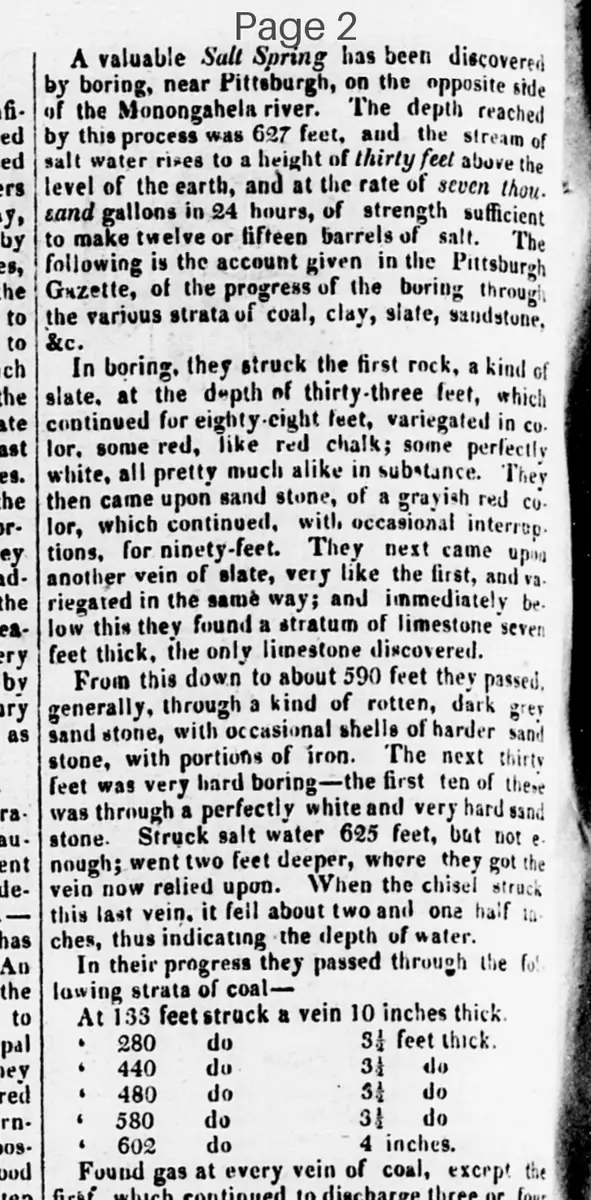
A valuable salt spring was discovered near Pittsburgh, across the Monongahela River, by boring to 627 feet. The salt water rises 30 feet above ground, flowing at 7,000 gallons per 24 hours, strong enough for 12-15 barrels of salt. Boring revealed strata of slate, sandstone, limestone, and coal veins, with gas discharges.
Merged-components note: Merged table of coal strata into the article on salt spring discovery near Pittsburgh.
Clipping
OCR Quality
Full Text
In boring, they struck the first rock, a kind of slate, at the depth of thirty-three feet, which continued for eighty-eight feet, variegated in color, some red, like red chalk; some perfectly white, all pretty much alike in substance. They then came upon sand stone, of a grayish red color, which continued, with occasional interruptions, for ninety feet. They next came upon another vein of slate, very like the first, and variegated in the same way; and immediately below this they found a stratum of limestone seven feet thick, the only limestone discovered. From this down to about 590 feet they passed generally, through a kind of rotten, dark grey sand stone, with occasional shells of harder sand stone, with portions of iron. The next thirty feet was very hard boring—the first ten of these was through a perfectly white and very hard sand stone. Struck salt water 625 feet, but not enough; went two feet deeper, where they got the vein now relied upon. When the chisel struck this last vein, it fell about two and one half inches, thus indicating the depth of water.
In their progress they passed through the following strata of coal—
Found gas at every vein of coal, except the first, which continued to discharge three or four weeks from each vein. Mr. Murray thinks that the gas now discharged would light an establishment larger than the Exchange Hotel in this city
| At 133 feet struck a vein 10 inches thick | |||
| • | 280 | do | 3½ feet thick. |
| • | 440 | do | 3½ do |
| • | 480 | do | 3½ do |
| • | 580 | do | 3½ do |
| • | 602 | do | 4 inches. |
What sub-type of article is it?
What keywords are associated?
What entities or persons were involved?
Where did it happen?
Domestic News Details
Primary Location
Near Pittsburgh, On The Opposite Side Of The Monongahela River
Key Persons
Outcome
stream of salt water rises to thirty feet above earth level, at seven thousand gallons in 24 hours, strength sufficient to make twelve or fifteen barrels of salt. gas discharged from coal veins.
Event Details
Boring reached 627 feet, passing through slate (33-121 feet, variegated), sandstone (90 feet, grayish red), another slate vein, limestone (7 feet), rotten dark grey sandstone to 590 feet with iron portions, hard white sandstone (10 feet), struck salt water at 625 feet, sufficient vein at 627 feet. Passed through coal strata at various depths, with gas discharges.