Thank you for visiting SNEWPapers!
Sign up free
Literary
January 24, 1829
Republican Herald
Providence, Providence County, Rhode Island
What is this article about?
This essay sketches the general character of Carolinians, emphasizing their hospitality as a habitual trait shaped by circumstances, limited access to information fostering traveler welcome, comparisons to other nationalities' traits, and slavery's effects promoting equality among whites but indolence and aversion to labor, while defending against accusations of cruelty.
Clipping
OCR Quality
95%
Excellent
Full Text
SKETCHES OF THE SOUTH
No. 5—General Character.
Continued.
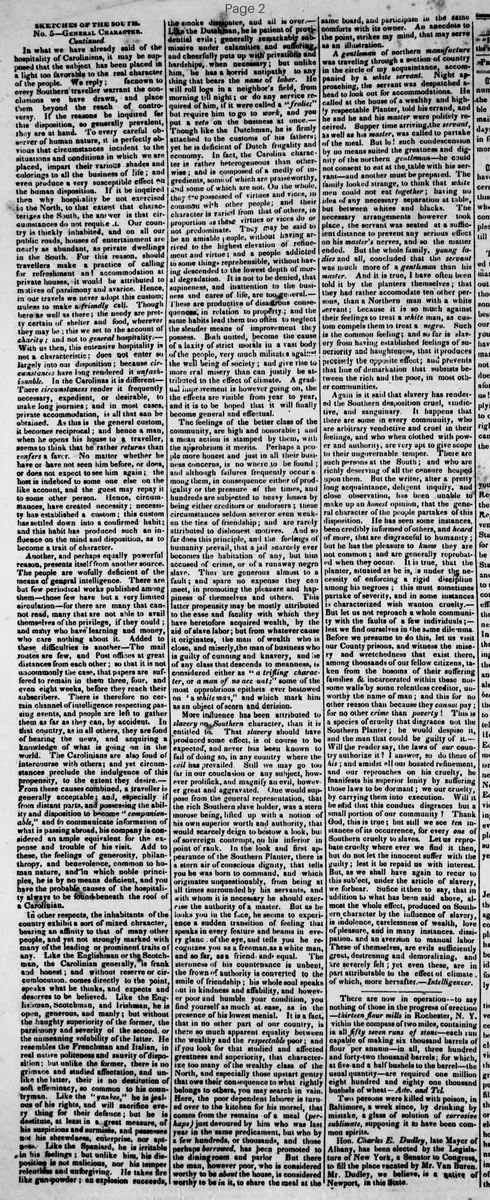
In what we have already said of the hospitality of Carolinians, it may be supposed that the subject has been placed in a light too favorable to the real character of the people. We reply; fact known to every Southern traveller warrants the conclusions we have drawn, and places them beyond the reach of controversy. If the reasons be inquired for this disposition, so generally prevalent, they are at hand. To every careful observer of human nature, it is perfectly obvious that circumstances incident to the situations and conditions in which we are placed, impart their various shades and colorings to all the business of life; and even produce a very susceptible effect on the human disposition. If it be inquired then why hospitality be not exercised in the North, to that extent that characterizes the South, the answer is that circumstances do not require it. Our country is thickly inhabited, and on all our public roads, houses of entertainment are nearly as abundant, as private dwellings in the South. For this reason, should travellers make a practice of calling for refreshment and accommodation at private houses, it would be attributed to motives of parsimony and avarice. Hence, in our travels we never adopt this custom; unless to make a friendly call. Though here as well as there; the needy are pretty certain of shelter and food, wherever they may be; this we set to the account of charity; and not to general hospitality. With us then, this extensive hospitality is not a characteristic; does not enter so largely into our disposition; because circumstances have long rendered it unfashionable. In the Carolinas it is different—There circumstances render it frequently necessary, expedient, or desirable, to make long journeys; and in most cases, private accommodation, is all that can be obtained. As this is the general custom, it becomes reciprocal; and hence a man, when he opens his house to a traveller, seems to think that he rather returns than confers a favor. No matter whether he have or have not seen him before, or does or does not expect to see him again; the host is indebted to some one else on the like account, and the guest may repay it to some other person. Hence, circumstances, have created necessity; necessity has established a custom; this custom has settled down into a confirmed habit; and this habit has produced such an influence on the mind and disposition, as to become a trait of character.
Another, and perhaps equally powerful reason, presents itself from another source. The people are woefully deficient of the means of general intelligence. There are but few periodical works published among them—those few have but a very limited circulation—for there are many that cannot read, many that are not able to avail themselves of the privilege, if they could; and many who have learning and money, who care nothing about it. Added to these difficulties is another—The mail routes are few, and Post offices at great distances from each other; so that it is not uncommonly the case, that papers are suffered to remain in them three, four, and even eight weeks, before they reach their subscribers. There is therefore no certain channel of intelligence respecting passing events, and people are left to gather them as far as they can, by accident. In that country, as in all others, they are fond of hearing the news, and acquiring a knowledge of what is going on in the world. The Carolinians are also fond of intercourse with others; and yet circumstances preclude the indulgence of this propensity, to the extent they desire. From these causes combined, a traveller is generally acceptable; and, especially if from distant parts, and possessing the ability and disposition to become "companionable," and to communicate information of what is passing abroad, his company is considered an ample equivalent for the expense and trouble of his visit. Add to these, the feelings of generosity, philanthropy, and benevolence, common to human nature, and in which noble principles, he is by no means deficient, and you have the probable causes of the hospitality always to be found beneath the roof of Carolinian.
In other respects, the inhabitants of the country exhibit a sort of mixed character, bearing an affinity to that of many other people, and yet not strongly marked with many of the leading or prominent traits of any. Like the Englishman or the Scotchman, the Carolinian generally, is frank and honest; and without reserve or circumlocution, comes directly to the point, speaks what he thinks, and expects and deserves to be believed. Like the Englishman, Scotchman, and Irishman, he is open, generous, and manly; but without the haughty superiority of the former, the parsimony and severity of the second, or the unmeaning volubility of the latter. He resembles the Frenchman and Italian, in real native politeness and suavity of disposition: but unlike the former, there is no grimace and studied affectation, and unlike the latter, there is no destitution of soft effeminacy, so common to his countryman. Like the "yankee," he is jealous of his rights, and will sacrifice everything for their defence; but he is destitute, at least in a great measure, of his suspiciousness and surmises, and possesses not his shrewdness, enterprise, nor aptness. Like the Spaniard, he is irritable in his feelings: but unlike him, "his disposition is not malicious, nor his temper relentless and unforgiving. He takes fire like gun powder; an explosion succeeds, the smoke dissipates, and all is over.
Like the Dutchman, he is patient of providential evils; generally remarkably submissive under calamities and suffering, and cheerfully puts up with privations and hardships, when necessary; but unlike him, he has a horrid antipathy to anything that bears the name of labor. He will roll logs in a neighbor's field, from morning till night; or do any service required of him, if it were called a "frolic;" but require him to go to work, and you put a veto on the business at once. Though like the Dutchman, he is firmly attached to the customs of his fathers; yet he is deficient of Dutch frugality and economy. In fact, the Carolina character is rather heterogeneous than otherwise; and is composed of a medley of ingredients, some of which are praiseworthy. They are possessed of virtues and vices, in common with other people; and their character is varied from that of others, in proportion as these virtues or vices do or do not predominate. They may be said to be an amiable people, without having arrived to the highest elevation of refinement and virtue; and a people addicted to some things reprehensible, without having descended to the lowest depth of moral degradation. It is not to be denied, that supineness, and inattention to the business and cares of life, are too general. These are productive of disastrous consequences, in relation to property; and the same habits lead them too often to neglect the slender means of improvement they possess. Both united, become the cause of a laxity of strict morals in a vast body of the people, very much militates against the well being of society: and give rise to more real misery than can justly be attributed to the effect of climate. A gradual improvement is however going on, the effects are visible from year to year, and it is to be hoped that it will finally become general and effectual.
The feelings of the better class of the community, are high and honorable; and a mean action is stamped by them, with the approbrium it merits. Perhaps a people more honest and just in all their business concerns, is no where to be found; and although failures frequently occur among them, in consequence either of prodigality or the pressure of the times, and hundreds are subjected to heavy losses by being either creditors or endorsers; these circumstances seldom sever or even weaken the ties of friendship; and are rarely attributed to dishonest motives. And so far does this principle, and the feelings of humanity prevail, that a jail scarcely ever becomes the habitation of any, but him accused of crime, or of a runaway negro slave. They are generous almost to a fault; and spare no expense they can meet, in promoting the pleasure and happiness of themselves and others. This latter propensity may be mostly attributed to the ease and facility with which they have heretofore acquired wealth, by the aid of slave labor; but from whatever cause it originates, the man of wealth who is close, and miserly, the man of business who is guilty of cunning and knavery, and he of any class that descends to meanness, is considered either as "a trifling character, or a man of no account;" some of the most opprobrious epithets ever bestowed on "a white man," and which mark him as an object of scorn and derision.
More influence has been attributed to slavery on Southern character, than it is entitled to. That slavery should have produced some effect, is of course to be expected, and never has been known to fail of doing so, in any country where the evil has prevailed. Still we may go too far in our conclusions on any subject, however prolific, and magnify an evil, however great and aggravated. One would suppose from the general representation, that the rich Southern slave holder, was a stern morose being, lifted up with a notion of his own superior worth and authority, that would scarcely deign to bestow a look, but of sovereign contempt, on his inferior in point of rank. In the look and first appearance of the Southern Planter, there is a stern air of conscious dignity, that tells you he was born to command, and which originates unquestionably, from being at all times surrounded by his servants, and with whom it is necessary he should exercise the authority of a master. But as he looks you in the face, he seems to experience a sudden transition of feeling that speaks in every feature and beams in every glance of the eye, and tells you he recognizes you as a freeman, as a white man, and so far, as a friend and equal. The sternness of his countenance is unbent, the frown of authority is converted to the smile of friendship; his whole soul speaks out in kindness and affability, and however poor and humble your condition, you find yourself as much at ease, as in the presence of his lowest menial. It is a fact, that in no other part of our country, is there so much apparent equality between the wealthy and the respectable poor; and if you look for that studied and affected greatness and superiority, that characterize too many of the wealthy class of the North, and especially those upstart gentry that owe their consequence to what rightly belongs to others, you may search in vain. Here, the poor dependent laborer is turned over to the kitchen for his morsel, that comes from the remains of a meal (perhaps) just devoured by him who was last year in the same predicament, but who by a few hundreds, or thousands, and those perhaps borrowed, has been promoted to the dining room and parlor. But there the man, however poor, who is considered worthy to be about the house, is considered worthy to be in it, to share the meal at the same board, and participate in the same comforts with its owner.
An anecdote to the point, strikes my mind, that may serve as an illustration. A gentleman of northern manufacture was traveling through a section of country in the circle of my acquaintance, accompanied by a white servant. Night approaching, the servant was despatched ahead to look out for accommodations. He called at the house of a wealthy and highly respectable Planter, told his errand, and he and his master were politely received. Supper time arriving, the servant, as well as his master, was called to partake of the meal. But lo! such condescension by no means suited the greatness and dignity of the northern gentleman—he could not consent to eat at the table with his servant—and another must be prepared. The family looked strange, to think that white men could not eat together; having no idea of any necessary separation at table, but between whites and blacks. The necessary arrangements however took place, the servant was seated at a sufficient distance to prevent any serious effect on his master's nerves, and so the matter ended. But the whole family, young ladies and all, concluded that the servant was much more of a gentleman than his master. And it is true, I have often been told it by the planters themselves: that they had rather accommodate ten other persons, than a Northern man with a white servant; because it is so much against their feelings to treat a white man, as custom compels them to treat a negro. Such is the common feeling; and so far is slavery from having established feelings of superiority and haughtiness, that it produces precisely the opposite effect; and prevents that line of demarkation that subsists between the rich and the poor, in most other communities.
Again is it said that slavery has rendered the Southern disposition cruel, vindictive, and sanguinary. It happens that there are some in every community, who are arbitrary, vindictive and cruel in their feelings, and who when clothed with power and authority, are very apt to give scope to their ungovernable temper. There are such persons at the South; and who are richly deserving of all the censure heaped upon them. But the writer, after a pretty long acquaintance, diligent inquiry, and close observation, has been unable to make up an honest opinion, that the general character of the people partakes of this disposition. He has seen some instances, been credibly informed of others, and heard of more, that are disgraceful to humanity; but he has the pleasure to know they are not common; and are generally reprobated when they occur. It is true, that the planter, situated as he is, is under the necessity of enforcing a rigid discipline among his negroes; this must sometimes partake of severity, and in some instances is characterized with wanton cruelty. But let us not reproach a whole community with the faults of a few individuals; lest we find ourselves in the same dilemma. Before we presume to do this, let us visit our County prisons, and witness the misery and wretchedness that exist there, among thousands of our fellow citizens, taken from the bosoms of their suffering families & incarcerated within those noisome walls by some relentless creditor, unworthy the name of man; and this for no other reason than because they cannot pay; for no other crime than poverty! This is a species of cruelty that disgraces not the Southern Planter; he would despise it, and the man that could be guilty of it. Will the reader say, the laws of our country authorize it? I answer, so do those of his; and amidst all our boasted refinement, and our reproaches on his cruelty, he manifests his superior lenity by suffering those laws to be dormant; we our cruelty, by carrying them into execution. Will it be said that this conduct disgraces but a small portion of our community? Thank God, this is true; but still we see ten instances of its occurrence, for every one of Southern cruelty to slaves. Let us reprobate cruelty wherever we find it then, but do not let the innocent suffer with the guilty; lest it be repaid us with interest. But, as we shall have again to recur to this subject, under the article of slavery, we forbear. Suffice it then to say, that in addition to what has been said above, almost the whole effect, produced on Southern character by the influence of slavery, is indolence, carelessness of wealth, love of pleasure, and in many instances, dissipation, and an aversion to manual labor. These of themselves, are evils sufficiently great, distressing and demoralizing, and are severely felt; yet even these, are in part attributable to the effect of climate, of which, more hereafter.—Intelligencer.
No. 5—General Character.
Continued.
In what we have already said of the hospitality of Carolinians, it may be supposed that the subject has been placed in a light too favorable to the real character of the people. We reply; fact known to every Southern traveller warrants the conclusions we have drawn, and places them beyond the reach of controversy. If the reasons be inquired for this disposition, so generally prevalent, they are at hand. To every careful observer of human nature, it is perfectly obvious that circumstances incident to the situations and conditions in which we are placed, impart their various shades and colorings to all the business of life; and even produce a very susceptible effect on the human disposition. If it be inquired then why hospitality be not exercised in the North, to that extent that characterizes the South, the answer is that circumstances do not require it. Our country is thickly inhabited, and on all our public roads, houses of entertainment are nearly as abundant, as private dwellings in the South. For this reason, should travellers make a practice of calling for refreshment and accommodation at private houses, it would be attributed to motives of parsimony and avarice. Hence, in our travels we never adopt this custom; unless to make a friendly call. Though here as well as there; the needy are pretty certain of shelter and food, wherever they may be; this we set to the account of charity; and not to general hospitality. With us then, this extensive hospitality is not a characteristic; does not enter so largely into our disposition; because circumstances have long rendered it unfashionable. In the Carolinas it is different—There circumstances render it frequently necessary, expedient, or desirable, to make long journeys; and in most cases, private accommodation, is all that can be obtained. As this is the general custom, it becomes reciprocal; and hence a man, when he opens his house to a traveller, seems to think that he rather returns than confers a favor. No matter whether he have or have not seen him before, or does or does not expect to see him again; the host is indebted to some one else on the like account, and the guest may repay it to some other person. Hence, circumstances, have created necessity; necessity has established a custom; this custom has settled down into a confirmed habit; and this habit has produced such an influence on the mind and disposition, as to become a trait of character.
Another, and perhaps equally powerful reason, presents itself from another source. The people are woefully deficient of the means of general intelligence. There are but few periodical works published among them—those few have but a very limited circulation—for there are many that cannot read, many that are not able to avail themselves of the privilege, if they could; and many who have learning and money, who care nothing about it. Added to these difficulties is another—The mail routes are few, and Post offices at great distances from each other; so that it is not uncommonly the case, that papers are suffered to remain in them three, four, and even eight weeks, before they reach their subscribers. There is therefore no certain channel of intelligence respecting passing events, and people are left to gather them as far as they can, by accident. In that country, as in all others, they are fond of hearing the news, and acquiring a knowledge of what is going on in the world. The Carolinians are also fond of intercourse with others; and yet circumstances preclude the indulgence of this propensity, to the extent they desire. From these causes combined, a traveller is generally acceptable; and, especially if from distant parts, and possessing the ability and disposition to become "companionable," and to communicate information of what is passing abroad, his company is considered an ample equivalent for the expense and trouble of his visit. Add to these, the feelings of generosity, philanthropy, and benevolence, common to human nature, and in which noble principles, he is by no means deficient, and you have the probable causes of the hospitality always to be found beneath the roof of Carolinian.
In other respects, the inhabitants of the country exhibit a sort of mixed character, bearing an affinity to that of many other people, and yet not strongly marked with many of the leading or prominent traits of any. Like the Englishman or the Scotchman, the Carolinian generally, is frank and honest; and without reserve or circumlocution, comes directly to the point, speaks what he thinks, and expects and deserves to be believed. Like the Englishman, Scotchman, and Irishman, he is open, generous, and manly; but without the haughty superiority of the former, the parsimony and severity of the second, or the unmeaning volubility of the latter. He resembles the Frenchman and Italian, in real native politeness and suavity of disposition: but unlike the former, there is no grimace and studied affectation, and unlike the latter, there is no destitution of soft effeminacy, so common to his countryman. Like the "yankee," he is jealous of his rights, and will sacrifice everything for their defence; but he is destitute, at least in a great measure, of his suspiciousness and surmises, and possesses not his shrewdness, enterprise, nor aptness. Like the Spaniard, he is irritable in his feelings: but unlike him, "his disposition is not malicious, nor his temper relentless and unforgiving. He takes fire like gun powder; an explosion succeeds, the smoke dissipates, and all is over.
Like the Dutchman, he is patient of providential evils; generally remarkably submissive under calamities and suffering, and cheerfully puts up with privations and hardships, when necessary; but unlike him, he has a horrid antipathy to anything that bears the name of labor. He will roll logs in a neighbor's field, from morning till night; or do any service required of him, if it were called a "frolic;" but require him to go to work, and you put a veto on the business at once. Though like the Dutchman, he is firmly attached to the customs of his fathers; yet he is deficient of Dutch frugality and economy. In fact, the Carolina character is rather heterogeneous than otherwise; and is composed of a medley of ingredients, some of which are praiseworthy. They are possessed of virtues and vices, in common with other people; and their character is varied from that of others, in proportion as these virtues or vices do or do not predominate. They may be said to be an amiable people, without having arrived to the highest elevation of refinement and virtue; and a people addicted to some things reprehensible, without having descended to the lowest depth of moral degradation. It is not to be denied, that supineness, and inattention to the business and cares of life, are too general. These are productive of disastrous consequences, in relation to property; and the same habits lead them too often to neglect the slender means of improvement they possess. Both united, become the cause of a laxity of strict morals in a vast body of the people, very much militates against the well being of society: and give rise to more real misery than can justly be attributed to the effect of climate. A gradual improvement is however going on, the effects are visible from year to year, and it is to be hoped that it will finally become general and effectual.
The feelings of the better class of the community, are high and honorable; and a mean action is stamped by them, with the approbrium it merits. Perhaps a people more honest and just in all their business concerns, is no where to be found; and although failures frequently occur among them, in consequence either of prodigality or the pressure of the times, and hundreds are subjected to heavy losses by being either creditors or endorsers; these circumstances seldom sever or even weaken the ties of friendship; and are rarely attributed to dishonest motives. And so far does this principle, and the feelings of humanity prevail, that a jail scarcely ever becomes the habitation of any, but him accused of crime, or of a runaway negro slave. They are generous almost to a fault; and spare no expense they can meet, in promoting the pleasure and happiness of themselves and others. This latter propensity may be mostly attributed to the ease and facility with which they have heretofore acquired wealth, by the aid of slave labor; but from whatever cause it originates, the man of wealth who is close, and miserly, the man of business who is guilty of cunning and knavery, and he of any class that descends to meanness, is considered either as "a trifling character, or a man of no account;" some of the most opprobrious epithets ever bestowed on "a white man," and which mark him as an object of scorn and derision.
More influence has been attributed to slavery on Southern character, than it is entitled to. That slavery should have produced some effect, is of course to be expected, and never has been known to fail of doing so, in any country where the evil has prevailed. Still we may go too far in our conclusions on any subject, however prolific, and magnify an evil, however great and aggravated. One would suppose from the general representation, that the rich Southern slave holder, was a stern morose being, lifted up with a notion of his own superior worth and authority, that would scarcely deign to bestow a look, but of sovereign contempt, on his inferior in point of rank. In the look and first appearance of the Southern Planter, there is a stern air of conscious dignity, that tells you he was born to command, and which originates unquestionably, from being at all times surrounded by his servants, and with whom it is necessary he should exercise the authority of a master. But as he looks you in the face, he seems to experience a sudden transition of feeling that speaks in every feature and beams in every glance of the eye, and tells you he recognizes you as a freeman, as a white man, and so far, as a friend and equal. The sternness of his countenance is unbent, the frown of authority is converted to the smile of friendship; his whole soul speaks out in kindness and affability, and however poor and humble your condition, you find yourself as much at ease, as in the presence of his lowest menial. It is a fact, that in no other part of our country, is there so much apparent equality between the wealthy and the respectable poor; and if you look for that studied and affected greatness and superiority, that characterize too many of the wealthy class of the North, and especially those upstart gentry that owe their consequence to what rightly belongs to others, you may search in vain. Here, the poor dependent laborer is turned over to the kitchen for his morsel, that comes from the remains of a meal (perhaps) just devoured by him who was last year in the same predicament, but who by a few hundreds, or thousands, and those perhaps borrowed, has been promoted to the dining room and parlor. But there the man, however poor, who is considered worthy to be about the house, is considered worthy to be in it, to share the meal at the same board, and participate in the same comforts with its owner.
An anecdote to the point, strikes my mind, that may serve as an illustration. A gentleman of northern manufacture was traveling through a section of country in the circle of my acquaintance, accompanied by a white servant. Night approaching, the servant was despatched ahead to look out for accommodations. He called at the house of a wealthy and highly respectable Planter, told his errand, and he and his master were politely received. Supper time arriving, the servant, as well as his master, was called to partake of the meal. But lo! such condescension by no means suited the greatness and dignity of the northern gentleman—he could not consent to eat at the table with his servant—and another must be prepared. The family looked strange, to think that white men could not eat together; having no idea of any necessary separation at table, but between whites and blacks. The necessary arrangements however took place, the servant was seated at a sufficient distance to prevent any serious effect on his master's nerves, and so the matter ended. But the whole family, young ladies and all, concluded that the servant was much more of a gentleman than his master. And it is true, I have often been told it by the planters themselves: that they had rather accommodate ten other persons, than a Northern man with a white servant; because it is so much against their feelings to treat a white man, as custom compels them to treat a negro. Such is the common feeling; and so far is slavery from having established feelings of superiority and haughtiness, that it produces precisely the opposite effect; and prevents that line of demarkation that subsists between the rich and the poor, in most other communities.
Again is it said that slavery has rendered the Southern disposition cruel, vindictive, and sanguinary. It happens that there are some in every community, who are arbitrary, vindictive and cruel in their feelings, and who when clothed with power and authority, are very apt to give scope to their ungovernable temper. There are such persons at the South; and who are richly deserving of all the censure heaped upon them. But the writer, after a pretty long acquaintance, diligent inquiry, and close observation, has been unable to make up an honest opinion, that the general character of the people partakes of this disposition. He has seen some instances, been credibly informed of others, and heard of more, that are disgraceful to humanity; but he has the pleasure to know they are not common; and are generally reprobated when they occur. It is true, that the planter, situated as he is, is under the necessity of enforcing a rigid discipline among his negroes; this must sometimes partake of severity, and in some instances is characterized with wanton cruelty. But let us not reproach a whole community with the faults of a few individuals; lest we find ourselves in the same dilemma. Before we presume to do this, let us visit our County prisons, and witness the misery and wretchedness that exist there, among thousands of our fellow citizens, taken from the bosoms of their suffering families & incarcerated within those noisome walls by some relentless creditor, unworthy the name of man; and this for no other reason than because they cannot pay; for no other crime than poverty! This is a species of cruelty that disgraces not the Southern Planter; he would despise it, and the man that could be guilty of it. Will the reader say, the laws of our country authorize it? I answer, so do those of his; and amidst all our boasted refinement, and our reproaches on his cruelty, he manifests his superior lenity by suffering those laws to be dormant; we our cruelty, by carrying them into execution. Will it be said that this conduct disgraces but a small portion of our community? Thank God, this is true; but still we see ten instances of its occurrence, for every one of Southern cruelty to slaves. Let us reprobate cruelty wherever we find it then, but do not let the innocent suffer with the guilty; lest it be repaid us with interest. But, as we shall have again to recur to this subject, under the article of slavery, we forbear. Suffice it then to say, that in addition to what has been said above, almost the whole effect, produced on Southern character by the influence of slavery, is indolence, carelessness of wealth, love of pleasure, and in many instances, dissipation, and an aversion to manual labor. These of themselves, are evils sufficiently great, distressing and demoralizing, and are severely felt; yet even these, are in part attributable to the effect of climate, of which, more hereafter.—Intelligencer.
What sub-type of article is it?
Essay
What themes does it cover?
Social Manners
Slavery Abolition
Moral Virtue
What keywords are associated?
Southern Hospitality
Carolinian Character
Slavery Influence
Regional Customs
Moral Traits
Literary Details
Title
Sketches Of The South No. 5—General Character.
Subject
General Character Of Carolinians And Southern Hospitality, Influenced By Slavery And Circumstances.
Form / Style
Prose Essay On Regional Character And Customs.
Key Lines
Hence, Circumstances, Have Created Necessity; Necessity Has Established A Custom; This Custom Has Settled Down Into A Confirmed Habit; And This Habit Has Produced Such An Influence On The Mind And Disposition, As To Become A Trait Of Character.
It Is A Fact, That In No Other Part Of Our Country, Is There So Much Apparent Equality Between The Wealthy And The Respectable Poor;
Let Us Reprobate Cruelty Wherever We Find It Then, But Do Not Let The Innocent Suffer With The Guilty; Lest It Be Repaid Us With Interest.