Thank you for visiting SNEWPapers!
Sign up free
The Newberry Herald And News
Newberry, Newberry County, South Carolina
What is this article about?
In 1885, explorer John W. Kelly discovered the Pitmegea River on Alaska's northeast coast near the Arctic Ocean. Ascending it, he found a glacier where summer sunlight melts snow, allowing deposited soil and seeds to sprout into a carpet of green grass and bright arctic flowers like buttercups and poppies.
Clipping
OCR Quality
Full Text
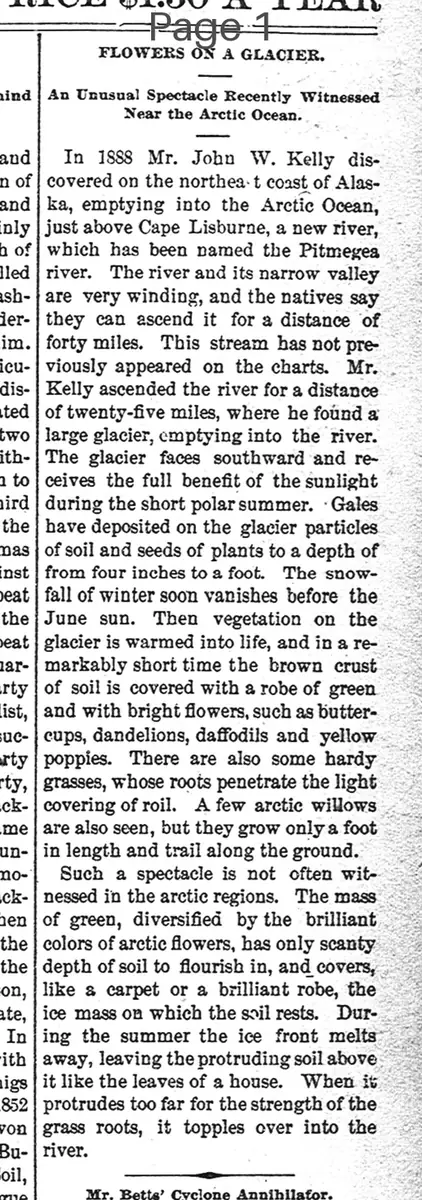
An Unusual Spectacle Recently Witnessed
Near the Arctic Ocean.
In 1885 Mr. John W. Kelly discovered on the northeast coast of Alaska, emptying into the Arctic Ocean, just above Cape Lisburne, a new river, which has been named the Pitmegea river. The river and its narrow valley are very winding, and the natives say they can ascend it for a distance of forty miles. This stream has not previously appeared on the charts. Mr. Kelly ascended the river for a distance of twenty-five miles, where he found a large glacier, emptying into the river. The glacier faces southward and receives the full benefit of the sunlight during the short polar summer. Gales have deposited on the glacier particles of soil and seeds of plants to a depth of from four inches to a foot. The snowfall of winter soon vanishes before the June sun. Then vegetation on the glacier is warmed into life, and in a remarkably short time the brown crust of soil is covered with a robe of green and with bright flowers, such as buttercups, dandelions, daffodils and yellow poppies. There are also some hardy grasses, whose roots penetrate the light covering of soil. A few arctic willows are also seen, but they grow only a foot in length and trail along the ground.
Such a spectacle is not often witnessed in the arctic regions. The mass of green, diversified by the brilliant colors of arctic flowers, has only scanty depth of soil to flourish in, and covers, like a carpet or a brilliant robe, the ice mass on which the soil rests. During the summer the ice front melts away, leaving the protruding soil above it like the eaves of a house. When it protrudes too far for the strength of the grass roots, it topples over into the river.
What sub-type of article is it?
What themes does it cover?
What keywords are associated?
What entities or persons were involved?
Where did it happen?
Story Details
Key Persons
Location
Northeast Coast Of Alaska, Near Arctic Ocean, Above Cape Lisburne, Pitmegea River
Event Date
1885
Story Details
John W. Kelly discovers a new river in Alaska leading to a southward-facing glacier where summer sun melts snow, enabling soil and seeds deposited by gales to grow into green vegetation and bright arctic flowers, creating an unusual spectacle before the ice melts and soil topples into the river.