Thank you for visiting SNEWPapers!
Sign up free
Story
April 13, 1910
The Manning Times
Manning, Clarendon County, South Carolina
What is this article about?
Historical overview of English parliamentary efforts to suppress profane swearing, from bills under James I in 1623, a fine-collection department in 1630, revival after Restoration under William and Mary, and increases under George II.
Clipping
OCR Quality
98%
Excellent
Full Text
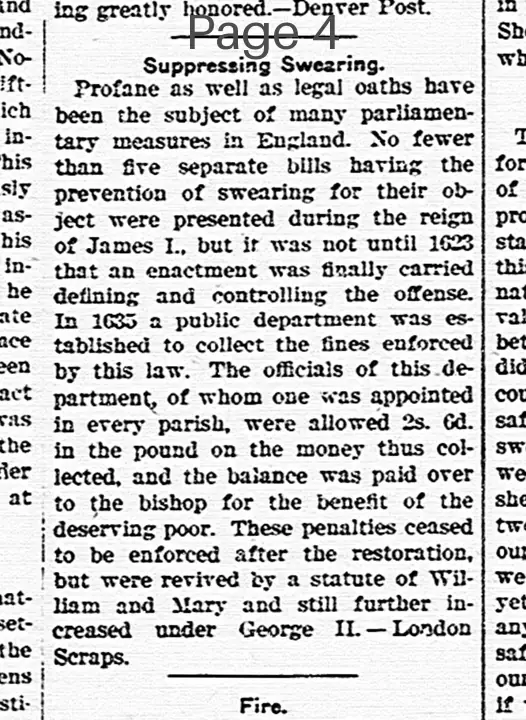
Suppressing Swearing.
Profane as well as legal oaths have been the subject of many parliamentary measures in England. No fewer than five separate bills having the prevention of swearing for their object were presented during the reign of James I., but it was not until 1623 that an enactment was finally carried defining and controlling the offense. In 1630 a public department was established to collect the fines enforced by this law. The officials of this department, of whom one was appointed in every parish, were allowed 2s. 6d. in the pound on the money thus collected. and the balance was paid over to the bishop for the benefit of the deserving poor. These penalties ceased to be enforced after the restoration. but were revived by a statute of William and Mary and still further increased under George II.—London Scraps.
Profane as well as legal oaths have been the subject of many parliamentary measures in England. No fewer than five separate bills having the prevention of swearing for their object were presented during the reign of James I., but it was not until 1623 that an enactment was finally carried defining and controlling the offense. In 1630 a public department was established to collect the fines enforced by this law. The officials of this department, of whom one was appointed in every parish, were allowed 2s. 6d. in the pound on the money thus collected. and the balance was paid over to the bishop for the benefit of the deserving poor. These penalties ceased to be enforced after the restoration. but were revived by a statute of William and Mary and still further increased under George II.—London Scraps.
What sub-type of article is it?
Historical Event
Curiosity
What themes does it cover?
Moral Virtue
Social Manners
Crime Punishment
What keywords are associated?
Swearing Suppression
Parliamentary Bills
Fines For Oaths
Historical Laws
Profane Oaths
What entities or persons were involved?
James I.
William And Mary
George Ii.
Where did it happen?
England
Story Details
Key Persons
James I.
William And Mary
George Ii.
Location
England
Event Date
Reign Of James I., 1623, 1630, After The Restoration, Statute Of William And Mary, Under George Ii.
Story Details
Parliament passed bills to prevent swearing under James I, culminating in a 1623 law; a 1630 department collected parish fines for the poor; penalties lapsed post-Restoration but revived and increased under William and Mary and George II.