Thank you for visiting SNEWPapers!
Sign up free
South Carolina Temperance Advocate And Register Of Agriculture And General Literature
Columbia, Richland County, South Carolina
What is this article about?
Temperance address by A. C. Garlington delivered December 26, 1842, at Warrior's Creek Temperance Society, condemning intemperance's destructive effects on individuals, families, and the nation, while advocating moral reform, patriotism, and virtuous living tied to Christmas celebration.
Clipping
OCR Quality
Full Text
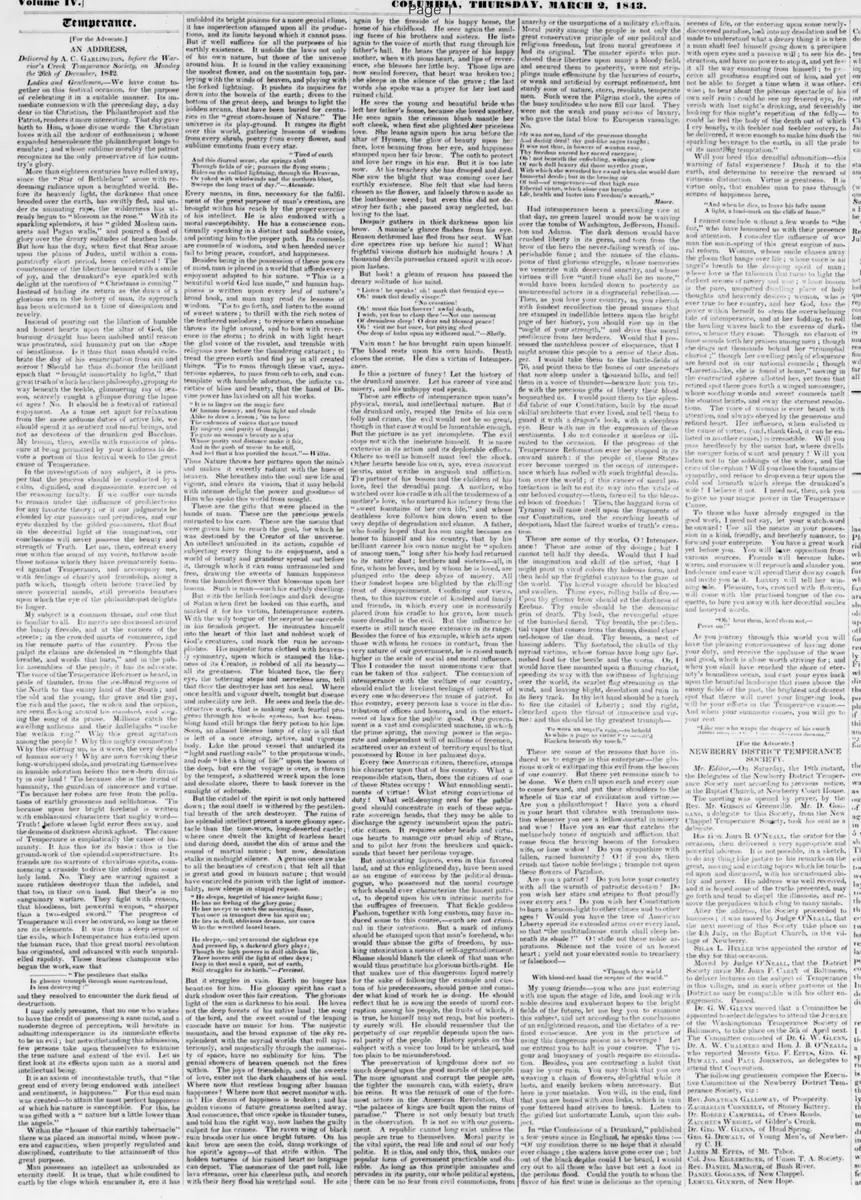
[For the Advocate.]
AN ADDRESS,
Delivered by A. C. Garlington, before the Warrior's Creek Temperance Society, on Monday the 26th of December, 1842.
Ladies and Gentlemen,
We have come together on this festival occasion, for the purpose of celebrating it in a suitable manner. Its immediate connexion with the preceding day, a day dear to the Christian, the Philanthropist and the Patriot, renders it more interesting. That day gave birth to Him, whose divine words the Christian loves with all the ardour of enthusiasm: whose expanded benevolence the philanthropist longs to emulate: and whose sublime morality the patriot recognizes as the only preservative of his country's glory.
More than eighteen centuries have rolled away, since the "Star of Bethlehem" arose with redeeming radiance upon a benighted world. Before its heavenly light, the darkness that once brooded over the earth, has swiftly fled, and under its animating rays, the wilderness has already begun to "blossom as the rose." With its sparkling splendors, it has "gilded Moslem minarets and Pagan walls," and poured a flood of glory over the dreary solitudes of heathen lands.
But how has the day, when first that Star arose upon the plains of Judea, until within a comparatively short period, been celebrated! The countenance of the libertine beamed with a smile of joy, and the drunkard's eye sparkled with delight at the mention of "Christmas is coming."
Instead of hailing its return as the dawn of a glorious era in the history of man, its approach has been welcomed as a time of dissipation and revelry.
Instead of pouring out the libation of humble and honest hearts upon the altar of God, the burning draught has been imbibed until reason was prostrated, and humanity put on the shape of beastliness. Is it thus that man should celebrate the day of his emancipation from sin and sorrow! Should he thus dishonor the brilliant epoch that "brought immortality to light," that great truth of which heathen philosophy, groping its way beneath the feeble, glimmering ray of reason, scarcely caught a glimpse during the lapse of ages! No. It should be a festival of rational enjoyment. As a time set apart for relaxation from the more arduous duties of active life, we should spend it as sentient and moral beings, and not as devotees of the drunken god Bacchus.
My bosom, then, swells with emotions of pleasure at being permitted by your kindness to devote a portion of this festival week to the great cause of Temperance.
In the investigation of any subject, it is proper that the process should be conducted by a calm, dignified, and dispassionate exercise of the reasoning faculty. If we suffer our minds to remain under the influence of predilections for any favorite theory; or if our judgments be clouded by our passions and prejudices, and our eyes dazzled by the gilded gossamers, that float in the deceitful light of the imagination, our conclusions will never possess the beauty and strength of Truth. Let me, then, entreat every one within the sound of my voice, to throw aside those notions which they have prematurely formed against Temperance, and accompany me, with feelings of charity and friendship, along a path which, though often before travelled by more powerful minds, still presents beauties upon which the eye of the philanthropist delights to linger.
My subject is a common theme, and one that is familiar to all. Its merits are discussed around the family fireside, and at the corners of the streets: in the crowded marts of commerce, and in the remote parts of the country. From the pulpit its claims are defended in "thoughts that breathe, and words that burn," and in the public assemblies of the people, it has its advocate. The voice of the Temperance Reformer is heard, in peals of thunder, from the ice-bound regions of the North to this sunny land of the South; and the old and the young, the grave and the gay, the rich and the poor, the widow and the orphan, are seen flocking around his standard, and singing the song of its praise. Millions catch the swelling anthems and their hallelujahs "make the welkin ring."
Why this great agitation among the people! Why this mighty commotion! Why thus stirring up, as it were, the very depths of human society! Why are men forsaking their long-worshipped idols, and prostrating themselves in humble adoration before this new-born divinity in our land! 'Tis because she is the friend of humanity, the guardian of innocence and virtue. 'Tis because her robes are free from the pollutions of earthly grossness and selfishness. 'Tis because upon her bright forehead is written with emblazoned characters that mighty word—Truth! before whose light error flees away, and the demons of darkness shrink aghast. The cause of Temperance is emphatically the cause of humanity. It has this for its basis: this is the ground-work of the splendid superstructure. Its friends are no warriors of chivalrous spirits, commencing a crusade to drive the infidel from some holy land. No. They are warring against a more ruthless destroyer than the infidel, and that too, in their own land. But theirs is no sanguinary warfare. They fight with reason, that bloodless, but powerful weapon, "sharper than a two-edged sword." The progress of Temperance will ever be onward, so long as these are its elements. It was from a deep sense of the evils, which Intemperance has entailed upon the human race, that this great moral revolution has originated, and advanced with such unparalleled rapidity. Those fearless champions who began the work, saw that,
"The pestilence that stalks in gloomy triumph through some eastern land, is less destroying,"
and they resolved to encounter the dark fiend of destruction.
I may safely presume, that no one who wishes to have the credit of possessing a sane mind, and a moderate degree of perception, will hesitate in admitting intemperance in its immediate effects to be an evil; but notwithstanding this admission, few persons take upon themselves to examine the true nature and extent of the evil. Let us first look at its effects upon man as a moral and intellectual being.
It is an axiom of incontestable truth, that "the great end of every being endowed with intellect and sentiment, is happiness." For this end man was created—to attain the most perfect happiness of which his nature is susceptible. For this, he was gifted with a "nature but a little lower than the angels."
Within the "house of this earthly tabernacle" there was placed an immortal mind, whose powers and capacities, when properly regulated and disciplined, contribute to the attainment of this great purpose.
Man possesses an intellect as unbounded as eternity itself. It is true, that while confined to earth by the clogs which encumber it, ere it has unfolded its bright pinions for a more genial clime, it has imperfection stamped upon all its productions, and its limits beyond which it cannot pass. But it well suffices for all the purposes of his earthly existence. It unfolds the laws not only of his own nature, but those of the universe around him. It is found in the valley examining the modest flower, and on the mountain top, parleying with the winds of heaven, and playing with the forked lightning. It pushes its inquiries far down into the bowels of the earth; dives to the bottom of the great deep, and brings to light the hidden arcana, that have been buried for centuries in the "great store-house of Nature." The universe is its play-ground. It ranges its flight over this world, gathering lessons of wisdom from every shrub, poetry from every flower, and sublime emotions from every star.
"Tired of earth and this diurnal scene, she springs aloft through fields of air; pursues the flying storm; rides on the vollied lightning, through the Heavens, or yoked with whirlwinds and the northern blast, sweeps the long tract of day."—Akenside.
Every means, in fine, necessary for the fulfilment of the great purpose of man's creation, are brought within his reach by the proper exercise of his intellect. He is also endowed with a moral susceptibility. He has a conscience continually speaking in a distinct and audible voice, and pointing him to the proper path. Its counsels are counsels of wisdom, and when heeded never fail to bring peace, comfort, and happiness.
Besides being in the possession of these powers of mind, man is placed in a world that affords every enjoyment adapted to his nature. "This is a beautiful world God has made," and human happiness is written upon every leaf of nature's broad book, and man may read its lessons of wisdom. 'Tis to go forth, and listen to the sound of sweet waters: to thrill with the rich notes of the feathered melodies; to rejoice when sunshine throws its light around, and to bow with reverence in the storm: to drink in with light heart the glad voice of the rivulet, and tremble with religious awe before the thundering cataract; to tread the green earth and find joy in all created things. 'Tis to roam through these vast, mysterious spheres, to pass from orb to orb, and contemplate with humble adoration, the infinite varieties of bliss and beauty, that the hand of Divine power has lavished on all his works.
—It is to linger on the magic face of human beauty, and from light and shade alike to draw a lesson; 'tis to love the cadences of voices that are tuned by majesty and purity of thought: to gaze on woman's beauty as a star whose purity and distance make it fair. And in the gush of music to be still, and feel that it has purified the heart."—Willis.
Thus Nature throws her pictures upon the mind and makes it sweetly radiant with the hues of heaven. She breathes into the soul new life and vigour, and clears its vision, that it may behold with intense delight the power and goodness of Him who spoke this world from nought.
There are the gifts that were placed in the hands of man. These are the precious jewels entrusted to his care. These are the means that were given him to reach the goal, for which he was destined by the Creator of the universe. An intellect unlimited in its action, capable of subjecting every thing to its enjoyment, and a world of beauty and grandeur spread out before it, through which it can roam untrammeled and free, drawing the sweets of human happiness from the humblest flower that blossoms upon her bosom. Such is man—such his earthly dwelling.
But with the hellish feelings and dark designs of Satan when first he looked on this earth, and marked it for his victim, Intemperance enters. With the wily tongue of the serpent he succeeds in his fiendish project. He insinuates himself into the heart of this last and noblest work of God's creatures, and mark the ruin he accomplishes. His majestic form clothed with heavenly symmetry, upon which is stamped the likeness of its Creator, is robbed of all its beauty—all its greatness. The bloated face, the fiery eye, the tottering steps and nerveless arm, tell that there the destroyer has set his seal. Where once health and vigour dwelt, nought but disease and imbecility are left. He sees and feels the destructive work, that is making such fearful progress through his whole system, but his trembling hand still brings the fiery potion to his lips. Soon, an almost lifeless lump of clay is all that is left of a once strong, active, and vigorous body. Like the proud vessel that unfurled its "light and rustling sails" to the propitious winds, and rode "like a thing of life" upon the bosom of the deep, but ere the voyage is over, is thrown by the tempest, a shattered wreck upon the lone and desolate shore, there to bask forever in the sunlight of solitude.
But the citadel of the spirit is not only battered down; the soul itself is withered by the pestilential breath of the arch destroyer. The ruins of his splendid intellect present a more gloomy spectacle than the time-worn, long-deserted castle: where once dwelt the knight of fearless heart and daring deed, amidst the din of arms and the sound of martial music; but now, desolation stalks in midnight silence. A genius once awake to all the beauties of creation: that felt all that is great and good in human nature: that would have encircled its pinion with the light of immortality, now sleeps in stupid repose.
"He sleeps, forgetful of his once bright fame; he has no feeling of the glory gone; he has no eye to catch the mounting flame that once in transport drew his spirit on; he lies in dull, oblivious dreams, nor cares who the wreathed laurel bears. He sleeps,—and yet around the sightless eye and pressed lip, a darkened glory plays: though the high powers in dull oblivion lie, there hovers still the light of other days; deep in that soul a spirit, not of earth, still struggles for its birth."—Percival.
But it struggles in vain. Earth no longer has beauties for him. His gloomy spirit has cast a dark shadow over this fair creation. The glorious light of the sun is darkness to his soul. He loves not the deep forests of his native land; the song of the bird, and the sweet sound of the leaping cascade have no music for him. The majestic mountain, and the broad expanse of the sky resplendent with the myriad worlds that roll mysteriously, and majestically through the immensity of space, have no sublimity for him. The genial showers of heaven quench not the fires within. The joys of friendship, and the sweets of love, enter not the dark chambers of his soul. Where now that restless longing after human happiness! Where now that secret monitor within! His dream of happiness is broken: and his golden visions of future greatness melted away. And conscience, that once spoke in thunder tones, and told him the right way, now lashes the guilty culprit for his crimes. The raven wing of black ruin broods over his once bright future. On his knit brow are seen the cold, damp workings of his spirit's agony—of that strife within. The hidden tortures of his ruined heart no language can depict. The memories of the past roll, like lava streams, over his cheerless path, and scorch with their fiery flood his wretched soul. He sits again by the fireside of his happy home, the home of his childhood. He sees again the smiling faces of his brothers and sisters. He lists again to the voice of mirth that rang through his father's hall. He hears the prayer of his happy mother, when with pious heart, and lips of reverence, she blesses her little boy. Those lips are now sealed forever, that heart was broken too: she sleeps in the silence of the grave; the last words she spoke was a prayer for her lost and ruined child.
He sees the young and beautiful bride who left her father's home, because she loved another. He sees again the crimson blush mantle her soft cheek, when first she plighted her priceless love. She leans again upon his arm before the altar of Hymen, the glow of beauty upon her face, love beaming from her eye, and happiness stamped upon her fair brow. The oath to protect and love her rings in his ear. But it is too late now. At his treachery she has drooped and died. She saw the blight that was coming over her earthly existence. She felt that she had been chosen as the flower, and falsely thrown aside as the loathsome weed; but even this did not destroy her faith: she passed away neglected, but loving to the last.
Despair gathers in thick darkness upon his brow. A maniac's glance flashes from his eye. Reason dethroned has fled from her seat. What dire spectres rise up before his mind! What frightful visions disturb his midnight hours! A thousand devils pursue his crazed spirit with scorpion lashes.
But look! a gleam of reason has passed the dreary solitude of his mind.
"Listen! he speaks! oh! mark that frenzied eye—Oh! mark that deadly visage."
"No cessation! Oh! must this last forever! awful death, I wish, yet fear to clasp thee!—Not one moment of dreamless sleep! O dear and blessed peace! Oh! visit me but once, but pitying shed one drop of balm upon my withered soul."—Shelley.
Vain man! he has brought ruin upon himself. The blood rests upon his own hands. Death closes the scene. He dies a victim of Intemperance.
Is this a picture of fancy! Let the history of the drunkard answer. Let his career of vice and misery, and his unhappy end speak.
These are effects of intemperance upon man's physical, moral, and intellectual nature. But if the drunkard only, reaped the fruits of his own folly and crime, the evil would not be so great, though in that case it would be lamentable enough. But the picture is as yet incomplete. The evil stops not with the inebriate himself. It is more extensive in its action and its deplorable effects. Others as well as himself must feel the shock. Other hearts beside his own, aye, even innocent hearts, must writhe in anguish and affliction. The partner of his bosom and the children of his love, feel the dreadful pang. A mother, who watched over his cradle with all the tenderness of a mother's love, who nurtured his infancy from the "sweet fountains of her own life," and whose deathless love follows him down even to the very depths of degradation and shame. A father, who fondly hoped that his son might become an honor to himself and his country, that by his brilliant career his own name might be "spoken of among men," long after his body had returned to its native dust; brothers and sisters—all, in fine, whom he loves, and by whom he is loved, are plunged into the deep abyss of misery. All their fondest hopes are blighted by the chilling frost of disappointment. Confining our views, then, to this narrow circle of kindred and family and friends, in which every one is necessarily placed from his cradle to his grave, how much more dreadful is the evil. But the influence he exerts is still much more extensive in its range. Besides the force of his example, which acts upon those with whom he comes in contact, from the very nature of our government, he is raised much higher in the scale of social and moral influence. Thus I consider the most momentous view that can be taken of this subject. The connexion of intemperance with the welfare of our country, should enlist the liveliest feelings of interest of every one who deserves the name of patriot. In this country, every person has a voice in the distribution of offices and honors, and in the enactment of laws for the public good. Our government is a vast and complicated machine, in which the prime spring, the moving power is the separate and independent will of millions of freemen, scattered over an extent of territory equal to that possessed by Rome in her palmiest days. Every free American citizen, therefore, stamps his character upon that of his country. What a responsible station, then, does the citizen of one of these States occupy! What ennobling sentiments of virtue! What strong convictions of duty! What self-denying zeal for the public good should concentrate in each of these separate sovereign heads, that they may be able to discharge the agency incumbent upon the patriotic citizen. It requires sober heads and virtuous hearts to manage our proud ship of State, and to pilot her from the breakers and quicksands that beset her perilous voyage.
But intoxicating liquors, even in this favored land, and at this enlightened day, have been used as an engine of success by the political demagogue, who possessed not the moral courage which should ever characterize the honest patriot, to depend upon his own intrinsic merits for the suffrages of freemen. That fickle goddess Fashion, together with long custom, may have induced some to this course, such are not criminal in their intentions. But a mark of infamy should be stamped upon that man's forehead, who would thus abuse the gifts of freedom, by making intoxication a means of self-aggrandizement. Shame should blanch the cheek of that man who would thus prostitute his glorious birth-right. He that makes use of this dangerous liquid merely for the sake of following the example and custom of his predecessors, should pause and consider what kind of work he is doing. He should reflect that he is sowing the seeds of moral corruption among his people, the fruits of which, it is true, he himself may not reap, but his posterity surely will. He should remember that the perpetuity of our republic depends upon the moral purity of the people. History speaks on this subject with a voice too loud to be unheard, and too plain to be misunderstood.
The preservation of kingdoms does not so much depend upon the good morals of the people. The more ignorant and corrupt the people are, the tighter the monarch can, with safety, draw his reins. It was the remark of one of the foremost actors in the American Revolution, that "the palaces of kings are built upon the ruins of paradise." There is not only beauty but truth in the observation. It is not so with our government. A republic cannot long exist unless the people are true to themselves. Moral purity is the vital spirit, the real life and soul of our body politic. It is this, and only this, that makes our popular form of government practicable and durable. As long as this principle animates and pervades in its purity, our whole political system, there can be no fear from civil commotions, from anarchy or the usurpations of a military chieftain.
Moral purity among the people is not only the great conservative principle of our political and religious freedom, but from moral greatness it had its original. The master spirits who purchased their liberties upon many a bloody field, and secured them to posterity, were not striplings made effeminate by the luxuries of courts, or weak and artificial by corrupt refinement, but sturdy sons of nature, stern, resolute, temperate men. Such were the Pilgrim stock, the sires of the busy multitudes who now fill our land. They were not the weak and puny scions of luxury, who gave the fatal blow to European vassalage. No.
"It was not so, land of the generous thought and daring deed! thy god-like sages taught; it was not thus, in bowers of wanton ease, thy freedom nursed her sacred energies; oh! not beneath the enfeebling, withering glow of such dull luxury did those myrtles grow, with which she wreathed her sword when she would dare immortal deeds: but in the bracing air of toil—of temperance—of that high rare ethereal virtue, which alone can breathe life, health and lustre into Freedom's wreath." Moore.
Had intemperance been a prevailing vice at that day, no green laurel would now be waving over the tombs of Washington, Jefferson, Hamilton and Adams. The dark demon would have crushed liberty in its germ, and torn from the brow of the hero the never-failing wreath of imperishable fame: and the names of the champions of that glorious struggle, whose memories we venerate with deserved sanctity, and whose virtues will live "until time shall be no more," would have been handed down to posterity as unsuccessful actors in a disgraceful rebellion.
Then, as you love your country, as you cherish with fondest recollection the proud names that are stamped in indelible letters upon the bright page of her history, you should rise up in the "might of your strength," and drive this moral pestilence from her borders. Would that I possessed the matchless power of eloquence, that I might arouse this people to a sense of their danger. I would take them to the battle-fields of '76, and point them to the bones of our ancestors that now sleep under a thousand hills, and tell them in a voice of thunder—beware how you trifle with the precious gifts of liberty their blood bequeathed us. I would point them to the splendid fabric of our Constitution, built by the most skilful architects that ever lived, and tell them to guard it with a dragon's look, with a sleepless eye. Bear with me in the expression of these sentiments. I do not consider it useless or ill-suited to the occasion. If the progress of the Temperance Reformation ever be stopped in its onward march: if the people of these States ever become merged in the ocean of intemperance which has rolled with such frightful desolation over the world; if this cancer of moral putrefaction is left to eat its way into the vitals of our beloved country—then, farewell to the blessed boon of freedom! Then, the haggard form of Tyranny will raise itself upon the fragments of our Constitution, and the scorching breath of despotism, blast the fairest works of truth's creation.
These are some of thy works, O! Intemperance! These are some of thy doings: but I cannot tell half thy deeds. Would that I had the imagination and skill of the artist, that I might paint in vivid colors thy hideous form, and then hold up the frightful canvass to the gaze of the world. Thy horrid visage should be bloated and swollen. Thine eyes, rolling balls of fire.—Upon thy gloomy brow should sit the darkness of Erebus. Thy smile should be the demoniac grin of death. Thy look, the revengeful stare of the banished fiend. Thy breath, the pestilential vapor that comes from the damp, dismal charnel-house of the dead. Thy bosom, a nest of hissing adders. Thy footstool, the skulls of thy myriad victims, whose forms have long ago furnished food for the beetle and the worm. Or, I would have thee mounted upon a flaming chariot, speeding its way with the swiftness of lightning over the world, its scarlet flag streaming in the wind, and leaving blight, desolation and ruin in its fiery track. In thy left hand should be a torch to fire the citadel of Liberty: and thy right, clenched upon the throat of innocence and virtue: and this should be thy greatest triumph—
"To work an angel's ruin,—to behold as white a page as virtue's sullied and—"
These are some of the reasons that have induced us to engage in this enterprize—the glorious work of extirpating this evil from the bosom of our country. But there yet remains much to be done. We then call upon each and every one to come forward, and put their shoulders to the wheels of this car of civilization and virtue.
Are you a philanthropist! Have you a chord in your heart that vibrates with tremulous motion whenever you see a fellow-mortal in misery and woe! Have you an ear that catches the melancholy tones of anguish and affliction that come from the heaving bosom of the forsaken wife, or lone widow! Do you sympathize with fallen, ruined humanity! O: if you do, then crush not these noble feelings; trample not upon these flowers of Paradise.
Are you a patriot! Do you love your country with all the warmth of patriotic devotion! Do you wish her stars and stripes to float proudly over every sea! Do you wish her Constitution to burn a beacon-light to other climes and to other ages! Would you have the tree of American Liberty spread its extended arms over every land, so that "the multitudinous earth shall sleep beneath its shade!" O! stifle not these noble aspirations. Silence not the voice of an honest heart; yield not your elevated souls to treachery or falsehood—
"Though they wield with blood-red hand the sceptre of the world."
My young friends—you who are just entering with me upon the stage of life, and looking with noble desires and exuberant hopes to the bright fields of the future, let me beg you to examine this subject, and act according to the conclusions of an enlightened reason, and the dictates of a refined conscience. Are you in the practice of using this dangerous poison as a beverage! Let me entreat you to halt in your course. The vigour and buoyancy of youth require no stimulation. Besides, you are contracting a habit that may be your ruin. You may think that you are weaving a chain of flowers, delightful while it lasts, and easily broken when necessary. But here is your mistake. You will, in the end, find that you are bound with strong links, which in vain your fettered hand strives to break. Listen to the gifted but unfortunate Lamb, upon this subject.
In "the Confessions of a Drunkard," published a few years since in England, he speaks thus:
"Of my condition there is no hope that it should ever change; the waters have gone over me: but out of the black depths could I be heard, I would cry out to all those who have but set a foot in the perilous flood. Could the youth to whom the flavor of his first wine is delicious as the opening scenes of life, or the entering upon some newly-discovered paradise, look into my desolation and be made to understand what a dreary thing it is when a man shall feel himself going down a precipice with open eyes and a passive will: to see his destruction, and have no power to stop it, and yet feel it all the way emanating from himself; to perceive all goodness emptied out of him, and yet not be able to forget a time when it was otherwise; to bear about the piteous spectacle of his own self ruin: could he feel the body of the death out of which I cry hourly, with feebler and feebler outcry, to be delivered, it were enough to make him dash the sparkling beverage to the earth, in all the pride of its mantling temptation."
Will you heed this dreadful admonition—this warning of fatal experience! Dash it to the earth, and determine to receive the reward of virtuous distinction. Virtue is greatness. It is virtue only, that enables man to pass through scenes of happiness here,
"And when he dies, to leave his lofty name a light, a land-mark on the cliffs of fame."
I cannot conclude without a few words to "the fair," who have honoured us with their presence and attention. I consider the influence of woman the main-spring of this great engine of moral reform. Woman, whose smile chases away the gloom that hangs over life: whose voice is an angel's breath to the drooping spirit of man: whose love is the talisman that turns to light the darkest scenes of misery and woe; whose bosom is the pure, unspotted dwelling place of holy thoughts and heavenly desires; woman, who is ever true to her country, and her God, has the power within herself to stem the overwhelming tide of intemperance, and at her bidding, to roll the howling waves back to the caverns of darkness, whence they came. Though no clarion of fame sounds forth her praises among men; though she drags not thousands behind her "triumphal chariot;" though her swelling peals of eloquence are heard not in our national councils; though "Lucretia-like, she is found at home," moving in the contracted sphere allotted her, yet from that retired spot there goes forth a winged messenger, whose soothing words and sweet counsels melt the stoutest hearts, and sway the sternest resolutions. The voice of woman is ever heard with attention, and always obeyed by the generous and refined heart. Her influence, when enlisted in the cause of virtue (and, thank God, it can be enlisted in no other cause,) is irresistible. Will you pass heedlessly by the mean hut, where dwells the meager form of want and penury! Will you listen not to the sobbings of the widow, and the cries of the orphan! Will you close the fountains of sympathy, and refuse to drop even a tear upon the cold sod beneath which sleeps the drunkard's wife! I believe it not. I need not, then, ask you to give us your magic power in the Temperance Cause.
To those who have already engaged in the good work, I need not say, let your watch-word be onward! Use all the means in your possession in a kind, friendly, and brotherly manner, to forward your enterprize. You have a great work yet before you. You will meet opposition from various sources. Friends will become lukewarm, and enemies will reproach and slander you. Indolence and ease will spread their downy couch and invite you to it. Luxury will tell her winning tale. "Pleasure, too, crowned with flowers, will come with the practised tongue of the coquette, to lure you away with her deceitful smiles and honeyed words"
"Oh! hear them, heed them not. Press on."
As you journey through this world you will have the pleasing consciousness of having done your duty, and receive the applause of the wise and good, which is alone worth striving for; and when you shall have reached the shore of eternity's boundless ocean, and cast your eyes back upon the beautiful landscape that rises above the sunny fields of the past, the brightest and dearest spot that there will meet your lingering look, will be your efforts in the Temperance cause.—And when your summons comes, you will go to your rest
"Like one who wraps the drapery of his couch about him, and lies down to pleasant dreams."
What sub-type of article is it?
What themes does it cover?
What keywords are associated?
What entities or persons were involved?
Where did it happen?
Story Details
Key Persons
Location
Warrior's Creek
Event Date
1842 12 26
Story Details
A. C. Garlington delivers a passionate address on the evils of intemperance, illustrating its ruinous effects on the body, mind, family, and nation, contrasting it with human potential and divine gifts, and urging temperance reform for personal virtue, family protection, and preservation of American liberty.