Thank you for visiting SNEWPapers!
Sign up free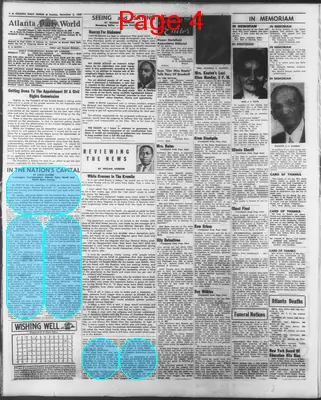
Atlanta Daily World
Atlanta, Fulton County, Georgia
What is this article about?
Herbert Brownell Jr., outgoing U.S. Attorney General, delivered a speech on October 22 in Hartford, Connecticut, emphasizing federal supremacy in enforcing laws, citing historical precedents like Shays' and Whiskey Rebellions, and linking to current school desegregation efforts including Little Rock.
Clipping
OCR Quality
Full Text
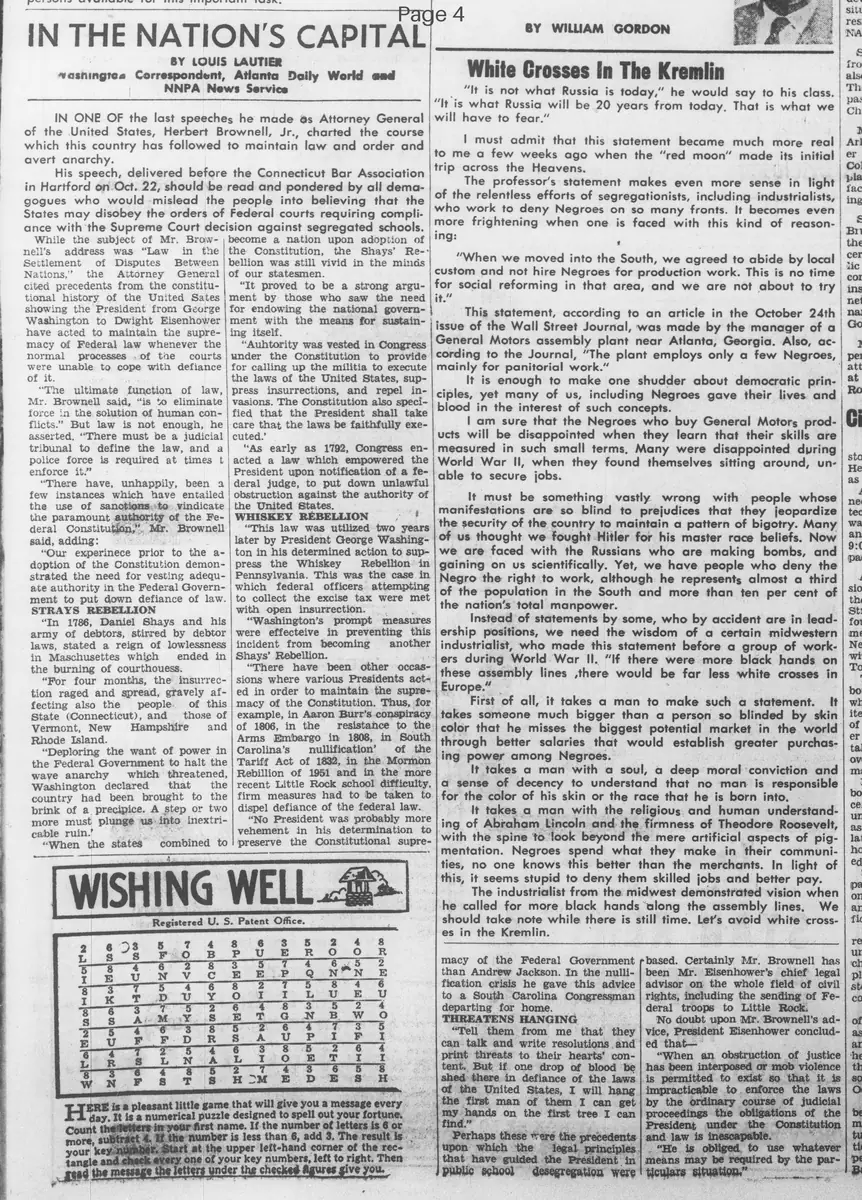
BY LOUIS LAUTIER
Washington Correspondent, Atlanta Daily World and NNPA News Service
IN ONE OF the last speeches he made as Attorney General of the United States, Herbert Brownell, Jr., charted the course which this country has followed to maintain law and order and avert anarchy.
His speech, delivered before the Connecticut Bar Association in Hartford on Oct. 22, should be read and pondered by all demagogues who would mislead the people into believing that the States may disobey the orders of Federal courts requiring compliance with the Supreme Court decision against segregated schools.
While the subject of Mr. Brownell's address was "Law in the Constitution, the Shays' Rebellion was still vivid in the minds of our statesmen.
He cited precedents from the constitutional history of the United States showing the President from George Washington to Dwight Eisenhower have acted to maintain the supremacy of Federal law whenever the normal processes of the courts were unable to cope with defiance of it.
"The ultimate function of law, Mr. Brownell said, "is to eliminate force in the solution of human conflicts." But law is not enough, he asserted. "There must be a judicial tribunal to define the law, and a police force is required at times to enforce it."
"There have, unhappily, been a few instances which have entailed the use of sanctions to vindicate the paramount authority of the Federal Constitution," Mr. Brownell said, adding:
"Our experience prior to the adoption of the Constitution demonstrated the need for vesting adequate authority in the Federal Government to put down defiance of law.
SHAYS REBELLION
"In 1786, Daniel Shays and his army of debtors, stirred by debtor laws, started a reign of lawlessness in Massachusetts which ended in the burning of courthouses.
"For four months, the insurrection raged and spread, gravely affecting also the people of this State (Connecticut), and those of Vermont, New Hampshire and Rhode Island.
"Deploring the want of power in the Federal Government to halt the wave anarchy which threatened, Washington declared that the country had been brought to the brink of a precipice. A step or two more must plunge us into inextri-cable ruin.
"When the states combined to form a more perfect union, they agreed that the national government must have the power to preserve order. It proved to be a strong argument by those who saw the need for endowing the national government with the means for sustaining itself.
"Authority was vested in Congress under the Constitution to provide for calling up the militia to execute the laws of the United States, suppress insurrections, and repel invasions. The Constitution also specified that the President shall take care that the laws be faithfully executed."
"As early as 1792, Congress enacted a law which empowered the President upon notification of a federal judge to put down unlawful obstruction against the authority of the United States.
WHISKEY REBELLION
"This law was utilized two years later by President George Washington in his determined action to suppress the Whiskey Rebellion in Pennsylvania. This was the case in which federal officers attempting to collect the excise tax were met with open insurrection.
"Washington's prompt measures were effective in preventing this incident from becoming another Shays' Rebellion.
"There have been other occasions where various Presidents acted in order to maintain the supremacy of the Constitution. Thus, for example, in Aaron Burr's conspiracy of 1806, in the resistance to the Arms Embargo in 1808, in South Carolina's nullification of the Tariff Act of 1832, in the Mormon Rebellion of 1851 and in the more recent Little Rock school difficulty. Firm measures had to be taken to dispel defiance of the federal law.
"No President was probably more vehement in his determination to preserve the Constitutional supremacy of the Federal Government than Andrew Jackson. In the nullification crisis he gave this advice to a South Carolina Congressman departing for home.
THREATENS HANGING
"Tell them from me that they can talk and write resolutions and print threats to their hearts' content. But if one drop of blood be shed there in defiance of the laws of the United States, I will hang the first man of them I can get my hands on the first tree I can find."
Perhaps these were the precedents upon which the legal principles that have guided the President in public school desegregation were based. Certainly Mr. Brownell has been Mr. Eisenhower's chief legal advisor on the whole field of civil rights, including the sending of Federal troops to Little Rock.
No doubt upon Mr. Brownell's advice, President Eisenhower concluded that "When an obstruction of justice has been interposed or mob violence is permitted to exist so that it is impracticable to enforce the laws by the ordinary course of judicial proceedings the obligations of the President under the Constitution and law is inescapable.
He is obliged to use whatever means may be required by the particulars situation."
What sub-type of article is it?
What keywords are associated?
What entities or persons were involved?
Where did it happen?
Domestic News Details
Primary Location
Hartford, Connecticut
Event Date
Oct. 22
Key Persons
Outcome
the speech outlined historical precedents for federal enforcement of law to prevent anarchy, applied to school desegregation and little rock crisis.
Event Details
Herbert Brownell, Jr. delivered a speech before the Connecticut Bar Association on the supremacy of federal law, citing Shays' Rebellion (1786), Whiskey Rebellion (1794), and other historical instances where presidents enforced constitutional authority, linking to current compliance with Supreme Court desegregation rulings and use of federal troops in Little Rock.