Thank you for visiting SNEWPapers!
Sign up free
Virginia Argus
Richmond, Virginia
What is this article about?
Reports from Zanesville, Ohio, on July 22, 1812, detail General William Hull's army landing in Sandwich, Canada, with minimal opposition, capturing the town. Includes accounts of captured American vessels with provisions, baggage, and about 50 prisoners including Paymaster Lewis Dent and Capt. John Sharp; Major Munson's accidental shooting; artillery fire on British; Hull's proclamation to Canadians; and Indian presence at Fort Malden.
Merged-components note: The text on page 3 directly continues the domestic news report on Gen. Hull's invasion of Canada and related events.
Clippings
1 of 2
OCR Quality
Full Text
(OHIO.)
ZANESVILLE. July 22.
GLORY! GLORY! TO THE VOLUNTEERS OF OHIO, AND THE TIPPACANOE BOYS, WHO HAVE FIRST PLANTED THE AMERICAN STANDARD IN CANADA!
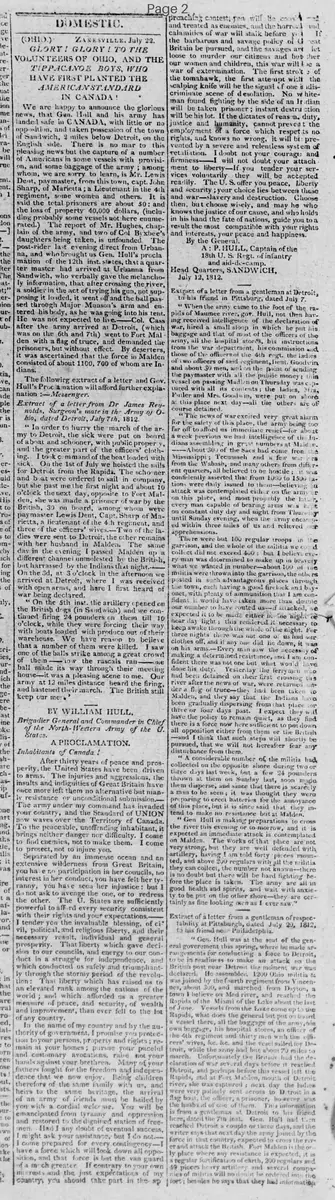
We are happy to announce the glorious news, that Gen. Hull and his army has landed safe in CANADA, with little or no opposition, and taken possession of the town of Sandwich, 2 miles below Detroit, on the English side. There is no mar to this pleasing news but the capture of a number of Americans in some vessels with provision, and some baggage of the army; among whom, we are sorry to learn, is Mr. Lewis Dent, paymaster, from this town, capt. John Sharp, of Marietta; a Lieutenant in the 4th regiment, some women and others. It is said the total prisoners are about 50: and the loss of property 40,000 dollars, (including probably some vessels not here enumerated.) The report of Mr. Hughes, chaplain of the army, and two of Col Byxbee's daughters being taken, is unfounded. The post-rider last evening direct from Urbana, and who brought us Gen. Hull's proclamation of the 12th inst. states, that a quarter master had arrived at Urbana from Sandwich, who verbally gave the melancholy information, that after crossing the river, a soldier in the act of trying his gun, not supposing it loaded, it went off and the ball passed through Major Munson's arm and entered his body, as he was going into his tent. He was not expected to live.—Col. Cass after the army arrived at Detroit, (which was on the 6th and 7th) went to Fort Malden with a flag of truce, and demanded the prisoners, but without effect. By deserters, it was ascertained that the force in Malden consisted of about 1100, 700 of whom are Indians.
The following extract of a letter and Gov. Hull's Proclamation will afford further explanation:—Messenger.
Extract of a letter from Dr James Reynolds, Surgeon's mate in the Army of Ohio, dated Detroit, July 7th, 1812.
"In order to hurry the march of the army to Detroit, the sick were put on board of a boat and schooner, with public property, and the greater part of the officers' clothing. I took command of the boat loaded with sick. On the 1st of July we hoisted the sails for Detroit from the Rapids. The schooner and boat were ordered to sail in company, but she past me the first night and about 10 o'clock the next day, opposite to Fort Malden, she was made a prisoner of war by the British, 30 on board, among whom were paymaster Lewis Dent, Capt. Sharp of Marietta, a lieutenant of the 4th regiment, and three of the officers' wives.—Two of the ladies were sent to Detroit, the other remains with her husband in Malden. The same day in the evening I passed Malden up a different channel unmolested by the British, but harrassed by the Indians that night.—On the 3d, at 3 o'clock in the afternoon we arrived at Detroit, where I was received with open arms, and here I first heard of war being declared.
"On the 5th inst. the artillery opened on the British dogs (in Sandwich) and we continued firing 24 pounders on them till 10 o'clock, while they were forcing their way with boats loaded with produce out of their warehouse. We have reason to believe that a number of them were killed. I saw one of the balls strike among a great crowd of them—how the rascals ran—one ball made its way through their meeting house—it was a pleasing scene to me. Our army at 12 miles distance heard the firing, and hastened their march. The British still keep our men
BY WILLIAM HULL,
Brigadier General and Commander in Chief of the North-Western Army of the United States.
A PROCLAMATION.
Inhabitants of Canada!
After thirty years of peace and prosperity, the United States have been driven to arms. The injuries and aggressions, the insults and indignities of Great Britain have once more left them no alternative but manly resistance or unconditional submission.
The army under my command has invaded your Country, and the Standard of the UNION now waves over the Territory of Canada.
To the peaceable, unoffending inhabitant, it brings neither danger nor difficulty. I come to find enemies, not to make them. I come to protect, not to injure you.
Separated by an immense ocean and an extensive wilderness from Great Britain, you have no participation in her councils, no interest in her conduct, you have felt her tyranny, you have seen her injustice: but I do not ask to avenge the one, or to redress the other. The U. States are sufficiently powerful to afford every security consistent with their rights and your expectations.
I tender you the invaluable blessing, of civil, political, and religious liberty, and their necessary result, individual and general prosperity. That liberty which gave decision to our councils, and energy to our conduct in a struggle for independence, and which conducted us safely and triumphantly through the stormy period of the revolution: That liberty which has raised us to an elevated rank among the nations of the world: and which afforded us a greater measure of peace, and security, of wealth and improvement, than ever fell to the lot of any country.
In the name of my country and by the authority of government, I promise you protection to your persons, property and rights; remain at your homes; pursue your peaceable and customary avocations, raise not your hands against your brethren. Many of your fathers fought for the freedom and independence that we now enjoy. Being children therefore of the same family with us, and heirs to the same heritage, the arrival of an army of friends must be hailed by you with a cordial welcome. You will be emancipated from tyranny and oppression and restored to the dignified station of freemen. Had I any doubt of eventual success, I might ask your assistance, but I do not.—I come prepared for every contingency—I have a force which will look down all opposition, and that force is but the van guard of a much greater If contrary to your own interests and the just expectations of my Country, you should take part in the approaching contest: you will be considered and treated as enemies, and the horrors and calamities of war will stalk before you.
If the barbarous and savage policy of Great Britain be pursued, and the savages are let loose to murder our citizens and butcher our women and children, this war will be a war of extermination. The first stroke of the tomahawk, the first attempt with the scalping knife will be the signal of indiscriminate scene of desolation. No white-man found fighting by the side of an Indian will be taken prisoner; instant destruction will be his lot. If the dictates of reason, duty, justice and humanity, cannot prevent the employment of a force which respects no rights, and knows no wrong, it will be prevented by a severe and relentless system of retaliation. I doubt not your courage: and firmness—I will not doubt your attachment to liberty—If you tender your services voluntarily they will be accepted readily. The U. S. offer you peace, Liberty and security; your choice lies between these and war—slavery and destruction. Choose then, but choose wisely, and may he who knows the justice of our cause, and who holds in his hand the fate of nations, guide you to a result the most compatible with your rights and interests, your peace and happiness.
By the General.
A. P. HULL, Captain of the 18th U. S. Regt. of infantry and aid-de-camp.
Head Quarters, SANDWICH,
July 12, 1812.
Extract of a letter from a gentleman at Detroit, to his friend in Pittsburg, dated July 7.
"When the army came to the foot of the rapids of Maumee river, Gov. Hull, not then having received intelligence of the declaration of war, hired a small sloop in which he put his baggage and that of most of the officers of the army, all the hospital stores, his instructions from the war department, his commission and those of the officers of the 4th regt. the ladies of two officers of said regiment, lieut. Goodwin and about 30 men, and on the point of sending the paymaster with all the public money; this vessel on passing Malden on Thursday was captured with all its contents; the ladies, Mrs. Butler and Mrs. Goodwin, were put on shore at this place next day—all the others are of course detained.
"The news of war excited very great alarm for the safety of this place, the army being too far off to afford us immediate relief—for about a week previous we had intelligence of the Indians assembling in great numbers at Malden.—About 30 of the Sacs had come from the Mississippi; Tecumseh and a few warriors from the Wabash, and many others from different quarters, all believed to be hostile; it was confidently asserted that from 1000 to 1500 rations were daily issued to them—believing an attack was contemplated either on the army or on this place, and most probably the latter every man capable of bearing arms was kept on constant duty day and night from Thursday until Sunday evening, when the army encamped within three miles of us and relieved our apprehensions.
There were but 100 regular troops in the garrison, and the whole of the militia we could collect did not exceed 400: but I believe every man was determined to make up in bravery what we wanted in number—about 100 of the militia were thrown into the garrison, the others posted in such advantageous places through the town, each having a good firelock and bayonet, with plenty of ammunition that I am confident it would have taken more than double our number to have routed us—if attacked, we expected it to be made either in the night or near day light; this rendered it necessary to keep awake through the whole of the night. For three nights there was not one of us had our clothes off, and if any one did lie down, it was on his arms.—Every man saw the necessity of making a determined resistance, and I am confident there was not one but what would have done his duty. Yesterday the ferrymen who had been detained on their first crossing the river after the news of war, were returned under a flag of truce—they had been taken to Malden, and they say that the Indians have been gradually dispersing from that place for three or four days past. I expect they will have the policy to remain quiet, as they find there is a force now here sufficient to put down all opposition either from them or the British—and I think that such steps will shortly be pursued, that we will not hereafter fear any disturbance from them.
"A considerable number of the militia had collected on the opposite shore during two or three days last week, but a few 24 pounders thrown at them on Sunday last, soon made them disperse, and since that there is scarcely a man to be seen; it was thought they were preparing to erect batteries for the annoyance of this place, but it is since said that they intend to make no resistance but at Malden.
"Gen Hull is making preparations to cross the river this evening or to-morrow, and it is expected an immediate attack is contemplated on Malden. The works of that place are not very strong, but they are well defended with artillery, having I am told forty pieces mounted, and above 200 regulars with all the militia they can collect, the number not known—there is no doubt but there will be hard fighting before the place is taken. The army are all in good health and spirits, and wait with anxiety to be put on the other shore—they are certainly as fine looking men as I ever saw."
Extract of a letter from a gentleman of respectability at Pittsburgh, dated July 20, 1812, to his friend near Philadelphia.
"Gen. Hull was at the seat of the general government this spring, where he made arrangements for conducting a force to Detroit, to be in readiness to make an attack on the British post near Detroit the moment war was declared. He assembled 1200 Ohio militia & was joined by the fourth regiment from Vincennes, about 300, and marched from Dayton, a town I believe on Mad river, and reached the Rapids of the Miami of the Lake about the last of June. Vessels from the Lake come up to the Rapids. what does the general but put on board a vessel there, all the baggage of the army, his own baggage, his hospital stores, an officer of the 4th regiment and thirty men with the officers' wives, &c. &c. and the vessel sailed for Detroit, while the army had but about 70 miles to march. Unfortunately the British had the declaration of war several days before it reached Detroit, and perhaps before this vessel left the Rapids, and at Fort Malden, mouth of Detroit river, she was captured; next day the ladies were very politely sent across to Detroit in a flag boat, the officer, a prisoner, however was the husband of one of them. This information is from a gentleman at Detroit to his friend here, dated the 7th inst. Gen. Hull had then reached Detroit a couple or three days, and the writer says that next day the army joined by the force in that country, expected to cross the river and attack the British. Fort Malden is the only place where any resistance is expected, it is a regular fortification of earth, 200 regulars and 49 pieces heavy artillery and several companies of militia will no doubt be ordered into the fort; besides he says that they had about mating
that for some days the enemy had issued to Indians, daily assembled at Malden, 1600 rations, so that they expect some fighting. He says that the Ohio militia and troops are in fine spirits, and anxious to be led across to the enemy. We shall hear of something serious in the course of a week."
What sub-type of article is it?
What keywords are associated?
What entities or persons were involved?
Where did it happen?
Domestic News Details
Primary Location
Sandwich, Canada
Event Date
July 7 12, 1812
Key Persons
Outcome
capture of about 50 american prisoners including provisions and baggage valued at $40,000; major munson seriously wounded by accidental gunshot, not expected to live; american army lands safely in sandwich with little opposition; artillery fire on british in sandwich, believed to kill several; british force at fort malden about 1100 including 700 indians.
Event Details
General Hull's army invades Canada, lands at Sandwich near Detroit on July 12, 1812, with minimal resistance. Prior vessel captures by British at Fort Malden include sick, officers' baggage, and personnel. Accidental shooting injures Major Munson. Col. Cass demands prisoners unsuccessfully. Artillery bombardment of British positions. Hull issues proclamation to Canadians promising protection and liberty. Reports of Indian assemblies at Malden and preparations for attack.