Thank you for visiting SNEWPapers!
Sign up free
Editorial
September 21, 1786
Fowle's New Hampshire Gazette And General Advertiser
Portsmouth, Rockingham County, New Hampshire
What is this article about?
Pennsylvania assembly resolves to burn £20,000 in state bills of credit. A correspondent argues that public discontent reflects historical patterns rather than unique distress, attributing post-war economic woes (debts, trade decline, money shortage) to war's disruptions, urging frugality, industry, systemic reform, and national unity for recovery.
Clipping
OCR Quality
99%
Excellent
Full Text
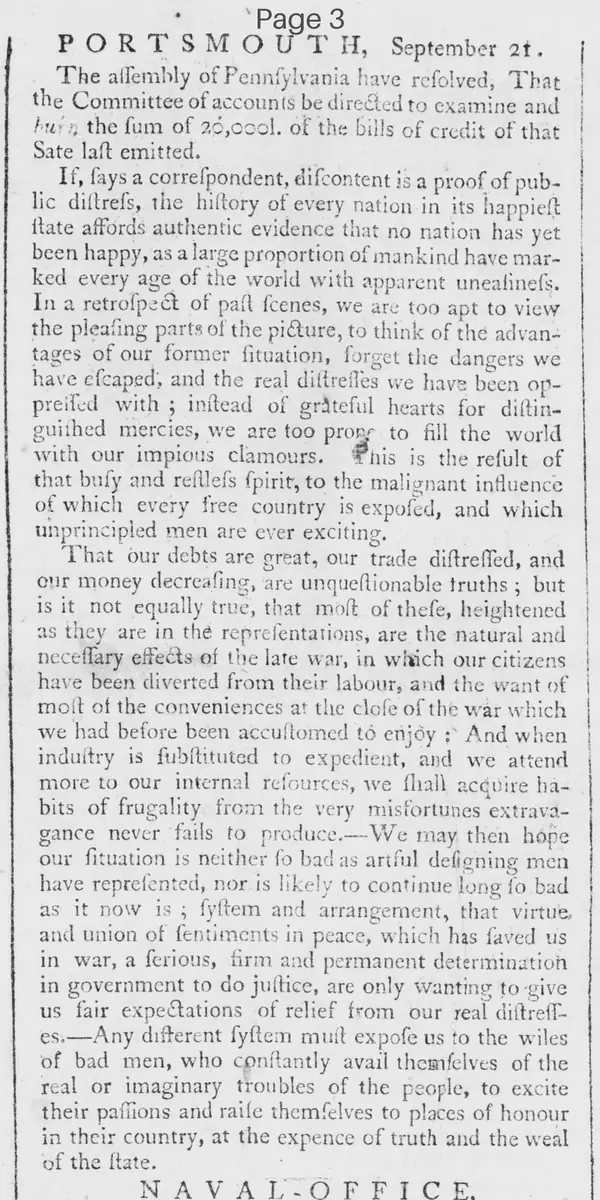
PORTS MOUTH, September 21.
The assembly of Pennsylvania have resolved, That the Committee of accounts be directed to examine and burn the sum of 20,000l. of the bills of credit of that State last emitted.
If, says a correspondent, discontent is a proof of public distress, the history of every nation in its happiest state affords authentic evidence that no nation has yet been happy, as a large proportion of mankind have marked every age of the world with apparent uneasiness.
In a retrospect of past scenes, we are too apt to view the pleasing parts of the picture, to think of the advantages of our former situation, forget the dangers we have escaped, and the real distresses we have been oppressed with; instead of grateful hearts for distinguished mercies, we are too prone to fill the world with our impious clamours. This is the result of that busy and restless spirit, to the malignant influence of which every free country is exposed, and which unprincipled men are ever exciting.
That our debts are great, our trade distressed, and our money decreasing, are unquestionable truths; but is it not equally true, that most of these, heightened as they are in the representations, are the natural and necessary effects of the late war, in which our citizens have been diverted from their labour, and the want of most of the conveniences at the close of the war which we had before been accustomed to enjoy: And when industry is substituted to expediency, and we attend more to our internal resources, we shall acquire habits of frugality from the very misfortunes extravagance never fails to produce.--We may then hope our situation is neither so bad as artful designing men have represented, nor is likely to continue long so bad as it now is; system and arrangement, that virtue and union of sentiments in peace, which has saved us in war, a serious, firm and permanent determination in government to do justice, are only wanting to give us fair expectations of relief from our real distresses.--Any different system must expose us to the wiles of bad men, who constantly avail themselves of the real or imaginary troubles of the people, to excite their passions and raise themselves to places of honour in their country, at the expense of truth and the weal of the state.
The assembly of Pennsylvania have resolved, That the Committee of accounts be directed to examine and burn the sum of 20,000l. of the bills of credit of that State last emitted.
If, says a correspondent, discontent is a proof of public distress, the history of every nation in its happiest state affords authentic evidence that no nation has yet been happy, as a large proportion of mankind have marked every age of the world with apparent uneasiness.
In a retrospect of past scenes, we are too apt to view the pleasing parts of the picture, to think of the advantages of our former situation, forget the dangers we have escaped, and the real distresses we have been oppressed with; instead of grateful hearts for distinguished mercies, we are too prone to fill the world with our impious clamours. This is the result of that busy and restless spirit, to the malignant influence of which every free country is exposed, and which unprincipled men are ever exciting.
That our debts are great, our trade distressed, and our money decreasing, are unquestionable truths; but is it not equally true, that most of these, heightened as they are in the representations, are the natural and necessary effects of the late war, in which our citizens have been diverted from their labour, and the want of most of the conveniences at the close of the war which we had before been accustomed to enjoy: And when industry is substituted to expediency, and we attend more to our internal resources, we shall acquire habits of frugality from the very misfortunes extravagance never fails to produce.--We may then hope our situation is neither so bad as artful designing men have represented, nor is likely to continue long so bad as it now is; system and arrangement, that virtue and union of sentiments in peace, which has saved us in war, a serious, firm and permanent determination in government to do justice, are only wanting to give us fair expectations of relief from our real distresses.--Any different system must expose us to the wiles of bad men, who constantly avail themselves of the real or imaginary troubles of the people, to excite their passions and raise themselves to places of honour in their country, at the expense of truth and the weal of the state.
What sub-type of article is it?
Economic Policy
Moral Or Religious
Social Reform
What keywords are associated?
Post War Economy
Public Discontent
Frugality
National Union
Economic Recovery
War Effects
What entities or persons were involved?
Pennsylvania Assembly
Correspondent
Editorial Details
Primary Topic
Post War Economic Distress And The Need For Frugality And National Unity
Stance / Tone
Optimistic Exhortation For Resilience Against Exaggerated Discontent
Key Figures
Pennsylvania Assembly
Correspondent
Key Arguments
Discontent Is A Historical Norm, Not Proof Of Unique Distress.
People Romanticize The Past And Forget Past Dangers And Real Oppressions.
Current Debts, Trade Distress, And Money Shortage Stem From The Late War's Disruptions.
Industry And Attention To Internal Resources Will Foster Frugality And Recovery.
Systemic Arrangement, Virtue, And Union Are Needed For Relief.
Unprincipled Men Exploit Troubles To Gain Power At The Expense Of Truth And State Welfare.