Thank you for visiting SNEWPapers!
Sign up free
The New York Packet
New York, New York County, New York
What is this article about?
In the House of Commons on May 15, Sir Adam Ferguson urged a committee to investigate claims for indemnification by merchants whose goods, sent to supply the British army in New York, were captured by an American privateer and recaptured. The trade was illegal but overlooked for army needs. The Chancellor opposed, citing illegality; Alderman Watson defended based on Sir William Howe's proclamation.
Clipping
OCR Quality
Full Text
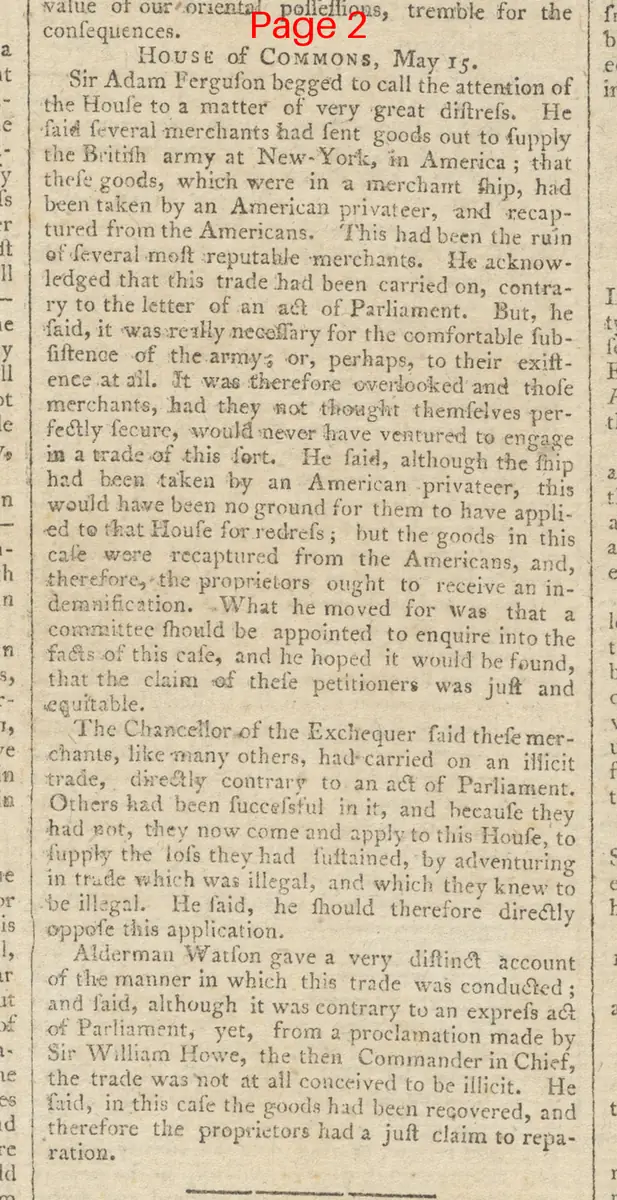
Sir Adam Ferguson begged to call the attention of the House to a matter of very great distress. He said several merchants had sent goods out to supply the British army at New-York, in America; that these goods, which were in a merchant ship, had been taken by an American privateer, and recaptured from the Americans. This had been the ruin of several most reputable merchants. He acknowledged that this trade had been carried on, contrary to the letter of an act of Parliament. But, he said, it was really necessary for the comfortable subsistence of the army: or, perhaps, to their existence at all. It was therefore overlooked and those merchants, had they not thought themselves perfectly secure, would never have ventured to engage in a trade of this sort. He said, although the ship had been taken by an American privateer, this would have been no ground for them to have applied to that House for redress; but the goods in this case were recaptured from the Americans, and, therefore, the proprietors ought to receive an indemnification. What he moved for was that a committee should be appointed to enquire into the facts of this case, and he hoped it would be found, that the claim of these petitioners was just and equitable.
The Chancellor of the Exchequer said these merchants, like many others, had carried on an illicit trade, directly contrary to an act of Parliament. Others had been successful in it, and because they had not, they now come and apply to this House, to supply the loss they had sustained, by adventuring in trade which was illegal, and which they knew to be illegal. He said, he should therefore directly oppose this application.
Alderman Watson gave a very distinct account of the manner in which this trade was conducted; and said, although it was contrary to an express act of Parliament, yet, from a proclamation made by Sir William Howe, the then Commander in Chief, the trade was not at all conceived to be illicit. He said, in this case the goods had been recovered, and therefore the proprietors had a just claim to reparation.
What sub-type of article is it?
What keywords are associated?
What entities or persons were involved?
Where did it happen?
Foreign News Details
Primary Location
New York, In America
Event Date
May 15
Key Persons
Outcome
ruin of several reputable merchants; goods recaptured; motion for committee to enquire into facts and claims for indemnification, opposed by chancellor
Event Details
Sir Adam Ferguson highlighted distress of merchants whose goods for British army in New York were taken by American privateer and recaptured, leading to ruin despite illegal trade necessary for army subsistence. He moved for a committee to investigate. Chancellor opposed, calling it illicit trade. Alderman Watson explained trade conducted under Sir William Howe's proclamation, not seen as illicit, and proprietors entitled to reparation after recovery.