Thank you for visiting SNEWPapers!
Sign up free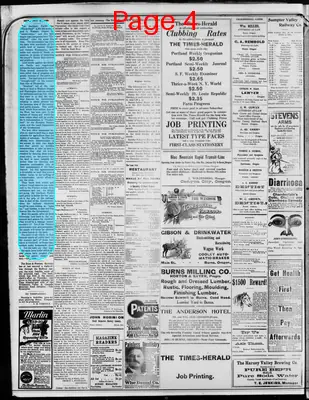
Story
March 12, 1910
The Times Herald
Burns, Harney County, Oregon
What is this article about?
The article criticizes Gifford Pinchot's conservation policies for withholding over 2 million acres of public land in Western Oregon and Washington from homesteaders, comparing it to railroad monopolies like Southern Pacific, arguing it violates laws and hinders settlement.
Clipping

OCR Quality
98%
Excellent
Full Text
DRIVING AWAY SETTLERS
The Southern Pacific has "Pinchotized" 2,000,000 acres of land in Western Oregon for "conservation," and five fake wagon-road companies have "Pinchotized" other big areas likewise. The Government has done the same with practically all the public land of western Oregon and western Washington, both inside and outside of forest reserves, on pretext of protecting the people's timber from thieves and grabbers.
Loud howls against the Southern Pacific and wagon-road companies have assailed the stars. These several monopolies have been called foes of progress and greedy enemies of the public interest. Yet their grip is no worse "strangle-hold" on the country than that of Pinchotism.
"Boosters" tell of the vast tracts of land in Western Oregon and Washington that are waiting for settlement and use; but, when they start in to find the land, they discover the Government refusing to admit settlers into the immense area of the unoccupied public domain. This public land, which from earliest days of the West, has been open to the makers of homes and which the laws ordain shall still be available to homesteaders, is "Pinchotized" by the Forestry Department, and the Land Department of the Government.
The laws allow homestead entries on reserve land that is more valuable for agriculture than for timber or minerals. But Pinchot officials have determination of the matter in their own hands and they permit no would-be homesteaders to take up land in reserves they shut out homesteaders by denying them homestead entry, on the pretext that the land is more valuable for timber than for farming, and therefore purchasable only on their appraisement of the value thereof, but this appraisement is invariably so high that even a timber buyer, to say nothing of a homesteader, cannot afford to pay the price.
Thus lands both within and without forest reserves are withheld by the Pinchot system from settlement and use. As things are going, the Southern Pacific land grant is better for the people in the grip of the railroad than in that of the Government since the railroad doubtless would be more willing to "open up," and besides, it may not live forever like the Government.
Must the people, after all their bitterness, turn back to the execrated land grants for comfort? That would be a strange resort, wouldn't it? Yet if the Pinchot government ever gets possession, the people will never be allowed to make homes on the land.
The point of all which is that because nearly all public land in the western part of these two states is timbered, no longer may settlers make homesteads upon it. Yet the laws say they may - the same laws under which the older states have peopled their lands and grown strong and rich. - Oregonian
The Southern Pacific has "Pinchotized" 2,000,000 acres of land in Western Oregon for "conservation," and five fake wagon-road companies have "Pinchotized" other big areas likewise. The Government has done the same with practically all the public land of western Oregon and western Washington, both inside and outside of forest reserves, on pretext of protecting the people's timber from thieves and grabbers.
Loud howls against the Southern Pacific and wagon-road companies have assailed the stars. These several monopolies have been called foes of progress and greedy enemies of the public interest. Yet their grip is no worse "strangle-hold" on the country than that of Pinchotism.
"Boosters" tell of the vast tracts of land in Western Oregon and Washington that are waiting for settlement and use; but, when they start in to find the land, they discover the Government refusing to admit settlers into the immense area of the unoccupied public domain. This public land, which from earliest days of the West, has been open to the makers of homes and which the laws ordain shall still be available to homesteaders, is "Pinchotized" by the Forestry Department, and the Land Department of the Government.
The laws allow homestead entries on reserve land that is more valuable for agriculture than for timber or minerals. But Pinchot officials have determination of the matter in their own hands and they permit no would-be homesteaders to take up land in reserves they shut out homesteaders by denying them homestead entry, on the pretext that the land is more valuable for timber than for farming, and therefore purchasable only on their appraisement of the value thereof, but this appraisement is invariably so high that even a timber buyer, to say nothing of a homesteader, cannot afford to pay the price.
Thus lands both within and without forest reserves are withheld by the Pinchot system from settlement and use. As things are going, the Southern Pacific land grant is better for the people in the grip of the railroad than in that of the Government since the railroad doubtless would be more willing to "open up," and besides, it may not live forever like the Government.
Must the people, after all their bitterness, turn back to the execrated land grants for comfort? That would be a strange resort, wouldn't it? Yet if the Pinchot government ever gets possession, the people will never be allowed to make homes on the land.
The point of all which is that because nearly all public land in the western part of these two states is timbered, no longer may settlers make homesteads upon it. Yet the laws say they may - the same laws under which the older states have peopled their lands and grown strong and rich. - Oregonian
What sub-type of article is it?
Historical Event
What themes does it cover?
Justice
Misfortune
What keywords are associated?
Pinchot Policies
Land Conservation
Homesteaders
Public Domain
Oregon
Washington
Settlement
Forestry Department
What entities or persons were involved?
Pinchot
Where did it happen?
Western Oregon And Western Washington
Story Details
Key Persons
Pinchot
Location
Western Oregon And Western Washington
Story Details
Government conservation policies under Pinchot withhold public timbered lands from homesteaders in the Pacific Northwest by classifying them as valuable only for timber at high prices, preventing settlement despite laws allowing agricultural homesteads, deemed worse than railroad land grants.