Thank you for visiting SNEWPapers!
Sign up free
Editorial
September 8, 1804
Virginia Argus
Richmond, Virginia
What is this article about?
An unsigned editorial by CATO critiques proposals for naval defense and non-importation against British aggressions, instead advocating a 50% tariff on all imported cotton goods to foster domestic manufacturing, weaken Britain's economy, and protect American trade and independence.
Clipping
OCR Quality
98%
Excellent
Full Text
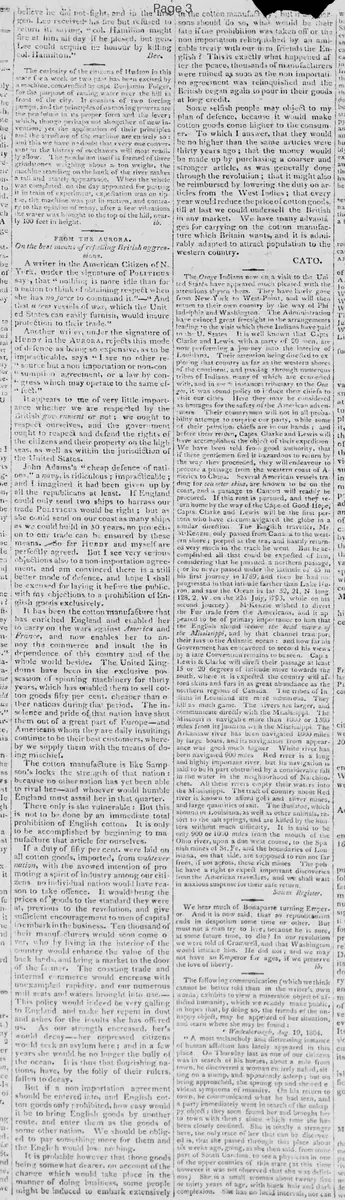
FROM THE AURORA.
On the best means of repelling British aggressions.
A writer in the American Citizen of N. York, under the signature of Politicus say, that "nothing is more idle than for a nation to think of obtaining respect when she has no force to command it." And that a few vessels of war, which the United States can easily furnish, would insure protection to their trade.
Another writer, under the signature of Handy in the Aurora, rejects this mode of defence as being so expensive, as to be impracticable, says "I see no other resource but a non importation or non-consumption agreement, or a law by congress which may operate to the same effect."
It appears to me of very little importance whether we are respected by the British government or not; we ought to respect ourselves, and the government ought to respect and defend the rights of the citizens and their property on the high seas, as well as within the jurisdiction of the United States.
John Adams's "cheap defence of nations," a navy, is ridiculous; impracticable; and I imagined it had been given up by all the republicans at least. If England could only send two ships to harass our trade Politicus would be right; but as she could send on our coast as many ships as we could build in 50 years, no protection to our trade can be ensured by these means. So far Handy and myself are perfectly agreed. But I see very serious objections also to a non-importation agreement, and am convinced there is a still better mode of defence, and hope I shall be excused for having it before the public, with my objections to a prohibition of English goods exclusively.
It has been the cotton manufacture that has enriched England and enabled her to carry on the wars against America and France, and now enables her to annoy the commerce and insult the independence of this country and of the whole world beside. The United Kingdoms have been in the exclusive possession of spinning machinery for thirty years, which has enabled them to sell cotton goods fifty per cent. cheaper than other nations during that period. The insolence and pride of that nation have shut them out of a great part of Europe—and Americans whom they are daily insulting continue to be their best customers, whereby we supply them with the means of doing mischief.
The cotton manufacture is like Samson's locks the strength of that nation: because no other nation has yet been able to rival her—and whoever would humble England must assail her in that quarter. There only is she vulnerable: But this is not to be done by an immediate total prohibition of English cotton. It is only to be accomplished by beginning to manufacture that article for ourselves.
If a duty of fifty per cent. were laid on all cotton goods, imported, from whatever nation, with the avowed intention of promoting a spirit of industry among our citizens no individual nation would have reason to take offence. It would bring the prices of goods to the standard they were at, previous to the revolution, and give sufficient encouragement to men of capital to embark in the business. Ten thousand of their manufacturers would soon come over, who by living in the interior of the country would enhance the value of the back lands, and bring a market to the door of the farmer. The coasting trade and internal commerce would increase with unexampled rapidity, and our numerous mill seats and waters brought into use.
This policy would in deed be very galling to England and make her repent in dust and ashes for the insults she has offered us. As our strength increased, hers would decay—her oppressed citizens would seek an asylum here; and in a few years she would be no longer the bully of the ocean. It is thus that flourishing nations, have, by the folly of their rulers, fallen to decay.
But if a non importation agreement should be entered into, and English cotton goods only prohibited, how easy would it be to bring English goods by another route, and enter them as the goods of some other nation. We should be obliged to pay something more for them and the English would lose nothing:
It is probable however that those goods being somewhat dearer, on account of the charge which would take place in the manner of doing business, some people might be be induced to embark extensively in the cotton manufacture. Suppose they should do so, what would be their fate if the prohibition was taken off or the non importation relinquished by an amicable treaty with our name friends the English? This is exactly what happened after the peace, thousands of manufacturers were ruined as soon as the non importation agreement was relinquished and the British began again to pour in their goods at long credit.
Some selfish people may object to my plan of defence, because it would make cotton goods come higher to the consumer. To which I answer, that they would be no higher than the same articles were thirty years ago; that the money would be made up by purchasing a coarser and stronger article, as was generally done through the revolution; that it might also be reimbursed by lowering the duty on articles from the West Indies; that every year would reduce the price of cotton goods, till at last we could undersell the British in any market. We have many advantages for carrying on the cotton manufacture which Britain wants, and it is admirably adapted to attract population to the western country.
CATO.
On the best means of repelling British aggressions.
A writer in the American Citizen of N. York, under the signature of Politicus say, that "nothing is more idle than for a nation to think of obtaining respect when she has no force to command it." And that a few vessels of war, which the United States can easily furnish, would insure protection to their trade.
Another writer, under the signature of Handy in the Aurora, rejects this mode of defence as being so expensive, as to be impracticable, says "I see no other resource but a non importation or non-consumption agreement, or a law by congress which may operate to the same effect."
It appears to me of very little importance whether we are respected by the British government or not; we ought to respect ourselves, and the government ought to respect and defend the rights of the citizens and their property on the high seas, as well as within the jurisdiction of the United States.
John Adams's "cheap defence of nations," a navy, is ridiculous; impracticable; and I imagined it had been given up by all the republicans at least. If England could only send two ships to harass our trade Politicus would be right; but as she could send on our coast as many ships as we could build in 50 years, no protection to our trade can be ensured by these means. So far Handy and myself are perfectly agreed. But I see very serious objections also to a non-importation agreement, and am convinced there is a still better mode of defence, and hope I shall be excused for having it before the public, with my objections to a prohibition of English goods exclusively.
It has been the cotton manufacture that has enriched England and enabled her to carry on the wars against America and France, and now enables her to annoy the commerce and insult the independence of this country and of the whole world beside. The United Kingdoms have been in the exclusive possession of spinning machinery for thirty years, which has enabled them to sell cotton goods fifty per cent. cheaper than other nations during that period. The insolence and pride of that nation have shut them out of a great part of Europe—and Americans whom they are daily insulting continue to be their best customers, whereby we supply them with the means of doing mischief.
The cotton manufacture is like Samson's locks the strength of that nation: because no other nation has yet been able to rival her—and whoever would humble England must assail her in that quarter. There only is she vulnerable: But this is not to be done by an immediate total prohibition of English cotton. It is only to be accomplished by beginning to manufacture that article for ourselves.
If a duty of fifty per cent. were laid on all cotton goods, imported, from whatever nation, with the avowed intention of promoting a spirit of industry among our citizens no individual nation would have reason to take offence. It would bring the prices of goods to the standard they were at, previous to the revolution, and give sufficient encouragement to men of capital to embark in the business. Ten thousand of their manufacturers would soon come over, who by living in the interior of the country would enhance the value of the back lands, and bring a market to the door of the farmer. The coasting trade and internal commerce would increase with unexampled rapidity, and our numerous mill seats and waters brought into use.
This policy would in deed be very galling to England and make her repent in dust and ashes for the insults she has offered us. As our strength increased, hers would decay—her oppressed citizens would seek an asylum here; and in a few years she would be no longer the bully of the ocean. It is thus that flourishing nations, have, by the folly of their rulers, fallen to decay.
But if a non importation agreement should be entered into, and English cotton goods only prohibited, how easy would it be to bring English goods by another route, and enter them as the goods of some other nation. We should be obliged to pay something more for them and the English would lose nothing:
It is probable however that those goods being somewhat dearer, on account of the charge which would take place in the manner of doing business, some people might be be induced to embark extensively in the cotton manufacture. Suppose they should do so, what would be their fate if the prohibition was taken off or the non importation relinquished by an amicable treaty with our name friends the English? This is exactly what happened after the peace, thousands of manufacturers were ruined as soon as the non importation agreement was relinquished and the British began again to pour in their goods at long credit.
Some selfish people may object to my plan of defence, because it would make cotton goods come higher to the consumer. To which I answer, that they would be no higher than the same articles were thirty years ago; that the money would be made up by purchasing a coarser and stronger article, as was generally done through the revolution; that it might also be reimbursed by lowering the duty on articles from the West Indies; that every year would reduce the price of cotton goods, till at last we could undersell the British in any market. We have many advantages for carrying on the cotton manufacture which Britain wants, and it is admirably adapted to attract population to the western country.
CATO.
What sub-type of article is it?
Economic Policy
Trade Or Commerce
Foreign Affairs
What keywords are associated?
British Aggressions
Cotton Manufacture
Protective Tariffs
Domestic Industry
Non Importation Agreement
Naval Defense
Economic Independence
What entities or persons were involved?
England
British Government
United States
John Adams
Politucus
Handy
Editorial Details
Primary Topic
Protective Tariffs On Cotton Imports To Promote Domestic Manufacturing Against British Economic Dominance
Stance / Tone
Advocacy For Tariff Based Economic Defense
Key Figures
England
British Government
United States
John Adams
Politucus
Handy
Key Arguments
Naval Defense Is Impracticable Due To Britain's Superior Fleet.
Non Importation Agreements Are Easily Evaded And Risk Ruining Domestic Manufacturers If Lifted.
Cotton Manufacturing Is The Source Of England's Economic Strength And War Making Ability.
Impose A 50% Duty On All Imported Cotton Goods To Encourage American Production Without Offending Specific Nations.
Tariffs Would Attract British Manufacturers To The Us, Boosting Internal Commerce And Land Values.
Domestic Manufacturing Would Weaken England Economically And Reduce Her Ability To Aggress.
Cotton Goods Prices Would Return To Pre Revolutionary Levels And Eventually Undersell British Products.
America Has Natural Advantages For Cotton Manufacturing, Aiding Western Population Growth.