Thank you for visiting SNEWPapers!
Sign up free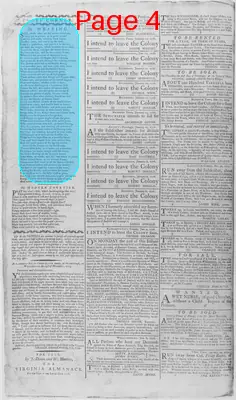
Poem
January 20, 1776
The Virginia Gazette
Richmond, Williamsburg, Richmond County, Virginia
What is this article about?
A poetic tribute to the art of weaving, portraying it as a divine invention essential for human clothing and dignity. It satirizes lawyers and physicians as dispensable, while emphasizing weaving's role in societal welfare and moral order.
Clipping
OCR Quality
95%
Excellent
Full Text
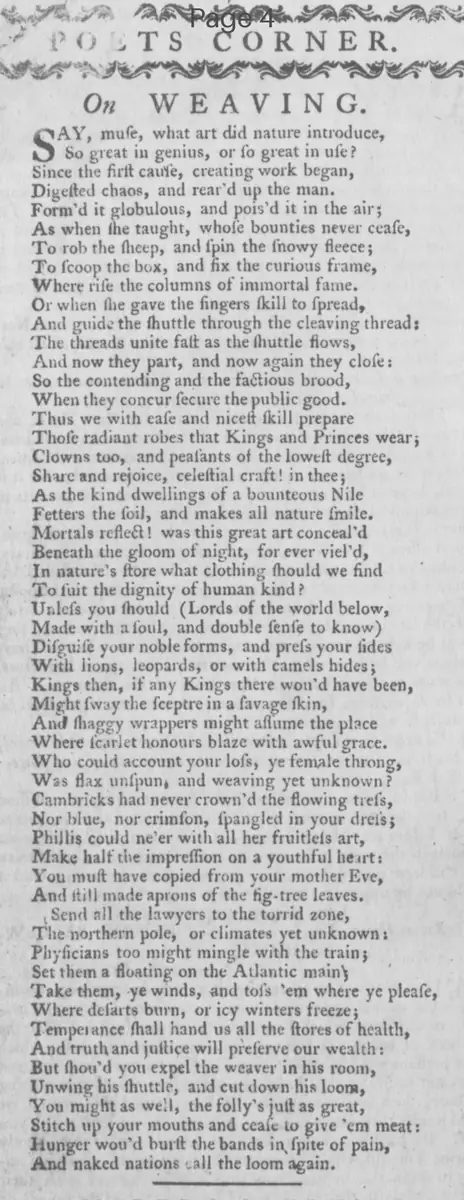
POET'S CORNER.
On WEAVING.
AY, muse, what art did nature introduce,
So great in genius, or so great in use?
Since the first cause, creating work began,
Digested chaos, and rear'd up the man.
Form'd it globulous, and pois'd it in the air;
As when the gods, whose bounties never cease,
To rob the sheep, and spin the snowy fleece;
To scoop the box, and fix the curious frame.
Where rise the columns of immortal fame.
Or when she gave the fingers skill to spread,
And guide the shuttle through the cleaving thread:
The threads unite fast as the shuttle flies,
And now they part, and now again they close:
So the contending and the factious brood,
When they concur secure the public good.
Thus we with ease and nicest skill prepare
Those radiant robes that Kings and Princes wear;
Clowns too, and peasants of the lowest degree,
Share and rejoice, celestial craft! in thee;
As the kind dwellings of a bounteous Nile
Fertilizes the soil, and makes all nature smile.
Mortals reflect! was this great art conceal'd
Beneath the gloom of night, for ever veil'd,
In nature's store what clothing should we find
To suit the dignity of human kind?
Unless you should (Lords of the world below,
Made with a soul, and double sense to know)
Disguise your noble forms, and press your sides
With lions, leopards, or with camels hides;
Kings then, if any Kings there wou'd have been,
Might sway the sceptre in a savage skin,
And shaggy wrappers might assume the place
Where scarlet honours blaze with awful grace.
Who could account your loss, ye female throng,
Was flax unspun and weaving yet unknown?
Cambricks had never crown'd the flowing tress,
Nor blue, nor crimson, spangled in your dress;
Phillis could ne'er with all her fruitless art,
Make half the impression on a youthful heart:
You must have copied from your mother Eve,
And still made aprons of the fig-tree leaves.
Send all the lawyers to the torrid zone,
The northern pole, or climates yet unknown:
Physicians too might mingle with the train;
Set them a floating on the Atlantic maink
Take them, ye winds, and toss 'em where ye please,
Where deserts burn, or icy winters freeze;
Temperance shall hand us all the stores of health,
And truth and justice will preserve our wealth :
But shou'd you expel the weaver in his room,
Unwing his shuttle, and cut down his loom,
You might as well, the folly's just as great,
Stitch up your mouths and cease to give 'em meat:
Hunger wou'd burst the bands in spite of pain,
And naked nations call the loom again.
On WEAVING.
AY, muse, what art did nature introduce,
So great in genius, or so great in use?
Since the first cause, creating work began,
Digested chaos, and rear'd up the man.
Form'd it globulous, and pois'd it in the air;
As when the gods, whose bounties never cease,
To rob the sheep, and spin the snowy fleece;
To scoop the box, and fix the curious frame.
Where rise the columns of immortal fame.
Or when she gave the fingers skill to spread,
And guide the shuttle through the cleaving thread:
The threads unite fast as the shuttle flies,
And now they part, and now again they close:
So the contending and the factious brood,
When they concur secure the public good.
Thus we with ease and nicest skill prepare
Those radiant robes that Kings and Princes wear;
Clowns too, and peasants of the lowest degree,
Share and rejoice, celestial craft! in thee;
As the kind dwellings of a bounteous Nile
Fertilizes the soil, and makes all nature smile.
Mortals reflect! was this great art conceal'd
Beneath the gloom of night, for ever veil'd,
In nature's store what clothing should we find
To suit the dignity of human kind?
Unless you should (Lords of the world below,
Made with a soul, and double sense to know)
Disguise your noble forms, and press your sides
With lions, leopards, or with camels hides;
Kings then, if any Kings there wou'd have been,
Might sway the sceptre in a savage skin,
And shaggy wrappers might assume the place
Where scarlet honours blaze with awful grace.
Who could account your loss, ye female throng,
Was flax unspun and weaving yet unknown?
Cambricks had never crown'd the flowing tress,
Nor blue, nor crimson, spangled in your dress;
Phillis could ne'er with all her fruitless art,
Make half the impression on a youthful heart:
You must have copied from your mother Eve,
And still made aprons of the fig-tree leaves.
Send all the lawyers to the torrid zone,
The northern pole, or climates yet unknown:
Physicians too might mingle with the train;
Set them a floating on the Atlantic maink
Take them, ye winds, and toss 'em where ye please,
Where deserts burn, or icy winters freeze;
Temperance shall hand us all the stores of health,
And truth and justice will preserve our wealth :
But shou'd you expel the weaver in his room,
Unwing his shuttle, and cut down his loom,
You might as well, the folly's just as great,
Stitch up your mouths and cease to give 'em meat:
Hunger wou'd burst the bands in spite of pain,
And naked nations call the loom again.
What sub-type of article is it?
Ode
Satire
What themes does it cover?
Commerce Trade
Satire Society
Moral Virtue
What keywords are associated?
Weaving
Craft
Satire
Lawyers
Physicians
Clothing
Society
Temperance
Poem Details
Title
On Weaving.
Subject
On Weaving
Form / Style
Rhymed Couplets
Key Lines
Ay, Muse, What Art Did Nature Introduce,
So Great In Genius, Or So Great In Use?
Send All The Lawyers To The Torrid Zone,
The Northern Pole, Or Climates Yet Unknown:
And Naked Nations Call The Loom Again.