Thank you for visiting SNEWPapers!
Sign up free
Literary
January 23, 1936
Imperial Valley Press
El Centro, Imperial County, California
What is this article about?
New York newspaper column discussing annoying book titles with examples from Defoe, Austen, Hemingway, and Shelley; anecdote on Gloria Vanderbilt's self-consciousness; advice on column writing; warning about theater fire hazards from reading programs; profile of London greeter Bucky Taylor.
Clipping
OCR Quality
95%
Excellent
Full Text
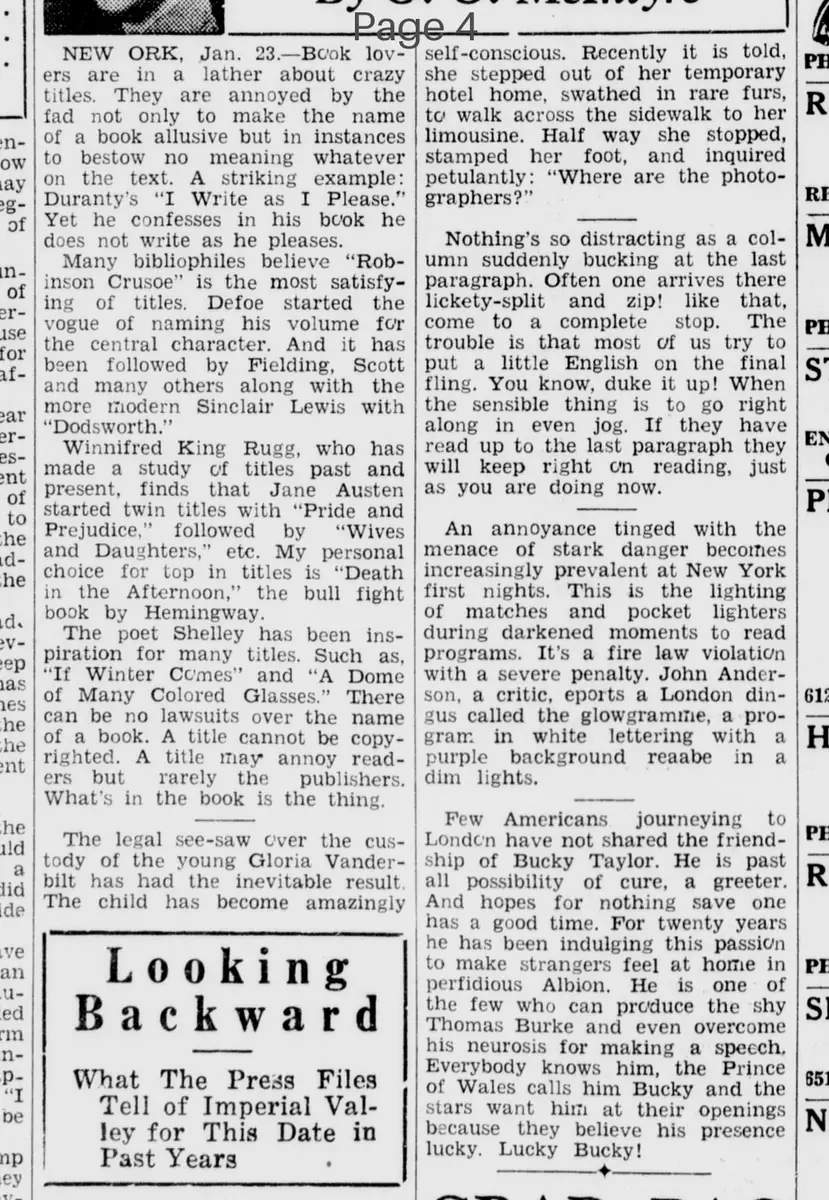
NEW YORK, Jan. 23.-Book lovers are in a lather about crazy titles. They are annoyed by the fad not only to make the name of a book allusive but in instances to bestow no meaning whatever on the text. A striking example: Duranty's "I Write as I Please." Yet he confesses in his book he does not write as he pleases.
Many bibliophiles believe "Robinson Crusoe" is the most satisfying of titles. Defoe started the vogue of naming his volume for the central character. And it has been followed by Fielding, Scott and many others along with the more modern Sinclair Lewis with "Dodsworth."
Winnifred King Rugg, who has made a study of titles past and present, finds that Jane Austen started twin titles with "Pride and Prejudice," followed by "Wives and Daughters," etc. My personal choice for top in titles is "Death in the Afternoon," the bull fight book by Hemingway.
The poet Shelley has been inspiration for many titles. Such as, "If Winter Comes" and "A Dome of Many Colored Glasses." There can be no lawsuits over the name of a book. A title cannot be copyrighted. A title may annoy readers but rarely the publishers.
What's in the book is the thing.
The legal see-saw over the custody of the young Gloria Vanderbilt has had the inevitable result. The child has become amazingly self-conscious. Recently it is told, she stepped out of her temporary hotel home, swathed in rare furs, to walk across the sidewalk to her limousine. Half way she stopped, stamped her foot, and inquired petulantly: "Where are the photographers?"
Nothing's so distracting as a column suddenly bucking at the last paragraph. Often one arrives there lickety-split and zip! like that, come to a complete stop. The trouble is that most of us try to put a little English on the final fling, You know, duke it up! When the sensible thing is to go right along in even jog. If they have read up to the last paragraph they will keep right on reading, just as you are doing now.
An annoyance tinged with the menace of stark danger becomes increasingly prevalent at New York first nights. This is the lighting of matches and pocket lighters during darkened moments to read programs. It's a fire law violation with a severe penalty. John Anderson, a critic, reports a London dingus called the glowgramme, a program, in white lettering with a purple background readable in dim lights.
Few Americans journeying to London have not shared the friendship of Bucky Taylor. He is past all possibility of cure, a greeter. And hopes for nothing save one has a good time. For twenty years he has been indulging this passion to make strangers feel at home in perfidious Albion. He is one of the few who can produce the shy Thomas Burke and even overcome his neurosis for making a speech. Everybody knows him, the Prince of Wales calls him Bucky and the stars want him at their openings because they believe his presence lucky. Lucky Bucky!
Many bibliophiles believe "Robinson Crusoe" is the most satisfying of titles. Defoe started the vogue of naming his volume for the central character. And it has been followed by Fielding, Scott and many others along with the more modern Sinclair Lewis with "Dodsworth."
Winnifred King Rugg, who has made a study of titles past and present, finds that Jane Austen started twin titles with "Pride and Prejudice," followed by "Wives and Daughters," etc. My personal choice for top in titles is "Death in the Afternoon," the bull fight book by Hemingway.
The poet Shelley has been inspiration for many titles. Such as, "If Winter Comes" and "A Dome of Many Colored Glasses." There can be no lawsuits over the name of a book. A title cannot be copyrighted. A title may annoy readers but rarely the publishers.
What's in the book is the thing.
The legal see-saw over the custody of the young Gloria Vanderbilt has had the inevitable result. The child has become amazingly self-conscious. Recently it is told, she stepped out of her temporary hotel home, swathed in rare furs, to walk across the sidewalk to her limousine. Half way she stopped, stamped her foot, and inquired petulantly: "Where are the photographers?"
Nothing's so distracting as a column suddenly bucking at the last paragraph. Often one arrives there lickety-split and zip! like that, come to a complete stop. The trouble is that most of us try to put a little English on the final fling, You know, duke it up! When the sensible thing is to go right along in even jog. If they have read up to the last paragraph they will keep right on reading, just as you are doing now.
An annoyance tinged with the menace of stark danger becomes increasingly prevalent at New York first nights. This is the lighting of matches and pocket lighters during darkened moments to read programs. It's a fire law violation with a severe penalty. John Anderson, a critic, reports a London dingus called the glowgramme, a program, in white lettering with a purple background readable in dim lights.
Few Americans journeying to London have not shared the friendship of Bucky Taylor. He is past all possibility of cure, a greeter. And hopes for nothing save one has a good time. For twenty years he has been indulging this passion to make strangers feel at home in perfidious Albion. He is one of the few who can produce the shy Thomas Burke and even overcome his neurosis for making a speech. Everybody knows him, the Prince of Wales calls him Bucky and the stars want him at their openings because they believe his presence lucky. Lucky Bucky!
What sub-type of article is it?
Essay
What themes does it cover?
Social Manners
What keywords are associated?
Book Titles
Literary Criticism
Gloria Vanderbilt
Newspaper Column
Bucky Taylor
Literary Details
Key Lines
What's In The Book Is The Thing.
Where Are The Photographers?
Lucky Bucky!