Thank you for visiting SNEWPapers!
Sign up free
Rhode Island American And Providence Gazette
Providence, Providence County, Rhode Island
What is this article about?
A satirical epistle from 'Posterity' to Sir Walter Scott, the Author of Waverley, critiquing his novels for superficial morality, biased historical portrayals of Scottish Covenanters, and lack of genuine religious or patriotic depth, contrasting them with works like Byron's Childe Harold.
Merged-components note: Continuation of the same literary piece 'Letters from Posterity to the Author of Waverley' across adjacent columns on page 1.
Clipping
OCR Quality
Full Text
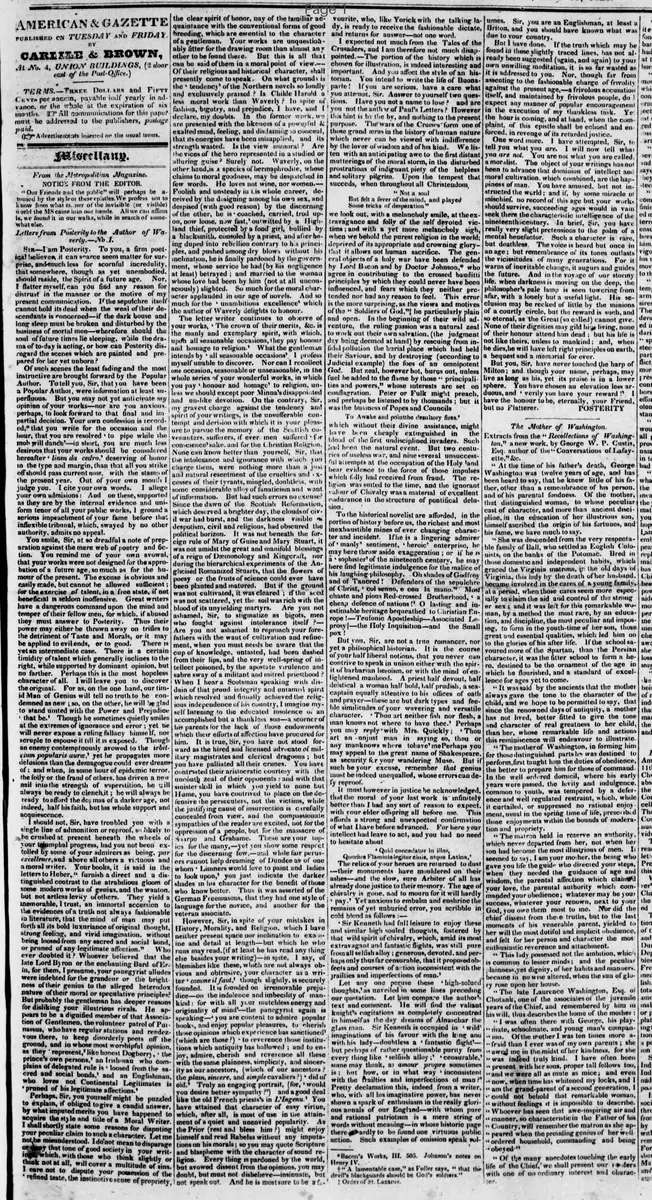
From the Metropolitan Magazine.
NOTICE FROM THE EDITOR.
"Our Friends and the public" will perhaps be amused by the style of these epistles. We profess not to know from what corner of the invisible (or visible) world the MS. came into our hands. All we can affirm is, we found it in our walks, while in search of something else.
Letters from Posterity to the Author of Waverley.—No. I.
Sir,—I am Posterity. To you, a living poetical believer, it can scarce seem matter for surprise, and much less for scornful incredulity, that somewhere, though as yet unembodied, should reside, the Spirit of a future age. Nor, I flatter myself, can you find any reason for distrust in the manner or the motive of my present communication. If the sepulchre itself cannot hold its dead when the weal of their descendants is concerned—if the dark house and long sleep must be broken and disturbed by the business of mortal men—wherefore should the soul of future times lie sleeping, while the drama of to-day is acting, or how can Posterity disregard the scenes which are painted and prepared for her yet unborn?
Of such scenes the least fading and the most instructive are brought forward by the Popular Author. To tell you, Sir, that you have been a Popular Author, were information at least superfluous. But you may not yet anticipate my opinion of your works—nor are you anxious, perhaps, to look forward to that final and impartial decision. Your own confession is recorded,* that you write for the occasion and the hour, that you are resolved 'to pipe while the mob will dance'—in short, you are much less desirous that your works should be considered hereafter 'linens d'acredo,' deserving of honor in the type and margin, than that all you strike off should pass current now, with the stamp of the present year. Out of your own mouth I judge you. I cite your own words. I allege your own admissions: And on these, supported as they are by the internal evidence and uniform tenor of all your public works, I ground a serious impeachment of your fame before that inflexible tribunal, which, swayed by no other authority, admits no appeal.
You smile, Sir, at so dreadful a note of preparation against the mere web of poetry and fiction. You remind me of your own avowal, that your works were not designed for the approbation of a future age, so much as for the humour of the present. The excuse is obvious and easily made, but cannot be allowed sufficient: for the exercise of talent, in a free state, if not beneficial is seldom inoffensive. Great writers have a dangerous command upon the mind and temper of their fellow men, for which, if abused, they must answer to Posterity. Thus their power may either be thrown away on trifles to the detriment of Taste and Morals, or it may be applied to evil ends, or to good. There is yet an intermediate case. There is a certain timidity of talent which generally inclines to the right, while supported by dominant opinion, but no farther. Perhaps this is the most hopeless character of all. I will leave you to discover the original. For as, on the one hand, our timid Man of Genius will tell no truth to be condemned as new; so, on the other, he will be glad to stand united with the Power and Prejudice 'that be.' Though he sometimes quietly smiles at the extremes of ignorance and error; yet he will never expose a ruling fallacy himself, nor scruple to espouse it till it is exposed. Though an enemy contemptuously avowed to the 'irbilium popularis aura,' yet he propagates more delusions than the demagogue could ever dream of: and when, in some hour of epidemic terror, the folly or the fraud of others has driven a new nail into the strength of superstition, he will always be ready to clench it; he will always be ready to afford the dons mas of a darker age, not indeed, half his faith, but his whole support and acquiescence.
I should not, Sir, have troubled you with a single line of admonition or reproof, so likely to be crushed at present beneath the wheels of your triumphant progress, had you not been extolled by some of your admirers as being, par excellence, and above all others a virtuous and a moral writer. Your books, it is said in the letters to Heber, "furnish a direct and a distinguished contrast to the atrabilious gloom of some modern works of genius, and the wanton, but not artless levity of others. They yield a memorable, I trust, an immortal accession to the evidences of a truth not always fashionable in literature, that the mind of man may put forth all its bold luxuriance of original thought, strong feeling, and vivid imagination, without being loosed from any sacred and social bond, or pruned of any legitimate affection." Who ever doubted it? Whoever believed that the late Lord Byron or the enchanting Bard of Erin, (for them, I presume, your panegyrist alludes) were indebted for the grandeur or the brightness of their genius to the alleged heterodox nature of their moral or speculative principles?
But probably the gentleman has deeper reasons for disliking your illustrious rivals. He appears to be a dignified member of that Association of Gentlemen, the volunteer patrol of Parnassus, who have regular stations and rendezvous there, to keep disorderly poets off the ground, and in whose most worshipful opinion, as they represent, 'like honest Dogberry,' the prince's own persons,' an Irishman who complains of delegated rule is 'loosed from the sacred and social bonds,' and an Englishman, who loves not Continental Legitimates is pruned of his legitimate affections.
Perhaps, Sir, you yourself might be puzzled to explain, if obliged to give a candid answer, by what imputed merits you have happened to acquire the style and title of a Moral Writer. I shall shortly state some reasons for disputing your peculiar claim to such a character. Let me not be misunderstood. I do not mean to disparage or deny that tone of good society in your writing, in which, with those who think slightly or think not at all, will cover a multitude of sins. I care not to dispute your possession of the refined taste, the instinctive sense of propriety, the clear spirit of honor, nay of the familiar acquaintance with the conventional forms of good breeding, which are essential to the character of a gentleman. Your works are unquestionably fitter for the drawing room than almost any other to be found there. But this is all that can be said of them in a moral point of view.—Of their religious and historical character, shall presently come to speak. On what grounds is the tendency of the Northern novels so loudly and exclusively praised? Is Childe Harold a less moral work than Waverley? In spite of fashion, bigotry, and prejudice, I have, and I declare, my doubts. In the former work, we are presented with the likeness of a powerful and exalted mind, feeling, and disdaining to conceal, that its energies have been misapplied, and its strength wasted. Is the view immoral? Are the vices of the hero represented in a studied or alluring guise? Surely not. Waverley, on the other hand, is a species of hermaphrodite, whose claims to moral goodness, may be despatched in few words. He loves not wine, nor women.—Foolish and unsteady in his whole career, deceived by the designing among his own sex, and despised (with good reason) by the discerning of the other, he is coaxed, carried, trod upon, now loose, now fast, outwitted by a Highland thief, protected by a fond girl, bullied by a blacksmith, consoled by a priest, and after being duped into rebellion contrary to his principles, and pushed among dry blows without his inclination, he is finally pardoned by the government, whose service he had (by his negligence at least) betrayed; and married to the woman whose love had been by him (not at all unconsciously) slighted. So much for the moral character applauded in our age of novels. And so much for the unambitious excellence which the author of Waverley delights to honour.
The letter writer continues to observe of your works, 'The crown of their merits, &c. is the manly and exemplary spirit, with which, upon all seasonable occasions, they pay honour and homage to religion.' What the gentleman intends by 'all seasonable occasions' I profess myself unable to discover. Nor can I recollect one occasion, seasonable or unseasonable, in the whole series of your wonderful works, in which you pay 'honour and homage' to religion, unless we should except poor Minna's disappointed and un-like devotion. On the contrary, Sir, my gravest charge against the tendency and spirit of your writings, is the unsufferable contempt and derision with which it is your pleasure to pursue the memory of the Scottish covenanters, sufferers, if ever men suffered, for conscience sake, and for the Christian Religion. None can know better than yourself, Sir, that the intolerance and ignorance with which you charge them, were nothing more than a just and natural resentment of the cruelties and excesses of their tyrants, mingled, doubtless, with some considerable alloy of fanaticism and want of information. But had such errors no excuse? Since the dawn of the Scottish Reformation, which deserved a brighter day, the clouds of civil war had burst, and the darkness visible despotism, civil and religious, had obscured the political horizon. It was not beneath the foreign rule of Mary of Guise and Mary Stuart, it was not amidst the great and manifold blessings of a reign of Demonology and Kingcraft, nor during the hierarchical experiments of the Anglicanized Romanized Stuarts, that the flowers of poesy or the fruits of science could ever have been planted and matured. But if the ground was not cultivated, it was cleared; if the seed was not scattered, yet the soil was rich with the blood of its unyielding martyrs. Are you not ashamed, Sir, to stigmatize as bigots, men who fought against intolerance itself?—Are you not ashamed to reproach your forefathers with the want of cultivation and refinement, when you must needs be aware that the cup of knowledge, untasted, had been dashed from their lips, and the very well-spring of intellect poisoned, by the apostate virulence and sabre sway of a militant and mitred priesthood?
When I hear a Scotsman speaking with disdain of that proud integrity and untamed spirit which resolved and finally achieved the religious independence of his country, I imagine myself listening to the educated insolence of an accomplished but a thankless sort—a scorner of his parents for the lack of those endowments which their efforts of affection have procured for him. It is true, Sir, you have not stood forward as the hired and licensed advocate of military magistrates and clerical dragoons; but you have palliated all their crimes. You have contrasted their aristocratic courtesy with the uncouth zeal of their opponents: and with that sinister skill in which you yield to none but Hume, you have contrived to place on the defensive the persecutors, not the victims, while the justifying cause of insurrection is carefully concealed from view, and the compassionate sympathies of the reader are excited, not for the oppression of a people, but for the massacre of Sharpe and Guthrie. These are your topics for the many,—yet you show some respect for the discerning few,—and while fair perusers cannot help dreaming of Dundee as of one whom 'Limners would love to paint and ladies to look upon,' you just indicate the darker shades in his character for the benefit of those who know better. Thus it was asserted of the German Freemasons, that they had one style of language for the novice, and another for the veteran associate.
However, Sir, in spite of your mistakes in History, Morality, and Religion, which I have neither present space nor inclination to examine and detail at length—but which he who runs may read, (if at least he has read any thing else besides your writing)—in spite, I say, of blemishes like these, which are not always obvious and obtrusive, your character as a writer comme il faut, though slightly, is securely founded. It is founded on irreconcilable prejudice—on the indolence and imbecility of mankind: for with all your matchless energy and originality of mind' (the panegyrist again is speaking)—'you are content to admire popular books, and enjoy popular pleasures, to cherish those opinions which experience has sanctioned' (which are those?)—'to reverence those institutions which antiquity has hallowed; and to enjoy, admire, cherish and reverence all these with the same plainness, simplicity, and sincerity as our ancestors, (which of our ancestors? the plain, sincere, and simple cavaliers?) did of old.' Truly an engaging portrait, (for, 'would you desire better sympathy?') and a good deal like the old French priest's in L'Ingenu. You have attained that character of easy virtue, which, after all, is most of use in the attainment of a quiet and unenvied popularity. As the Prior (rest and bless him?) might enjoy himself and read Rabelais without any imputations on his morals; so you may quote Scripture and blaspheme with the character of sound religion. Every thing is pardoned by the world, but avowed dissent from the opinions, you may doubt, but must not disbelieve—insinuate, but not speak out. And he is most sure to be a favourite, who, like Yorick with the talking lady, is ready to receive the fashionable dictate, and returns for answer—not one word.
I expected not much from the Tales of the Crusaders, and I am therefore not much disappointed.—The portion of the history which is chosen for illustration, is indeed interesting and important. And you affect the style of an historian. You intend to write the life of Bonaparte! If you are serious, have a care what you attempt, Sir. Answer to yourself two questions. Have you not a name to lose? and are you not the author of Paul's Letters? However this hint is by the by, and nothing to the present purpose. The wars of the Croisade form one of those grand aeras in the history of human nature which never can be viewed with indifference by the lover of wisdom and of his kind. We listen with an anticipating awe to the first distant mutterings of the moral storm, in the disturbed prostrations of indignant piety of the helpless and solitary pilgrim. Upon the tempest that succeeds, when throughout all Christendom,
"Not a soul
But felt a fever of the mind, and played
Some tricks of desperation"
we look out, with a melancholy smile, at the extravagance and folly of the self-devoted victims; and with a yet more melancholy sigh, when we behold the purest religion in the world; deprived of its appropriate and crowning glory—that it allows not human sacrifice. The general objects of a holy war have been defended by Lord Bacon and by Doctor Johnson,* who agree in contributing to the crusading banditti principles by which they could never have been influenced, and fears which they neither pretended nor had any reason to feel. This error is the more surprising, as the views and motives of the "Soldiers of God,"† lie particularly plain and open. In the beginning of their wild adventure, the ruling passion was a natural zeal to work out their own salvation. (the judgment day being deemed at hand) by rescuing from infidel pollution the burial place which had held their Saviour, and by destroying (according to Judicial example) the foes of an omnipotent God. But zeal, however hot, burns out, unless fuel be added to the flame by those "principalities and powers," whose interests are set on conflagration. Peter or Fulk might preach, and perhaps be listened to by thousands; but it was the business of Popes and Councils
To awake and point the desultory fires,
which without their divine assistance, might have been cheaply extinguished in the blood of the first undisciplined invaders. Such had been the natural event. But two centuries of useless war, and nine several unsuccessful attempts at the occupation of the Holy land bear evidence to the force of those impulses which folly had received from fraud. The religion was suited to the time, and the ignorant valour of Chivalry was a material of excellent endurance in the structure of pontifical delusion.
To the historical novelist are afforded, in the portion of history before us, the richest and most inexhaustible mines of ever changing character and incident. If he is a lingering admirer of 'manly' sentiment, 'heroic' enterprise, he may here throw aside exaggeration; or if he is a sophister of the nineteenth century, he may here find legitimate indulgence for the malice of his laughing philosophy. Oh shades of Godfrey and of Tancred! Defenders of the sepulchre of Christ, 'col senno, con la mano,' Most chaste and pious Red-crossed Brotherhood, a cheap defence of nations! O lasting and inestimable heritage bequeathed to Christian Europe!—Teutonic Apostleship—Associated Leprosy—the Holy Inquisition—and the Small pox!
But you, Sir, are not a true romancer, nor yet a philosophical historian. It is the course of your half liberal notions, that you never can contrive to speak in unison either with the spirit of barbarian heroism, or with the mind of enlightened manhood. A priest half devout, half deistical; a woman half bold, half prudish, a sea-captain equally attentive to his offices of oath and prayer—these are but dark types and feeble similitudes of your wavering and versatile character. Thou art neither fish nor flesh, a man knows not where to have thee.' Perhaps you may reply with Mrs. Quickly; Thou art an unjust man in saying so, thou or any man knows where to have me. Perhaps you may appeal to the great name of Shakespeare, as security for your wandering Muse. But if such be your excuse, remember that genius must be indeed unequalled, whose errors can defy reproof.
It must however in justice be acknowledged, that the moral of your last work is infinitely better than I had any sort of reason to expect, with your elder offspring all before me. This affords a strong and unexpected confirmation of what I have before advanced. For here your intellect had leave to act, and you had no need to hesitate about
Quid concedatur in illos.
Quorum Flaminiae ciner, atque Latina,
The relics of your heroes are returned to dust—their monuments have mouldered on their ashes—and the slow, sure Arbiter of all has already done justice to their memory. The age of chivalry is gone, and to mourn for it will hardly 'pay.' Yet anxious to embalm and enshrine the remains of yet unburied error, you scribble in cold blood as follows:—
'Sir Kenneth had full leisure to enjoy these and similar high souled thoughts, fostered by that wild spirit of chivalry, which, amid its most extravagant and fantastic flights, was still pure from all selfish alloy; generous, devoted, and perhaps only thus far censurable, that it proposed objects and courses of action inconsistent with the frailties and imperfections of man.'
Let any one peruse these high-souled thoughts,' as unveiled in some lines preceding our quotation. Let him compare the author's text and comment. He will find the valiant knight's cogitations as completely concentred in himself as the day dreams of Alnaschar the glass man. Sir Kenneth is occupied in 'wild' imaginations of his favour with the king and with his lady—doubtless a fantastic flight'—but perhaps of rather questionable purity from every thing like 'selfish alloy;' censurable, some may think, at amour propre sometimes is: but how, or in what way inconsistent with the frailties and imperfections of man? Pretty declamation this, indeed, from a writer who, with all his imaginative power, has never shown a spark of enthusiasm in the really glorious annals of our England—with whom pure and rational patriotism is a mere string of words without meaning—in whose historic page there hardly can be found one virtuous public action. Such examples of omission speak of
*Bacon's Works, III. 505.
Johnson's notes on Henry IV.
"A lamentable case," as Fuller says, "that the devil's blackguards should be God's soldiers."
Order of St. Lazarus.
umes. Sir, you are an Englishman, at least a Briton, and you should have known what was due to your country. But I have done. "If the truth which may be found in these slightly traced lines, has not already been suggested (again, and again) to your own unwilling meditation, it is so far wasted as it is addressed to you. Nor, though far from assenting to the fashionable charge of frivolity against the present age,—a frivolous accusation itself, and maintained by frivolous people, do I expect any manner of popular encouragement in the execution of my thankless task. Yet the hour is coming, and at hand, when the complaint, of this epistle shall be echoed and enforced, in revenge of its retarded justice.
One word more. I have attempted, Sir, to tell you what you are. I will now tell what you are not. You are not what you are called. a moralist. The object of your writings has not been to advance that dominion of intellect and moral cultivation, which combined, are the happiness of man. You have amused, but not instructed the world; and if, by some miracle of mischief, no record of this age but your works should survive, succeeding ages would in vain seek there the characteristic intelligence of the nineteenth century. In brief, Sir, you have really very slight pretensions to the palm of a mental benefactor. Such a character is rare, but deathless. The voice is heard but once in an age; but remembrance of its tones outlasts the vicissitudes of many generations. For it warns of inevitable change, it augurs and guides the future. And in the voyage of our stormy life, when darkness is moving on the deep, the philosopher's pale lamp is seen towering from afar, with a lonely but a useful light. His seclusion may be recked of little by the minions of a courtly circle, but the reward is such, and so eternal, as the Great (so called) cannot give. None of their dignities may gild his living, none of their honour attend him dead; but his life is not like theirs, unless to mankind: and, when he dies, he will have left right principles on earth, a bequest and a memorial for ever.
But you, Sir, have never touched the harp of Milton; and though your name, perhaps, may live as long as his, yet its praise is in a lower sphere. You have chosen an elevation less arduous, and 'verily you have your reward!' I have the honour to be, eternally, your Friend, but no Flatterer.
POSTERITY.
What sub-type of article is it?
What themes does it cover?
What keywords are associated?
What entities or persons were involved?
Literary Details
Title
Letters From Posterity To The Author Of Waverley.—No. I.
Author
Posterity
Subject
Critique Of Sir Walter Scott's Moral, Historical, And Religious Portrayals In His Novels
Form / Style
Satirical Epistle In Prose
Key Lines