Thank you for visiting SNEWPapers!
Sign up free
Story
September 2, 1890
The Indianapolis Journal
Indianapolis, Marion County, Indiana
What is this article about?
During the Mexican War, Midshipman Charles G. Hunter captures Alvarado against Commodore Perry's blockade orders, leading to his arrest but ultimate vindication by Congress with a vote of thanks and new command.
Clipping
OCR Quality
98%
Excellent
Full Text
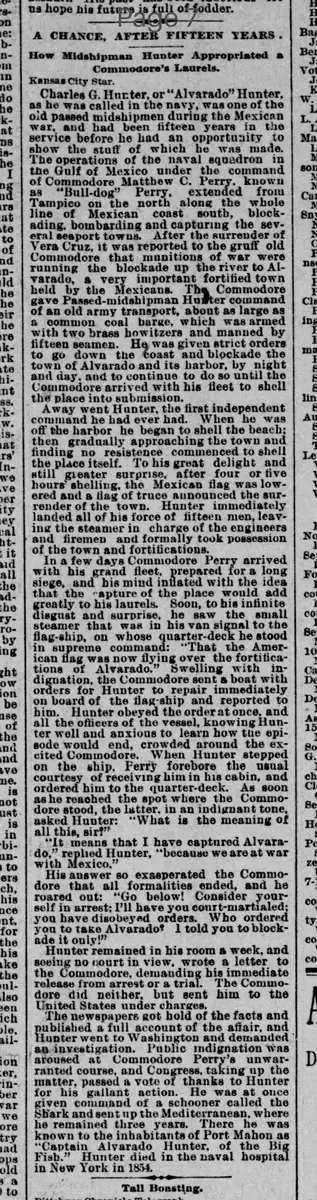
A CHANCE, AFTER FIFTEEN YEARS.
How Midshipman Hunter Appropriated a Commodore's Laurels.
Kansas City Star.
Charles G. Hunter, or "Alvarado" Hunter, as he was called in the navy, was one of the old passed midshipmen during the Mexican war, and had been fifteen years in the service before he had an opportunity to show the stuff of which he was made.
The operations of the naval squadron in the Gulf of Mexico under the command of Commodore Matthew C. Perry, known as "Bull-dog" Perry, extended from Tampico on the north along the whole line of Mexican coast south, blockading, bombarding and capturing the several seaport towns.
After the surrender of Vera Cruz, it was reported to the gruff old Commodore that munitions of war were running the blockade up the river to Alvarado, a very important fortified town held by the Mexicans.
The Commodore gave Passed-midshipman Hunter command of an old army transport, about as large as a common coal barge, which was armed with two brass howitzers and manned by fifteen seamen. He was given strict orders to go down the coast and blockade the town of Alvarado and its harbor, by night and day, and to continue to do so until the Commodore arrived with his fleet to shell the place into submission.
Away went Hunter, the first independent command he had ever had. When he was off the harbor he began to shell the beach; then gradually approaching the town and finding no resistance commenced to shell the place itself. To his great delight and still greater surprise, after four or five hours shelling, the Mexican flag was lowered and a flag of truce announced the surrender of the town. Hunter immediately landed all of his force of fifteen men, leaving the steamer in charge of the engineers and firemen and formally took possession of the town and fortifications.
In a few days Commodore Perry arrived with his grand fleet, prepared for a long siege, and his mind inflated with the idea that the capture of the place would add greatly to his laurels. Soon, to his infinite disgust and surprise, he saw the small steamer that was in his van signal to the flag-ship, on whose quarter-deck he stood in supreme command: That the American flag was now flying over the fortifications of Alvarado."
Swelling with indignation, the Commodore sent a boat with orders for Hunter to repair immediately on board of the flag-ship and reported to him. Hunter obeyed the order at once, and all the officers of the vessel, knowing Hunter well and anxious to learn how the episode would end, crowded around the excited Commodore. When Hunter stepped on the ship, Perry forebore the usual courtesy of receiving him in his cabin, and ordered him to the quarter-deck. As soon as he reached the spot where the Commodore stood, the latter, in an indignant tone, asked Hunter:
"What is the meaning of all this, sir?"
"It means that I have captured Alvarado," replied Hunter, "because we are at war with Mexico."
His answer so exasperated the Commodore that all formalities ended, and he roared out: "Go below! Consider yourself in arrest: I'll have you court-martialed: you have disobeyed orders. Who ordered you to take Alvarado? I told you to blockade it only!"
Hunter remained in his room a week, and seeing no court in view, wrote a letter to the Commodore, demanding his immediate release from arrest or a trial. The Commodore did neither, but sent him to the United States under charges.
The newspapers got hold of the facts and published a full account of the affair, and Hunter went to Washington and demanded an investigation. Public indignation was aroused at Commodore Perry's unwarranted course, and Congress, taking up the matter, passed a vote of thanks to Hunter for his gallant action. He was at once given command of a schooner called the Shark and sent up the Mediterranean, where he remained three years. There he was known to the inhabitants of Port Mahon as Captain Alvarado Hunter, of the Big Fish." Hunter died in the naval hospital in New York in 1854.
How Midshipman Hunter Appropriated a Commodore's Laurels.
Kansas City Star.
Charles G. Hunter, or "Alvarado" Hunter, as he was called in the navy, was one of the old passed midshipmen during the Mexican war, and had been fifteen years in the service before he had an opportunity to show the stuff of which he was made.
The operations of the naval squadron in the Gulf of Mexico under the command of Commodore Matthew C. Perry, known as "Bull-dog" Perry, extended from Tampico on the north along the whole line of Mexican coast south, blockading, bombarding and capturing the several seaport towns.
After the surrender of Vera Cruz, it was reported to the gruff old Commodore that munitions of war were running the blockade up the river to Alvarado, a very important fortified town held by the Mexicans.
The Commodore gave Passed-midshipman Hunter command of an old army transport, about as large as a common coal barge, which was armed with two brass howitzers and manned by fifteen seamen. He was given strict orders to go down the coast and blockade the town of Alvarado and its harbor, by night and day, and to continue to do so until the Commodore arrived with his fleet to shell the place into submission.
Away went Hunter, the first independent command he had ever had. When he was off the harbor he began to shell the beach; then gradually approaching the town and finding no resistance commenced to shell the place itself. To his great delight and still greater surprise, after four or five hours shelling, the Mexican flag was lowered and a flag of truce announced the surrender of the town. Hunter immediately landed all of his force of fifteen men, leaving the steamer in charge of the engineers and firemen and formally took possession of the town and fortifications.
In a few days Commodore Perry arrived with his grand fleet, prepared for a long siege, and his mind inflated with the idea that the capture of the place would add greatly to his laurels. Soon, to his infinite disgust and surprise, he saw the small steamer that was in his van signal to the flag-ship, on whose quarter-deck he stood in supreme command: That the American flag was now flying over the fortifications of Alvarado."
Swelling with indignation, the Commodore sent a boat with orders for Hunter to repair immediately on board of the flag-ship and reported to him. Hunter obeyed the order at once, and all the officers of the vessel, knowing Hunter well and anxious to learn how the episode would end, crowded around the excited Commodore. When Hunter stepped on the ship, Perry forebore the usual courtesy of receiving him in his cabin, and ordered him to the quarter-deck. As soon as he reached the spot where the Commodore stood, the latter, in an indignant tone, asked Hunter:
"What is the meaning of all this, sir?"
"It means that I have captured Alvarado," replied Hunter, "because we are at war with Mexico."
His answer so exasperated the Commodore that all formalities ended, and he roared out: "Go below! Consider yourself in arrest: I'll have you court-martialed: you have disobeyed orders. Who ordered you to take Alvarado? I told you to blockade it only!"
Hunter remained in his room a week, and seeing no court in view, wrote a letter to the Commodore, demanding his immediate release from arrest or a trial. The Commodore did neither, but sent him to the United States under charges.
The newspapers got hold of the facts and published a full account of the affair, and Hunter went to Washington and demanded an investigation. Public indignation was aroused at Commodore Perry's unwarranted course, and Congress, taking up the matter, passed a vote of thanks to Hunter for his gallant action. He was at once given command of a schooner called the Shark and sent up the Mediterranean, where he remained three years. There he was known to the inhabitants of Port Mahon as Captain Alvarado Hunter, of the Big Fish." Hunter died in the naval hospital in New York in 1854.
What sub-type of article is it?
Historical Event
Military Action
Personal Triumph
What themes does it cover?
Bravery Heroism
Justice
Fortune Reversal
What keywords are associated?
Mexican War
Naval Capture
Alvarado
Midshipman Hunter
Commodore Perry
Blockade
Court Martial
Congress Thanks
What entities or persons were involved?
Charles G. Hunter
Commodore Matthew C. Perry
Where did it happen?
Alvarado, Mexico; Gulf Of Mexico
Story Details
Key Persons
Charles G. Hunter
Commodore Matthew C. Perry
Location
Alvarado, Mexico; Gulf Of Mexico
Event Date
During The Mexican War
Story Details
Passed midshipman Charles G. Hunter, ordered to blockade Alvarado, instead shells and captures the town with 15 men. Commodore Perry, arriving later, arrests him for disobeying orders, but public outcry leads Congress to thank Hunter and grant him command of the schooner Shark.