Thank you for visiting SNEWPapers!
Sign up free
Story
December 13, 1897
Marietta Daily Leader
Marietta, Washington County, Ohio
What is this article about?
Explanation of naming conventions: 'van' in Dutch and Belgian names has no noble significance and is common across classes, while 'von' in German names strictly denotes nobility, as in the case of Alexander von Humboldt.
Clipping
OCR Quality
95%
Excellent
Full Text
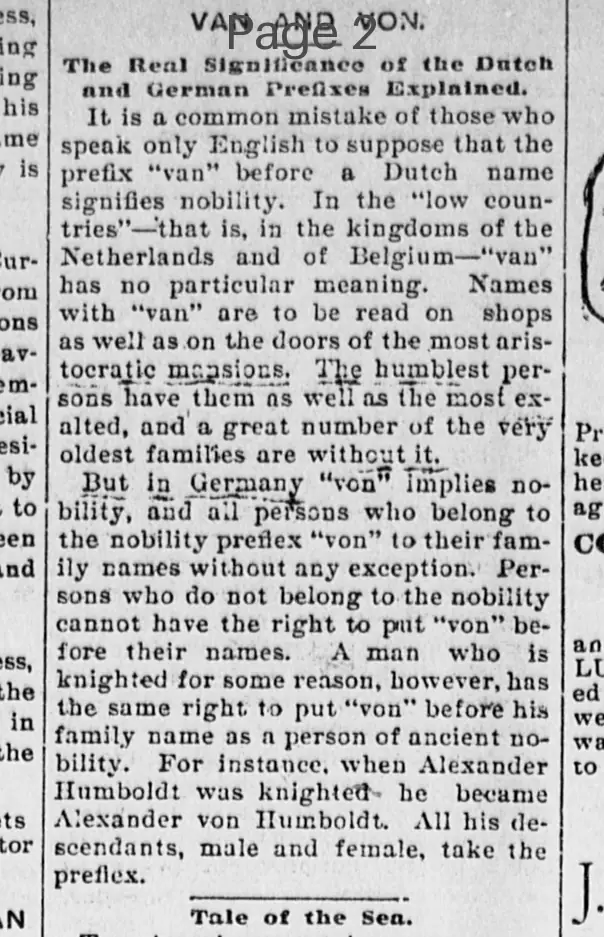
The Real Significance of the Dutch
and German Prefixes Explained.
It is a common mistake of those who
speak only English to suppose that the
prefix "van" before a Dutch name
signifies nobility. In the "low countries"—that is, in the kingdoms of the
Netherlands and of Belgium—"van"
has no particular meaning. Names
with "van" are to be read on shops
as well as on the doors of the most aristocratic mansions. The humblest persons have them as well as the most exalted, and a great number of the very oldest families are without it.
But in Germany "von" implies nobility, and all persons who belong to the nobility prefix "von" to their family names without any exception. Persons who do not belong to the nobility cannot have the right to put "von" before their names. A man who is knighted for some reason, however, has the same right to put "von" before his family name as a person of ancient nobility. For instance, when Alexander Humboldt was knighted—he became Alexander von Humboldt. All his descendants, male and female, take the prefix.
and German Prefixes Explained.
It is a common mistake of those who
speak only English to suppose that the
prefix "van" before a Dutch name
signifies nobility. In the "low countries"—that is, in the kingdoms of the
Netherlands and of Belgium—"van"
has no particular meaning. Names
with "van" are to be read on shops
as well as on the doors of the most aristocratic mansions. The humblest persons have them as well as the most exalted, and a great number of the very oldest families are without it.
But in Germany "von" implies nobility, and all persons who belong to the nobility prefix "von" to their family names without any exception. Persons who do not belong to the nobility cannot have the right to put "von" before their names. A man who is knighted for some reason, however, has the same right to put "von" before his family name as a person of ancient nobility. For instance, when Alexander Humboldt was knighted—he became Alexander von Humboldt. All his descendants, male and female, take the prefix.
What sub-type of article is it?
Curiosity
What themes does it cover?
Social Manners
What keywords are associated?
Dutch Prefixes
German Nobility
Van Meaning
Von Significance
Naming Conventions
Alexander Humboldt
What entities or persons were involved?
Alexander Humboldt
Alexander Von Humboldt
Where did it happen?
Netherlands, Belgium, Germany
Story Details
Key Persons
Alexander Humboldt
Alexander Von Humboldt
Location
Netherlands, Belgium, Germany
Story Details
Common English misconception that 'van' indicates Dutch nobility is incorrect; it is neutral in the Low Countries. In contrast, German 'von' exclusively signifies nobility, granted to knighted individuals like Alexander Humboldt, who became Alexander von Humboldt, with descendants retaining it.