Thank you for visiting SNEWPapers!
Sign up free
The Star
Reynoldsville, Jefferson County, Pennsylvania
What is this article about?
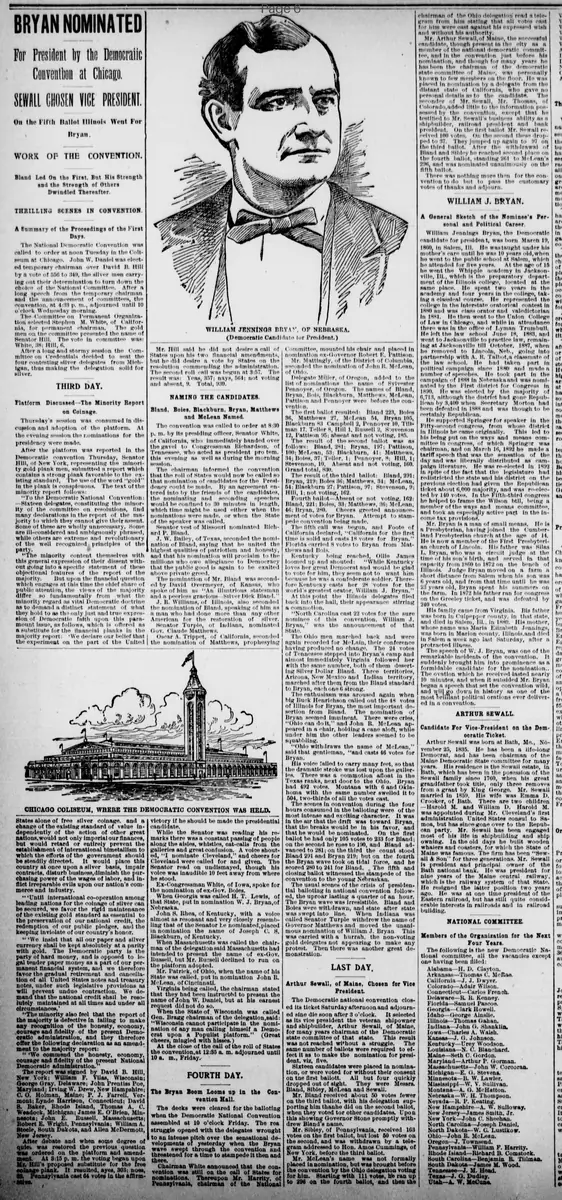
The 1896 Democratic National Convention in Chicago nominated William J. Bryan for president on the fifth ballot amid a free silver platform debate and intense balloting, with Arthur Sewall chosen as vice president after five ballots.
Merged-components note: Merged image with the main Democratic convention story, as the image is contextually related and adjacent in reading order.
Clipping
OCR Quality
Full Text
Convention at Chicago
SEWALL CHOSEN VICE PRESIDENT.
On the Fifth Ballot Illinois Went For Bryan.
WORK OF THE CONVENTION.
Bland Led On the First, But His Strength and the Strength of Others Dwindled Thereafter.
THRILLING SCENES IN CONVENTION.
A Summary of the Proceedings of the First Days.
The National Democratic Convention was called to order at noon Tuesday in the Coliseum at Chicago. John W. Daniel was elected temporary chairman over David B. Hill by a vote of 556 to 349, the silver men carrying out their determination to turn down the choice of the National Committee. After a long speech from the temporary chairman and the announcement of committees, the convention at 4:33 p. m. adjourned until 10 o'clock Wednesday morning.
The Committee on Permanent Organization selected Stephen M. White of California for permanent chairman. The gold men on the committee presented the name of Senator Hill. The vote in committee was: White, 38; Hill, 6.
After a long and stormy session the Committee on Credentials decided to seat the four contesting silver delegates from Michigan, thus making the delegation solid for silver.
THIRD DAY.
Platform Discussed—The Minority Report on Coinage.
Thursday's session was consumed in discussion and adoption of the platform. At the evening session the nominations for the presidency were made.
After the platform was reported in the Democratic convention Thursday, Senator Hill of New York, representing the minority gold plank men, submitted a report which contains a strong plank favorable to the existing standard. "The use of the word 'gold' in the plank is conspicuous." The text of the minority report follows:
Mr. Hill said he did not desire a call of States upon his two financial amendments, but he did desire a vote by States on the resolution commending the administration. The second roll call was begun at 3:57. The result was: Yeas, 357; nays, 564; not voting and absent, 9. Total, 930.
NAMING THE CANDIDATES.
Bland, Boies, Blackburn, Bryan, Matthews and McLean Named.
The convention was called to order at 8:30 p. m. by its presiding officer, Senator White of California, who immediately handed over the gavel to Congressman Richardson of Tennessee, who acted as president pro tem. this evening as well as during the morning session.
"To the Democratic National Convention:
-Sixteen delegates, constituting the minority of the committee on resolutions, find many declarations in the report of the majority to which they cannot give their assent. Some of these are wholly unnecessary. Some are ill-considered and ambiguously phrased, while others are extreme and revolutionary of the well recognized principles of the party.
"The minority content themselves with this general expression of their dissent without going into a specific statement of these objectionable features of the report of the majority. But upon the financial question which engages at this time the chief share of public attention, the views of the majority differ so fundamentally from what the minority regard as vital Democratic doctrine as to demand a distinct statement of what they hold to as the only just and true expression of Democratic faith upon this paramount issue, as follows, which is offered as a substitute for the financial planks in the majority report: We declare our belief that the experiment on the part of the United States alone of free silver coinage, and a change of the existing standard of value independently of the action of other great nations, would not only impair our finances, but would retard or entirely prevent the establishment of international bimetallism to which the efforts of the government should be steadily directed. It would place this country at once upon a silver basis, impair contracts, disturb business, diminish the purchasing power of the wages of labor, and inflict irreparable evils upon our nation's commerce and industry.
"Until international co-operation among leading nations for the coinage of silver can be secured, we favor the rigid maintenance of the existing gold standard as essential to the preservation of our national credit, the redemption of our public pledges, and the keeping inviolate of our country's honor.
"We insist that all our paper and silver currency shall be kept absolutely at a parity with gold. The Democratic party is the party of hard money, and is opposed to legal tender paper money as a part of our permanent financial system, and we therefore favor the gradual retirement and cancellation of all United States notes and treasury notes, under such legislative provisions as will prevent undue contraction. We demand that the national credit shall be resolutely maintained at all times and under all circumstances.
"The minority also feel that the report of the majority is defective in failing to make any recognition of the honesty, economy, courage and fidelity of the present Democratic administration, and they therefore offer the following declaration as an amendment to the majority report:
"We commend the honesty, economy, courage and fidelity of the present National Democratic administration."
The report was signed by David B. Hill, New York; William F. Vilas, Wisconsin; George Gray, Delaware; John Prentiss Poe, Maryland; Irving W. Drew, New Hampshire; C. O. Holman, Maine; P. J. Farrell, Vermont; Lynde Harrison, Connecticut; David B. Baker, Rhode Island; Thomas A. C. Weadock, Michigan; James E. O'Brien, Minnesota; John E. Russell, Massachusetts; Robert E. Wright, Pennsylvania; William A. Steele, South Dakota, and Allen McDermott, New Jersey.
After debate and when some degree of quiet was restored the previous question was ordered on the platform and amendment. At 3:15 p. m. the voting began upon Mr. Hill's proposed substitute for the free coinage plank. It resulted, ayes, 206; noes, 702. Pennsylvania cast 64 votes in the affirmative.
The chairman informed the convention that the roll of States would now be called so that nomination of candidates for the Presidency could be made. By an agreement entered into by the friends of the candidates, the nominating and seconding speeches would be confined to 30 minutes in length which time might be used either when the nominations were made or when the State of the speaker was called.
Senator Vest of Missouri nominated Richard P. Bland.
J. W. Bailey of Texas seconded the nomination of Bland, saying that he united the highest qualities of patriotism and honesty, and that his nomination will proclaim to the millions who owe allegiance to Democracy that the public good is again to be exalted above private greed.
The nomination of Mr. Bland was seconded by David Overmyer of Kansas, who spoke of him as "An illustrious statesman and a peerless gracious—Silver Dick Bland."
J. R. Williams of Illinois also seconded the nomination of Bland, speaking of him as a man who had done more than any other American for the restoration of silver.
Senator Turpie of Indiana nominated Gov. Claude Matthews.
Oscar A. Trippet of California seconded the nomination of Matthews, prophesying victory if he should be made the presidential candidate.
While the Senator was reading his remarks there was a constant passing of people along the aisles, whistles, cat-calls from the galleries and great confusion. A voice shouted, "Nominate Cleveland," and cheers for Cleveland were called for and given. The Senator read on undismayed, though his voice was inaudible 10 feet away from where he stood.
Ex-Congressman White of Iowa spoke for the nomination of ex-Gov. Boies.
When Georgia was called I. T. Lewis of that State put in nomination W. J. Bryan of Nebraska.
John H. Wilson of Kentucky, with a voice almost as resonant and very closely resembling that of the Senator, placed in nomination the name of Joseph C. S. Blackburn of Kentucky.
When Massachusetts was called the chairman of the delegation said Massachusetts had intended to present the name of ex-Gov. Russell, but Mr. Russell declined to run on the platform adopted.
Mr. Patrick of Ohio, when the name of his State was called, put in nomination John R. McLean of Cincinnati.
Virginia being called, the chairman stated that they had been instructed to present the name of John W. Daniel, but at his earnest request did not do so.
When the State of Wisconsin was called Gen. Bragg, chairman of the delegation, said: "Wisconsin cannot participate in the nomination of any man calling himself a Democrat upon a Populist platform." (Great cheers, mingled with hisses.)
At the close of the call of the roll of States the convention at 12:35 a. m. adjourned until 10 a. m., Friday.
FOURTH DAY.
The Bryan Boom Looms up in the Convention Hall.
The decks were cleared for the balloting when the Democratic National Convention assembled at 10 o'clock Friday. The real struggle opened with the delegates wrought to an intense pitch over the sensational developments of yesterday when the Bryan wave swept through the convention and threatened for a time to stampede it then and there.
Chairman White announced that the convention was still on the call of States for nominations. Thereupon Mr. Harrity of Pennsylvania, chairman of the National Committee, mounted his chair and placed in nomination ex-Governor Robert E. Pattison.
Mr. Mattingly of the District of Columbia seconded the nomination of John R. McLean of Ohio.
Delegate Miller of Oregon added to the list of nominations the name of Sylvester Pennoyer of Oregon. The names of Bland, Bryan, Boies, Blackburn, Matthews, McLean, Pattison and Pennoyer were before the convention.
The first ballot resulted: Bland 223, Boies 36, Matthews 27, McLean 54, Bryan 105, Blackburn 83, Campbell 2, Pennoyer 10, Tillman 17, Teller 8, Hill 1, Russell 2, Stevenson 12, Pattison 95; absent and not voting, 185.
The result of the second ballot was as follows: Bland, 281; Bryan, 197; Pattison, 100; McLean, 53; Blackburn, 41; Matthews, 34; Boies, 37; Teller, 1; Pennoyer, 8; Hill, 1; Stevenson, 10. Absent and not voting, 160. Grand total, 930.
The result of the third ballot: Bland, 291; Bryan, 219; Boies 86; Matthews, 34; McLean, 54; Blackburn 27; Pattison, 97; Stevenson, 9; Hill, 1; not voting, 162.
Fourth ballot—Absent or not voting, 162; Bland, 241; Boies, 33; Matthews, 36; McLean, 46; Bryan, 280. Cheers greeted announcement of votes for Bryan. Attempt to stampede convention being made.
The fifth call was begun, and Foote of California declared, "California for the first time is solid and casts 18 votes for Bryan."
Florida carried 8 votes to Bryan from Matthews and Boies.
Kentucky being reached, Ollie James loomed up and shouted: "While Kentucky loves her great Democrat and would be glad to vote for him, they seem not to want him because he was a confederate soldier. Therefore Kentucky casts her 28 votes for the world's greatest orator, William J. Bryan."
At this point the Illinois delegates filed back into the hall, their appearance stirring a commotion.
"North Carolina cast 22 votes for the sure nominee of this convention, William J. Bryan,"
was the announcement of that State.
The Ohio men marched back and were again recorded for McLean, their conference having produced no change. The 24 votes of Tennessee stepped into Bryan's camp and almost immediately Virginia followed her with the same number, both of them deserting Silver Dollar Bland. Three territories, Arizona, New Mexico and Indian territory marched after them from the Bland standard to Bryan, each one 6 strong.
The enthusiasm was aroused again when big Buck Henrickson called out the 48 votes of Illinois for Bryan, the most important desertion from Bland. The nomination of Bryan seemed imminent. There were cries, "Ohio can do it," and John R. McLean appeared in a chair, holding a cane aloft, while under him the other leaders seemed to be squabbling.
"Ohio withdraws the name of McLean," said that gentleman, "and casts 46 votes for Bryan."
His voice failed to carry many feet, so that the dramatic stroke was lost upon the galleries. There was a commotion afloat in the Texas ranks, next door to Ohio. Bryan had 492 votes. Montana with 6 and Oklahoma with the same number swelled it to 504, two-thirds of all the votes cast.
The scenes in convention during the four hours consumed in the balloting were of the most intense and exciting character. It was in the air that the drift was toward Bryan, that the breaks would be in his favor, and that he would be nominated. On the first ballot he had only 105 votes to 233 for Bland; on the second he rose to 190, and Bland advanced to 281; on the third the count stood Bland 291 and Bryan 219; but on the fourth the Bryan wave took on tidal force, and he scored 280 to 241 for Bland. The fifth and closing ballot witnessed the stampede of the convention to the young Nebraskan.
The usual scenes of the crisis of presidential balloting in national convention followed, the uproar lasting a quarter of an hour.
The Bryan wave was irresistible. Bland and Boies were withdrawn, and state after state was swept into line. When Indiana was called Senator Turpie withdrew the name of Governor Matthews and moved the unanimous nomination of William J. Bryan. This was carried with a hurrah, the non-voting gold delegates not appearing to make any protest. Then there was another great demonstration.
LAST DAY.
Arthur Sewall, of Maine, Chosen for Vice President.
The Democratic national convention closed its ticket Saturday afternoon and adjourned sine die soon after 3 o'clock. It selected as its vice president the veteran shipowner and shipbuilder, Arthur Sewall, of Maine, for many years chairman of the Democratic state committee of that state.
This result was not reached without a struggle. The same number of ballots were required to effect it as to make the nomination for president, viz, five.
Sixteen candidates were placed in nomination, or were voted for without their consent on the first ballot. All but four quickly dropped out of sight. They were Messrs. Bland, Sibley, McLean and Sewall.
Mr. Bland received about 50 votes fewer on the third ballot, with his delegation supporting him than he did on the second ballot, when they voted for other candidates. Upon this showing Governor Stone promptly withdrew Bland's name.
Mr. Sibley, of Pennsylvania, received 163 votes on the first ballot, but lost 50 votes on the second, and was withdrawn by a telegram addressed to Hon. Amos Cummings, of New York, before the third ballot.
Mr. McLean's name was not formally placed in nomination, but was brought before the convention by the Ohio delegation voting for him. Starting with 114 votes, he ran up to 296 on the fourth ballot, and then the chairman of the Ohio delegation read a telegram from him stating that all votes cast for him were cast against his expressed wish and without his authority.
Mr. Arthur Sewall of Maine, the successful candidate, though present in the city as a member of the national democratic committee, and in the convention just before his nomination, and though for many years he has been the chairman of the democratic state committee of Maine, was personally known to few members on the floor. He was placed in nomination by a delegate from the distant state of California, who gave no personal details as to the candidate. The seconder of Mr. Sewall, Mr. Thomas of Colorado, added little to the information possessed by the convention, except that he testified to Mr. Sewall's business ability as a shipbuilder, railroad president and bank president. On the first ballot Mr. Sewall received 100 votes. On the second these dropped to 37. They jumped up again to 97 on the third ballot. After the withdrawal of Bland and Sibley he reached second place on the fourth ballot, standing 261 to McLean's 296, and was nominated unanimously on the fifth ballot.
There was nothing more then for the convention to do but to pass the customary votes of thanks and adjourn.
What sub-type of article is it?
What themes does it cover?
What keywords are associated?
What entities or persons were involved?
Where did it happen?
Story Details
Key Persons
Location
Coliseum At Chicago
Event Date
Tuesday To Saturday In July 1896
Story Details
The Democratic National Convention nominated Bryan for president on the fifth ballot after a shift from Bland, adopting a free silver platform over gold standard opposition, and selected Sewall as vice president after five ballots.