Thank you for visiting SNEWPapers!
Sign up free
Literary
July 5, 1894
Southern Christian Advocate
Charleston, Charleston County, South Carolina
What is this article about?
Essay by W. I. Dawson arguing that poetry is essential for business men to maintain mental freshness, moral depth, and broader perspectives, using examples from Tennyson's funeral, the Bible, Gladstone, Darwin, and Dr. Monro Gibson's transformation.
Clipping
OCR Quality
98%
Excellent
Full Text
LITERARY.
The Case for Poetry for Business
BY W. I. DAWSON, D. D.
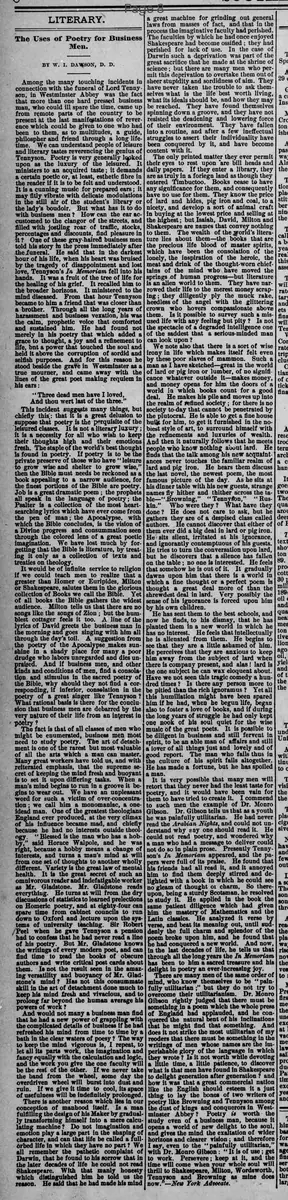
Among the many touching incidents in connection with the funeral of Lord Tennyson, in Westminster Abbey was the fact that more than one hard pressed business man, who could ill spare the time, came up from remote parts of the country to be present at the last manifestations of reverence which could be given to one who had been to them, as to multitudes, a guide, philosopher and friend through a long lifetime. We can understand people of leisure and literary tastes reverencing the genius of Tennyson. Poetry is very generally looked upon as the luxury of the leisured. It ministers to an acquired taste: it demands a certain poetic or, at least, esthetic fibre in the reader if it is to be felt and understood. It is a cunning music for prepared ears; it may fitly vibrate with delicate modulations in the still air of the student's library or the lady's boudoir. But what has it to do with business men? How can the ear accustomed to the clangor of the streets, and filled with jostling roar of traffic, stocks, percentages and discounts, find pleasure in it? One of these gray-haired business men told his story in the press immediately after the funeral. He said that in the darkest hour of his life, when his heart was bruised by the tragedy of disappointment and lost love, Tennyson's In Memoriam fell into his hands. It was a fruit of the tree of life for the healing of his grief. It recalled him to the broader horizons. It ministered to the mind diseased. From that hour Tennyson became to him a friend that was closer than a brother. Through all the long years of harassment and business vexation, his was the calm, prophetic voice that comforted and sustained him. He had found not merely in his poetry that which added a grace to thought, a joy and a refinement to life, but a power that touched the soul and held it above the corruption of sordid and selfish purposes. And for this reason he stood beside the grave in Westminster as a true mourner, and came away with the lines of the great poet making requiem in his ears:
"Three dead men have I loved,
And thou wert last of the three."
This incident suggests many things, but chiefly this: that it is a great delusion to suppose that poetry is the perquisite of the leisured classes. It is not a literary luxury; it is a necessity for all who wish to keep their thoughts high and their emotions fresh. The staple of the world's best thought is found in poetry. If poetry is to be the private preserve of those who have "leisure to grow wise and shelter to grow wise," then the Bible must needs be reckoned as a book appealing to a narrow audience, for the finest portions of the Bible are poetry. Job is a great dramatic poem; the prophets all speak in the language of poetry; the Psalter is a collection of the most heart-searching lyrics which have ever come from the pen of man; the Apocalypse, with which the Bible concludes, is the vision of a Divine progress and consummation seen through the colored lens of a great poetic imagination. We have lost much by forgetting that the Bible is literature, by treating it only as a collection of texts and treatises on theology.
It would be of infinite service to religion if we could teach men to realize that a greater than Homer or Euripides, Milton or Shakespeare, salutes them in the glorious collection of Books we call the Bible. Yet of all books the Bible gathers the widest audience. Milton tells us that there are no songs like the songs of Zion; but the humblest cottager feels it too. A line of the lyrics of David greets the business man in the morning and goes singing with him all through the day's toil. A suggestion from the poetry of the Apocalypse makes sunshine in a shady place for many a poor drudge who labors unregarded and dies unpraised. And if business men, and other kinds and conditions of men, find a consolation, and stimulus in the sacred poetry of the Bible, why should they not find a corresponding, if inferior, consolation in the poetry of a great singer like Tennyson? What rational basis is there for the conclusion that business men are debarred by the very nature of their life from an interest in poetry?
The fact is that of all classes of men who might be enumerated, business men most need to study poetry. The art of detachment is one of the rarest but most valuable of all the arts which a man can master. Many great workers have told us, and with reiterated emphasis, that the supreme secret of keeping the mind fresh and buoyant is to set it upon differing tasks. When a man's mind begins to run in a groove it begins to wear out. We have an unpleasant word for such a victim of over-concentration: we call him a monomaniac, a one-idea man. One of the greatest theologians England ever produced, at the very climax of his influence became mad, and chiefly because he had no interests outside theology.
"Blessed is the man who has a hobby." said Horace Walpole, and he was right, because a hobby means a change of interests, and turns a man's mind at will from one set of thoughts to another wholly different. Variety is the great law of mental health. It is the great secret of such an omnivorous reader and indefatigable worker as Mr. Gladstone. Mr. Gladstone reads everything. He turns at will from the dry discussions of statistics to learned prelections on Homeric poetry, and at eighty-four can spare time from cabinet councils to run down to Oxford and lecture upon the systems of university teaching. Sir Robert Peel when he gave Tennyson a pension had to confess that he had never read a line of his poetry. But Mr. Gladstone knows the writings of every modern poet, and can find time to read the books of obscure authors and write critical post cards about them. Is not the result seen in the amazing versatility and buoyancy of Mr. Gladstone's mind? Has not this consummate skill in the art of detachment done much to keep his mind fresh and vivacious, and to prolong far beyond the human average his powers of work?
And would not many a business man find that he had a new power of grappling with the complicated details of business if he had refreshed his mind from time to time by a bath in the clear waters of poesy? The way to keep the mind vigorous is, I repeat, to let all its parts work. the imagination and fancy equally with the calculation and logic, and the work you give the one faculty will be the rest of the other. If we never take the hand from the wheel, some day the overdriven wheel will burst into dust and ruin. If we give it time to cool, its space of usefulness will be indefinitely prolonged.
There is another reason which lies in our conception of manhood itself. Is a man fulfilling the design of his Maker by gradually transforming himself into a mere calculating machine? Do not imagination and emotion play a large part in the shaping of character, and can that life be called a full-orbed life in which they have no part? We all remember the pathetic complaint of Darwin, that he found to his sorrow that in the later decades of life he could not read Shakespeare. With that manly honesty which distinguished him be told us the reason. He said that he had made his mind a great machine for grinding out general laws from masses of fact, and that in the process the imaginative faculty had perished. The faculties by which he had once enjoyed Shakespeare had become ossified; they had perished for lack of use. In the case of Darwin such a deprivation was part of the great sacrifice that he made at the shrine of science; but there are many men who permit this deprivation to overtake them out of sheer stupidity and sordidness of aim. They have never taken the trouble to ask themselves what is the life best worth living, what its ideals should be, and how they may be reached, They have found themselves spinning down a groove, and they have not resisted the deadening and lowering force of their environment. They have fallen into a routine. and after a few ineffectual struggles to assert their individuality have been conquered by it, and have become content with it.
The only printed matter they ever permit their eyes to rest upon are bill heads and daily papers. If they enter a library, they are as truly in a foreign land as though they entered Timbuctoo. Books cease to have any significance for them, and consequently have no use for them. They know the price of lard and hides, pig iron and coal, to a nicety, and develop a sort of animal craft in buying at the lowest price and selling at the highest; but Isaiah, David, Milton and Shakespeare are names that convey nothing to them. The wealth of the world's literature lies about them-the books that are the precious life blood of master spirits, which have been the consolation of the lonely, the inspiration of the heroic. the meat and drink of the thought-worn chieftains of the mind who have moved the springs of human progress--but literature is an alien world to them. They have narrowed their life to the merest money scraping; they diligently ply the muck rake. heedless of the angel with the glittering crown who hovers compassionate above them. Is it possible to survey such a mis-used life with any feeling but pity? Is not the spectacle of a degraded intelligence one of the saddest that a serious-minded man can look upon?
We note also that there is a sort of wise irony in life which makes itself felt even by these poor slaves of mammon. Such a man as I have sketched-great in the world of lard or pig iron or lumber, of no significance whatever outside it-makes money. and money opens for him the doors of a world in which books count for a good deal. He makes his pile and moves up into the realm of refined society ; for there is no society to-day that cannot be penetrated by the plutocrat. He is able to get a fine house built for him, to get it furnished in the nobiest style of art, to surround himself with the refinements and luxuries of wealth. And then it naturally follows that he meets people who know nothing about lard. He finds that the talk among his new acquaintances never touches the familiar realm of lard and pig iron, He hears them discuss the last novel, the newest poem, the most famous picture of the day. As he sits at his dinner table with his new guests, strange names fly hither and thither across the table-"Browning," "Tennyson," "Ruskin." Who were they? What have they done? He does not care to ask, but he gathers they are of a despised class called authors. He cannot discover that either of them ever did a big deal in lard or pig iron. He sits silent, irritated at his ignorance. and ignorantly contemptuous of his guests. He tries to turn the conversation upon lard, but he discovers that a silence has fallen on the table; no one is interested. He feels that somehow he is out of it. It gradually dawns upon him that there is a world in which a fine thought or a perfect poem is thought a great deal more of than the shrewdest deal in lard. Very possibly the sense of his ignorance is forced upon him by his own children.
He has sent them to the best schools. and now he finds, to his dismay, that he has planted them in a new world in which he has no interest. He feels that intellectually he is alienated from them. He begins to see that they are a little ashamed of him. He perceives that they are anxious to keep him away from the subject of lard when there is company present, and alas! lard is the one subject he can wax eloquent about. Have we not seen this tragic comedy a hundred times? Is there any person more to be pitied than the rich ignoramus? Yet all this humiliation might have been spared him if he had, when he begun life, began also to foster a love of books, and if during the long years of struggle he had only kept one nook of his soul quiet for the wise music of the great poets. It is possible to be diligent in business and still fervent in spirit, to be an able man of affairs and still a lover of all things just and lovely and of good report. The man who fails thus in the culture of his spirit fails altogether. He has made a fortune, but he has spoiled a man.
It is very possible that many men will retort that they never had the least taste for poetry, and it would have been vain for them to have tried to create it. I commend to such men the example of Dr. Monro Gibson. Dr. Gibson tells us that as a youth he was painfully utilitarian. He had never read the Arabian Nights, and could not understand why any one should read it. He could not read poetry, and wondered why a man who had a message to deliver could not do so in plain prose. Presently Tennyson's In Memoriam appeared, and the papers were full of its praise. He found that his friends had all read it, and it annoyed him to find them deeply stirred and delighted with a book in which he could see no gleam of thought or charm, So thereupon, being a sturdy Scotsman, be resolved to study it. He applied in the book the same patient diligence which had given him the mastery of Mathematics and the Latin classics. He analyzed it verse by verse, and beat its meaning out, until suddenly the full charm and splendor of the poem broke upon him, and he found that he had conquered a new world. And now, in the last decades of life, he tells us that through all the long years the In Memoriam has been to him a sacred treasure and his delight in poetry an ever-increasing joy.
There are many men of the same order of mind, who know themselves to be "painfully utilitarian;" but they do not try to overcome their utilitarianism. Dr. Monro Gibson rightly judged that there must be something in a poem which the whole press of England had applauded, and he conquered the natural bent of his inclinations that he might find that something. And does it not strike the most utilitarian of my readers that there must be something in the writings of men whose names are the imperishable glory of the language in which they wrote? Is it not worth while devoting a little time, a little patience, to discover what it is that men have found in Shakespeare to delight generation after generation and how it was that a great commercial nation like the English should esteem it a just thing to lay the bones of two writers of poetry like Browning and Tennyson among the dust of kings and conquerors in Westminster Abbey? Poetry is worth the study even of a business man, because it opens a world of new delight to the soul, and gives the mind the exaltation of wider horizons and clearer vision: and therefore I say, even to the "painfully utilitarian," with Dr. Monro Gibson: "It is of use; get to work. Persevere: keep at it, and the time will come when your whole soul will thrill to Shakespeare, Milton, Wordsworth, Tennyson and Browning as mine does now."-New York Advocate.
The Case for Poetry for Business
BY W. I. DAWSON, D. D.
Among the many touching incidents in connection with the funeral of Lord Tennyson, in Westminster Abbey was the fact that more than one hard pressed business man, who could ill spare the time, came up from remote parts of the country to be present at the last manifestations of reverence which could be given to one who had been to them, as to multitudes, a guide, philosopher and friend through a long lifetime. We can understand people of leisure and literary tastes reverencing the genius of Tennyson. Poetry is very generally looked upon as the luxury of the leisured. It ministers to an acquired taste: it demands a certain poetic or, at least, esthetic fibre in the reader if it is to be felt and understood. It is a cunning music for prepared ears; it may fitly vibrate with delicate modulations in the still air of the student's library or the lady's boudoir. But what has it to do with business men? How can the ear accustomed to the clangor of the streets, and filled with jostling roar of traffic, stocks, percentages and discounts, find pleasure in it? One of these gray-haired business men told his story in the press immediately after the funeral. He said that in the darkest hour of his life, when his heart was bruised by the tragedy of disappointment and lost love, Tennyson's In Memoriam fell into his hands. It was a fruit of the tree of life for the healing of his grief. It recalled him to the broader horizons. It ministered to the mind diseased. From that hour Tennyson became to him a friend that was closer than a brother. Through all the long years of harassment and business vexation, his was the calm, prophetic voice that comforted and sustained him. He had found not merely in his poetry that which added a grace to thought, a joy and a refinement to life, but a power that touched the soul and held it above the corruption of sordid and selfish purposes. And for this reason he stood beside the grave in Westminster as a true mourner, and came away with the lines of the great poet making requiem in his ears:
"Three dead men have I loved,
And thou wert last of the three."
This incident suggests many things, but chiefly this: that it is a great delusion to suppose that poetry is the perquisite of the leisured classes. It is not a literary luxury; it is a necessity for all who wish to keep their thoughts high and their emotions fresh. The staple of the world's best thought is found in poetry. If poetry is to be the private preserve of those who have "leisure to grow wise and shelter to grow wise," then the Bible must needs be reckoned as a book appealing to a narrow audience, for the finest portions of the Bible are poetry. Job is a great dramatic poem; the prophets all speak in the language of poetry; the Psalter is a collection of the most heart-searching lyrics which have ever come from the pen of man; the Apocalypse, with which the Bible concludes, is the vision of a Divine progress and consummation seen through the colored lens of a great poetic imagination. We have lost much by forgetting that the Bible is literature, by treating it only as a collection of texts and treatises on theology.
It would be of infinite service to religion if we could teach men to realize that a greater than Homer or Euripides, Milton or Shakespeare, salutes them in the glorious collection of Books we call the Bible. Yet of all books the Bible gathers the widest audience. Milton tells us that there are no songs like the songs of Zion; but the humblest cottager feels it too. A line of the lyrics of David greets the business man in the morning and goes singing with him all through the day's toil. A suggestion from the poetry of the Apocalypse makes sunshine in a shady place for many a poor drudge who labors unregarded and dies unpraised. And if business men, and other kinds and conditions of men, find a consolation, and stimulus in the sacred poetry of the Bible, why should they not find a corresponding, if inferior, consolation in the poetry of a great singer like Tennyson? What rational basis is there for the conclusion that business men are debarred by the very nature of their life from an interest in poetry?
The fact is that of all classes of men who might be enumerated, business men most need to study poetry. The art of detachment is one of the rarest but most valuable of all the arts which a man can master. Many great workers have told us, and with reiterated emphasis, that the supreme secret of keeping the mind fresh and buoyant is to set it upon differing tasks. When a man's mind begins to run in a groove it begins to wear out. We have an unpleasant word for such a victim of over-concentration: we call him a monomaniac, a one-idea man. One of the greatest theologians England ever produced, at the very climax of his influence became mad, and chiefly because he had no interests outside theology.
"Blessed is the man who has a hobby." said Horace Walpole, and he was right, because a hobby means a change of interests, and turns a man's mind at will from one set of thoughts to another wholly different. Variety is the great law of mental health. It is the great secret of such an omnivorous reader and indefatigable worker as Mr. Gladstone. Mr. Gladstone reads everything. He turns at will from the dry discussions of statistics to learned prelections on Homeric poetry, and at eighty-four can spare time from cabinet councils to run down to Oxford and lecture upon the systems of university teaching. Sir Robert Peel when he gave Tennyson a pension had to confess that he had never read a line of his poetry. But Mr. Gladstone knows the writings of every modern poet, and can find time to read the books of obscure authors and write critical post cards about them. Is not the result seen in the amazing versatility and buoyancy of Mr. Gladstone's mind? Has not this consummate skill in the art of detachment done much to keep his mind fresh and vivacious, and to prolong far beyond the human average his powers of work?
And would not many a business man find that he had a new power of grappling with the complicated details of business if he had refreshed his mind from time to time by a bath in the clear waters of poesy? The way to keep the mind vigorous is, I repeat, to let all its parts work. the imagination and fancy equally with the calculation and logic, and the work you give the one faculty will be the rest of the other. If we never take the hand from the wheel, some day the overdriven wheel will burst into dust and ruin. If we give it time to cool, its space of usefulness will be indefinitely prolonged.
There is another reason which lies in our conception of manhood itself. Is a man fulfilling the design of his Maker by gradually transforming himself into a mere calculating machine? Do not imagination and emotion play a large part in the shaping of character, and can that life be called a full-orbed life in which they have no part? We all remember the pathetic complaint of Darwin, that he found to his sorrow that in the later decades of life he could not read Shakespeare. With that manly honesty which distinguished him be told us the reason. He said that he had made his mind a great machine for grinding out general laws from masses of fact, and that in the process the imaginative faculty had perished. The faculties by which he had once enjoyed Shakespeare had become ossified; they had perished for lack of use. In the case of Darwin such a deprivation was part of the great sacrifice that he made at the shrine of science; but there are many men who permit this deprivation to overtake them out of sheer stupidity and sordidness of aim. They have never taken the trouble to ask themselves what is the life best worth living, what its ideals should be, and how they may be reached, They have found themselves spinning down a groove, and they have not resisted the deadening and lowering force of their environment. They have fallen into a routine. and after a few ineffectual struggles to assert their individuality have been conquered by it, and have become content with it.
The only printed matter they ever permit their eyes to rest upon are bill heads and daily papers. If they enter a library, they are as truly in a foreign land as though they entered Timbuctoo. Books cease to have any significance for them, and consequently have no use for them. They know the price of lard and hides, pig iron and coal, to a nicety, and develop a sort of animal craft in buying at the lowest price and selling at the highest; but Isaiah, David, Milton and Shakespeare are names that convey nothing to them. The wealth of the world's literature lies about them-the books that are the precious life blood of master spirits, which have been the consolation of the lonely, the inspiration of the heroic. the meat and drink of the thought-worn chieftains of the mind who have moved the springs of human progress--but literature is an alien world to them. They have narrowed their life to the merest money scraping; they diligently ply the muck rake. heedless of the angel with the glittering crown who hovers compassionate above them. Is it possible to survey such a mis-used life with any feeling but pity? Is not the spectacle of a degraded intelligence one of the saddest that a serious-minded man can look upon?
We note also that there is a sort of wise irony in life which makes itself felt even by these poor slaves of mammon. Such a man as I have sketched-great in the world of lard or pig iron or lumber, of no significance whatever outside it-makes money. and money opens for him the doors of a world in which books count for a good deal. He makes his pile and moves up into the realm of refined society ; for there is no society to-day that cannot be penetrated by the plutocrat. He is able to get a fine house built for him, to get it furnished in the nobiest style of art, to surround himself with the refinements and luxuries of wealth. And then it naturally follows that he meets people who know nothing about lard. He finds that the talk among his new acquaintances never touches the familiar realm of lard and pig iron, He hears them discuss the last novel, the newest poem, the most famous picture of the day. As he sits at his dinner table with his new guests, strange names fly hither and thither across the table-"Browning," "Tennyson," "Ruskin." Who were they? What have they done? He does not care to ask, but he gathers they are of a despised class called authors. He cannot discover that either of them ever did a big deal in lard or pig iron. He sits silent, irritated at his ignorance. and ignorantly contemptuous of his guests. He tries to turn the conversation upon lard, but he discovers that a silence has fallen on the table; no one is interested. He feels that somehow he is out of it. It gradually dawns upon him that there is a world in which a fine thought or a perfect poem is thought a great deal more of than the shrewdest deal in lard. Very possibly the sense of his ignorance is forced upon him by his own children.
He has sent them to the best schools. and now he finds, to his dismay, that he has planted them in a new world in which he has no interest. He feels that intellectually he is alienated from them. He begins to see that they are a little ashamed of him. He perceives that they are anxious to keep him away from the subject of lard when there is company present, and alas! lard is the one subject he can wax eloquent about. Have we not seen this tragic comedy a hundred times? Is there any person more to be pitied than the rich ignoramus? Yet all this humiliation might have been spared him if he had, when he begun life, began also to foster a love of books, and if during the long years of struggle he had only kept one nook of his soul quiet for the wise music of the great poets. It is possible to be diligent in business and still fervent in spirit, to be an able man of affairs and still a lover of all things just and lovely and of good report. The man who fails thus in the culture of his spirit fails altogether. He has made a fortune, but he has spoiled a man.
It is very possible that many men will retort that they never had the least taste for poetry, and it would have been vain for them to have tried to create it. I commend to such men the example of Dr. Monro Gibson. Dr. Gibson tells us that as a youth he was painfully utilitarian. He had never read the Arabian Nights, and could not understand why any one should read it. He could not read poetry, and wondered why a man who had a message to deliver could not do so in plain prose. Presently Tennyson's In Memoriam appeared, and the papers were full of its praise. He found that his friends had all read it, and it annoyed him to find them deeply stirred and delighted with a book in which he could see no gleam of thought or charm, So thereupon, being a sturdy Scotsman, be resolved to study it. He applied in the book the same patient diligence which had given him the mastery of Mathematics and the Latin classics. He analyzed it verse by verse, and beat its meaning out, until suddenly the full charm and splendor of the poem broke upon him, and he found that he had conquered a new world. And now, in the last decades of life, he tells us that through all the long years the In Memoriam has been to him a sacred treasure and his delight in poetry an ever-increasing joy.
There are many men of the same order of mind, who know themselves to be "painfully utilitarian;" but they do not try to overcome their utilitarianism. Dr. Monro Gibson rightly judged that there must be something in a poem which the whole press of England had applauded, and he conquered the natural bent of his inclinations that he might find that something. And does it not strike the most utilitarian of my readers that there must be something in the writings of men whose names are the imperishable glory of the language in which they wrote? Is it not worth while devoting a little time, a little patience, to discover what it is that men have found in Shakespeare to delight generation after generation and how it was that a great commercial nation like the English should esteem it a just thing to lay the bones of two writers of poetry like Browning and Tennyson among the dust of kings and conquerors in Westminster Abbey? Poetry is worth the study even of a business man, because it opens a world of new delight to the soul, and gives the mind the exaltation of wider horizons and clearer vision: and therefore I say, even to the "painfully utilitarian," with Dr. Monro Gibson: "It is of use; get to work. Persevere: keep at it, and the time will come when your whole soul will thrill to Shakespeare, Milton, Wordsworth, Tennyson and Browning as mine does now."-New York Advocate.
What sub-type of article is it?
Essay
What themes does it cover?
Moral Virtue
Commerce Trade
Social Manners
What keywords are associated?
Poetry For Business
Tennyson
In Memoriam
Bible Poetry
Mental Detachment
Moral Development
Utilitarianism
Literary Appreciation
What entities or persons were involved?
By W. I. Dawson, D. D.
Literary Details
Title
The Case For Poetry For Business
Author
By W. I. Dawson, D. D.
Subject
Advocating Poetry For Business Men
Key Lines
"Three Dead Men Have I Loved,
And Thou Wert Last Of The Three."
"Blessed Is The Man Who Has A Hobby."
"It Is Of Use; Get To Work. Persevere: Keep At It, And The Time Will Come When Your Whole Soul Will Thrill To Shakespeare, Milton, Wordsworth, Tennyson And Browning As Mine Does Now."