Thank you for visiting SNEWPapers!
Sign up free
Editorial
November 11, 1842
New Hampshire Statesman And State Journal
Concord, Merrimack County, New Hampshire
What is this article about?
An editorial in the N.O. Bee encourages Whig party members to remain optimistic after a narrow defeat in Ohio's election to Locofocos, dismissing defeatist 'croakers.' It recalls Whig comebacks from 1839 losses to 1840 victories across multiple states and urges vigorous efforts to support Henry Clay for president, confident in reclaiming states like Ohio and Louisiana.
Clipping
OCR Quality
95%
Excellent
Full Text
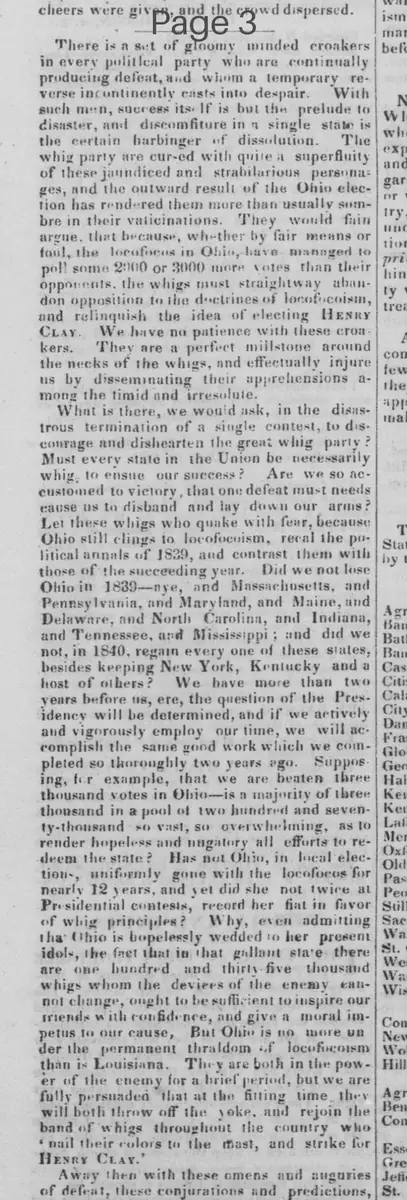
There is a sort of gloomy minded croakers in every political party who are continually producing defeat, and whom a temporary reverse incontinently casts into despair. With such men, success is but the prelude to disaster, and discomfiture in a single state is the certain harbinger of dissolution. The Whig party are cursed with quite a superfluity of these jaundiced and strabiliarions personages, and the outward result of the Ohio election has rendered them more than usually sombre in their vaticinations. They would fain argue, that because, whether by fair means or foul, the locofocos in Ohio, have managed to poll some 2000 or 3000 more votes than their opponents, the Whigs must straightway abandon opposition to the doctrines of locofocoism, and relinquish the idea of electing Henry Clay. We have no patience with these croakers. They are a perfect millstone around the necks of the Whigs, and effectually injure us by disseminating their apprehensions among the timid and irresolute. What is there, we would ask, in the disastrous termination of a single contest, to discourage and dishearten the great Whig party? Must every state in the Union be necessarily Whig, to ensure our success? Are we so accustomed to victory, that one defeat must needs cause us to disband and lay down our arms? Let these Whigs who quake with fear, because Ohio still clings to locofocoism, recall the political annals of 1839, and contrast them with those of the succeeding year. Did we not lose Ohio in 1839—aye, and Massachusetts, and Pennsylvania, and Maryland, and Maine, and Delaware, and North Carolina, and Indiana, and Tennessee, and Mississippi; and did we not, in 1840, regain every one of these states, besides keeping New York, Kentucky and a host of others? We have more than two years before us, ere the question of the Presidency will be determined, and if we actively and vigorously employ our time, we will accomplish the same good work which we completed so thoroughly two years ago. Supposing, for example, that we are beaten three thousand votes in Ohio—is a majority of three thousand in a poll of two hundred and seventy-thousand so vast, so overwhelming, as to render hopeless and nugatory all efforts to redeem the state? Has not Ohio, in local elections, uniformly gone with the locofocos for nearly 12 years, and yet did she not twice at Presidential contests, record her fiat in favor of Whig principles? Why, even admitting that Ohio is hopelessly wedded to her present idols, the fact that in that gallant state there are one hundred and thirty five thousand Whigs whom the devices of the enemy cannot change, ought to be sufficient to inspire our friends with confidence, and give a moral impetus to our cause. But Ohio is no more under the permanent thraldom of locofocoism than is Louisiana. They are both in the power of the enemy for a brief period, but we are fully persuaded that at the fitting time they will both throw off the yoke, and rejoin the band of Whigs throughout the country who nail their colors to the mast, and strike for Henry Clay. Away then with these omens and auguries of defeat, these conjurations and predictions, so fraught with woe and wailing! They are unworthy the character, the objects and the prospects of our party. They have no terrors for us at all events, and we beseech our Whig friends to laugh them to scorn. We solemnly declare that if every state in the Union were to pronounce unequivocally in favor of locofocoism, though it might diminish our hopes of success, it would not disarm us of our energy in combatting what we conscientiously believe to be error. We support Whig principles, because we hold that their ascendancy is indispensable to the prosperity, honor and dignity of the country, and we take it for granted, that every Whig is guided by similar views. What then, though false and pernicious doctrines prevail for a season, are we the less to combat them? Are we to cease to be Whigs, because we may peradventure fail to convince a majority of the voters of the Union that we are right? Such at least are not our sentiments. Nor has any thing yet transpired to cause us to forsake the high hopes we cherish of ultimate triumph. We are not of the saturnine and sluggish temperament to be weighed down by a few temporary reverses, and we have thus far, seen not a solitary tittle of evidence to prove that the one hundred and thirty three thousand majority of freemen who recorded their suffrages for Harrison and Tyler, have deserted the banner that led them to victory in 1840.—N. O. Bee.
What sub-type of article is it?
Partisan Politics
What keywords are associated?
Whig Party
Ohio Election
Locofocoism
Henry Clay
Political Defeat
Party Morale
1840 Election
What entities or persons were involved?
Whig Party
Locofocos
Henry Clay
Ohio
Louisiana
Harrison And Tyler
Editorial Details
Primary Topic
Whig Encouragement After Ohio Election Loss
Stance / Tone
Optimistic And Defiant Against Defeatism
Key Figures
Whig Party
Locofocos
Henry Clay
Ohio
Louisiana
Harrison And Tyler
Key Arguments
- gloomy 'croakers' in whig party harm morale after ohio loss
- ohio defeat by 2000-3000 votes is narrow and reversible
- recall 1839 whig losses in multiple states followed by 1840 sweep
- ohio has supported whigs in presidential elections despite local locofoco dominance
- 135,000 steadfast whigs in ohio provide hope
- over two years remain to rally for henry clay
- whig principles must be defended regardless of temporary defeats
- no evidence 1840 harrison-tyler voters have deserted