Thank you for visiting SNEWPapers!
Sign up free
Domestic News
September 6, 1834
The Liberator
Boston, Suffolk County, Massachusetts
What is this article about?
Moralistic essay decrying the neglect and infidelity of husbands, which causes profound suffering to devoted wives, while also advising wives to nurture their marriages through cheerful attention and home comforts.
Clipping
OCR Quality
98%
Excellent
Full Text
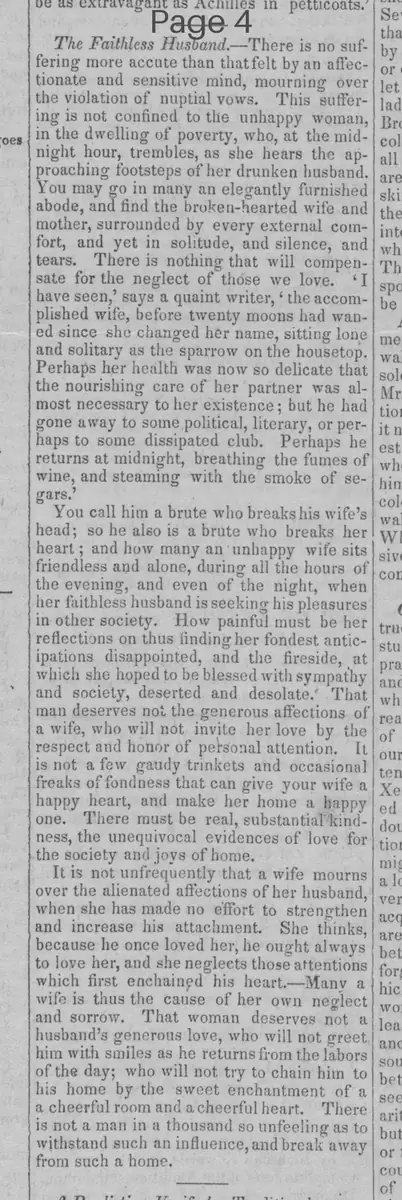
The Faithless Husband.—There is no suffering more acute than that felt by an affectionate and sensitive mind, mourning over the violation of nuptial vows. This suffering is not confined to the unhappy woman in the dwelling of poverty, who, at the midnight hour, trembles, as she hears the approaching footsteps of her drunken husband. You may go in many an elegantly furnished abode, and find the broken-hearted wife and mother, surrounded by every external comfort, and yet in solitude, and silence, and tears. There is nothing that will compensate for the neglect of those we love. I have seen,' says a quaint writer, 'the accomplished wife, before twenty moons had waned since she changed her name, sitting lone and solitary as the sparrow on the housetop. Perhaps her health was now so delicate that the nourishing care of her partner was almost necessary to her existence; but he had gone away to some political, literary, or perhaps to some dissipated club. Perhaps he returns at midnight, breathing the fumes of wine, and steaming with the smoke of segars. You call him a brute who breaks his wife's head; so he also is a brute who breaks her heart; and how many an unhappy wife sits friendless and alone, during all the hours of the evening, and even of the night, when her faithless husband is seeking his pleasures in other society. How painful must be her reflections on thus finding her fondest anticipations disappointed, and the fireside, at which she hoped to be blessed with sympathy and society, deserted and desolate.' That man deserves not the generous affections of a wife, who will not invite her love by the respect and honor of personal attention. It is not a few gaudy trinkets and occasional freaks of fondness that can give your wife a happy heart, and make her home a happy one. There must be real, substantial kindness, the unequivocal evidences of love for the society and joys of home. It is not unfrequently that a wife mourns over the alienated affections of her husband, when she has made no effort to strengthen and increase his attachment. She thinks, because he once loved her, he ought always to love her, and she neglects those attentions which first enchained his heart. Many a wife is thus the cause of her own neglect and sorrow. That woman deserves not a husband's generous love, who will not greet him with smiles as he returns from the labors of the day; who will not try to chain him to his home by the sweet enchantment of a cheerful room and a cheerful heart. There is not a man in a thousand so unfeeling as to withstand such an influence, and break away from such a home.
What sub-type of article is it?
Marital Advice
Domestic Relations
What keywords are associated?
Faithless Husband
Wife Suffering
Marital Neglect
Home Affection
Domestic Advice
Domestic News Details
Event Details
Essay on the acute suffering of wives due to husbands' neglect, infidelity, and absence, equating emotional heartbreak to physical brutality, and emphasizing mutual responsibilities in marriage for personal attention, kindness, and creating a cheerful home to sustain affection.