Thank you for visiting SNEWPapers!
Sign up free
Daily National Intelligencer
Washington, District Of Columbia
What is this article about?
In a House of Representatives speech, Mr. M'Lane of Delaware opposes restricting slavery in the proposed states of Missouri and Arkansas, arguing it violates the Constitution, the Louisiana Purchase treaty, and threatens the Union, while advocating for a future compromise line west of the Mississippi.
Merged-components note: This is a continuation of Mr. M'Lane's remarks on slavery restrictions, spanning pages 2 and 3; sequential reading order and text flow confirm merger into a single story.
Clippings
1 of 2
OCR Quality
Full Text
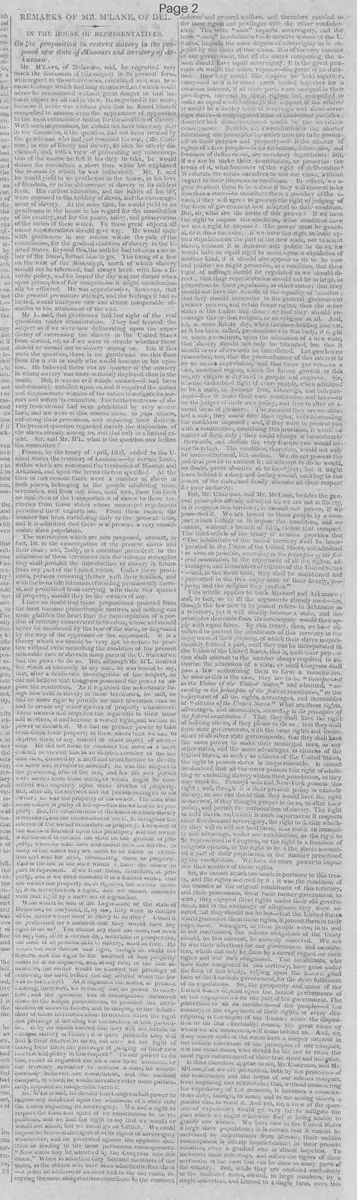
IN THE HOUSE OF REPRESENTATIVES.
On the proposition to restrict slavery in the proposed new state of Missouri and territory of Arkansas.
Mr. M'Lane, of Delaware, said, he regretted very much the discussion of this subject in its present form, with regard to these territories, calculated as it was to arouse feelings which had long slumbered, and which could never be resuscitated without great danger to that humane object we all had in view. He regretted it the more, because it never was without pain that he found himself compelled to assume even the appearance of opposition to the most enthusiastic notion for the abolition of slavery. With such impressions, he should not have taken any part in the discussion, if the question had not been treated by the gentleman who had just resumed his seat, (Mr. Cushman) as one of liberty and slavery, an idea he utterly disclaimed; and, with a view of preventing any misconception of the course he felt it his duty to take, he would detain the committee a short time while he explained the reasons by which he was influenced. Mr. M'L. said he would yield to no gentleman in the house, in his love of freedom, or in his abhorrence of slavery in its mildest form. His earliest education, and the habits of his life, were opposed to the holding of slaves, and the encouragement of slavery. At the same time, he would yield to no gentleman in the house in his regard for the constitution of his country, and for the peace, safety, and preservation of the union of these states. To these great objects all minor considerations should give way. He would unite with gentlemen in any course within the pale of the constitution, for the gradual abolition of slavery in the United States. Beyond this, the oath he had taken as a member of the house, forbade him to go. The fixing of a line on the west of the Mississippi, north of which slavery should not be tolerated, had always been with him a favorite policy, and he hoped the day was not distant when upon principles of fair compromise it might constitutionally be effected. He was apprehensive, however, that the present premature attempt, and the feelings it had elicited, would interpose new and almost insuperable obstacles to the attainment of the end.
Mr. M'L. said, that gentlemen had lost sight of the real questions under consideration. They had treated the subject as if we were now deliberating upon the expediency of increasing the slavery in the United States from abroad; or, as if we were to decide whether there should or should not be slavery among us. Sir, if this were the question, there is no gentleman on this floor from the north or south who would hesitate in his opinion. He believed there was no quarter of the country in which slavery was more seriously deplored than in the south. But, it was an evil which existed—it had been unfortunately entailed upon us. and it required the united and dispassionate wisdom of the nation to mitigate its horrors and soften its calamities. The further increase of slavery from abroad had been prohibited by very severe laws, and we were at this session about to pass others, enforcing their provisions, and repairing their defects. The present question regarded merely the disposition of the slaves already among us, and that only in a limited extent. Sir, said Mr. M'L. what is the question now before the committee?
France, by the treaty of April, 1803, ceded to the United States the territory of Louisiana—by certain limits, within which are contained the territories of Missouri and Arkansas, and upon the terms therein specified. At the time of this cession there were a number of slaves in both places, belonging to the people inhabiting those territories, and from that time, until now, there has been no inhibition of the transportation of slaves to these territories from those states whose municipal regulations permitted their exportation. From these causes, the number has been increasing daily to the present time, and it is admitted that there is at present a very considerable slave population.
The restrictions which are now proposed, amount, in fact, 1st. to the emancipation of the present slaves and their issue; and, 2ndly, to a condition precedent to the admission of these territories into the union, as states, that they shall prohibit the introduction of slavery in future from any part of the United States. Under these provisions, persons removing thither with their families, and with the bona fide intention of residing permanently therein, are prohibited from carrying with them this species of property, should they be the owners of any.
I have no doubt that these propositions proceed from the most humane philanthropic motives, and nothing can more gladden the heart than the contemplation of a portion of territory consecrated to freedom, whose soil should never be moistened by the tear of the slave, or degraded by the step of the oppressor or the oppressed. It is a theory which we should be very apt to reduce to practice without even consulting the condition of the present miserable race of slaves in many parts of the U. States if we had the power to do so. But, although Mr. M'L. desired the result as sincerely as any man, he was bound to say, that, after a deliberate investigation of the subject, he did not believe that Congress possessed the power to impose the restriction. As it regarded the unfortunate beings now held in slavery in those territories, he said, he had no more right to provide for their liberation than he had to invade any other species of property whatsoever. Their owners had acquired the legal title to their labor and services, it had become a vested right, and we had no power to disturb it. We had no greater power to take from them their property in these slaves than we had to deprive them of any chattel or other object of ownership. He did not mean to consider the slave as a mere chattel; he viewed him as an ill-fated member of the human race, doomed by a hard and cruel fortune to devote his labor and services to another; he was the subject of the protecting arm of the law, and his life and person were sacred from those outrages which might be committed with impunity upon other articles of property. But, after all, his services and his person belonged to his owner; he was the property of his owner. The man who steals a slave is guilty of felony.—this shows him to be property. But, the constitutions of the states in which slavery is tolerated, and the constitution of the U. S. recognize the interest of the owner in his slave as property. The union of the states is founded upon this principle; and the owner is authorized to reclaim his slave on the ground of property, when he shall have absconded from his service. In many of the states they are liable to be taken in execution and sold for debt, considering them as property. This is the law in the state which I have the honor in part to represent. If we treat them, therefore, as property, and if we even consider it in a limited sense, that the owner has property in, or right to, the service merely, it is, nevertheless, a right, and we cannot interfere with that right by a mere act of legislation.
What would be said of the Legislature of the state of Delaware, or Maryland, if, by law, they were to declare all the slaves within their territory to be free? Could it be pretended for a moment that they would have any right to do so? The utmost any state has done, has been to say, that, after a certain day, sometime in prospective, the issue of all persons held to slavery, shall be free. He would not now discuss this right, though he could not discern how the right to the usufruct of one's property could be at all impaired, and, at any rate, in the case alluded to, the owner would be allowed the privilege of removing his slave before the day arrived when the law was to take effect. As it regarded the slaves, at present existing, therefore, we certainly had no power to interfere; and the question was of consequence narrowed down to the simple propositions, to prohibit the introduction of slaves in future, and to deny to the inhabitants of those territories about to become states the right and privilege of deciding for themselves in this particular. It by no means follows that they will not decide to exclude slavery in future; it is quite probable they will find it in their interest to do so; but have we the right of taking from them the privilege of judging of their own interest and policy in this respect? To our power to do this, either as regarded the state now to be admitted, or the territory hereafter to become a state, he conscientiously believed the constitution, and the national compact, to which he would hereafter refer more particularly, opposed an insuperable barrier.
Mr. McLane said, he denied that Congress had power to impose any condition upon the admission of a state into the Union impairing its sovereignty. We had a right to require the form and spirit of its constitution to be republican, and we had the right to say that we would or would not admit, but we could go no farther. We could impose no terms in abridgment of its rights of sovereignty whatsoever, and he protested against the opposite doctrine as leading to the most pernicious consequences.
"New states may be admitted by the Congress into this union." When so admitted they become members of the union, as the others who have been admitted before them—it is but an addition of another link to the old chain; incurring the same obligations to contribute to the common defence and general welfare, and therefore entitled to the same rights and privileges with the other confederates. The term "state" imports sovereignty, and the term "state," in relation to the federative system of the U. States, imports the same degree of sovereignty as is enjoyed by the states of that union. It is of the very essence of our government, that all the states composing the union should have equal sovereignty. It is the great principle on which the union reposes—the germ of its duration. How long would this empire be held together, composed as it is of many parts united together for a common interest, if all those parts were unequal in their privileges, unequal in their rights; but compelled to make an equal contribution to the support of the others? It would be a motley tribe of sovereign and demi-sovereign states—a congregated mass of incoherent particles; disorder and dismemberment would be the inevitable consequence. Besides, sir, a constitution is the charter containing the principles by which men are to be governed in their persons and property—it is the charter of rights of a free people—in its formation, deliberation, and freedom of deliberation, are necessary ingredients: but, if we are to make their constitution, or prescribe the terms of it, what becomes of the right of deliberation? We dictate the terms ourselves to suit our views, without regard to their interests or condition. In effect, we agree to admit them to be a state if they will consent to be less than a state—to constitute them a member of the union, if they will agree to give up the right of judging of the form of government best adapted to their condition.
But, sir, what are the limits of this power? If we have the right to impose this condition, what condition have we not a right to impose? The power must be general, or it does not exist. If we have the right to insist upon a stipulation on the part of the new state, not to admit slaves, because it is humane and politic to do so, we would have an equal right to insist upon a stipulation of another kind, if it should also appear to us to be wise and politic: we might prescribe, as a condition, that their right of suffrage should be regulated as we should direct; that their representation should not be as large, in proportion to their population, as other states; that they should not have the benefit of the equality of taxation; that they should surrender to the general government greater powers, and retain fewer rights, than the other states of the Union had done; or that they should encourage this or that religion, or no religion at all. And, sir, as some future day, when the slave-holding interest, as it has been called, predominates in this body, it might be made a condition, upon the admission of a new state, that slavery should not only be tolerated, but that it should never afterwards be interdicted. Let gentlemen remember, too, that the predominance of this interest is by no means improbable, and that there yet remains a vast, unsettled region, which the future growth of this mighty empire is destined to people and improve. Sir, it is the undoubted right of every people, when admitted to be a state, to become free, sovereign, and independent—free to make their own constitution and laws—to be the judges of their own policy, and free to alter or amend them at pleasure. The moment they are constituted a state, they would have these rights, notwithstanding the condition imposed; and, if they were to present you with a constitution, containing this provision, it would be matter of form only; they could change it immediately afterwards, and abolish the very feature you would desire to retain. The condition, therefore, would not only be unconstitutional, but useless. We do not possess the political power to enforce it; an attempt to do so would, no doubt, prove abortive as to its object; but it might leave behind it a deep and lasting wound, rankling in the bosom of the state, and finally alienate all their respect for your authority.
But, Mr. Chairman, said Mr. McLane, besides the general principles already adverted to, we are not at liberty, as it respects this territory, to consult our power, if we possessed it. We are bound to these people by a compact which forbids us to impose the condition, and we cannot, without a breach of faith, violate that compact. The third article of the treaty of cession provides that "The inhabitants of the ceded territory shall be incorporated in the Union of the United States, and admitted as soon as possible, according to the principles of the federal constitution, to the enjoyment of all the rights, advantages, and immunities of citizens of the United States; and, in the mean time, they shall be maintained and protected in the free enjoyment of their liberty, property, and the religion they profess."
This article applies to both Missouri and Arkansaw; and, in fact, so do all the arguments already used—for, though the law now to be passed refers to Arkansaw as a territory, yet it will shortly become a state, and the principles derivable from its sovereignty would then apply with equal force. By this treaty, then, we have stipulated to protect the inhabitants of this territory in the enjoyment of their property, of which their slaves unquestionably formed a part, until they can be incorporated in the Union of the United States, that is, until their population shall amount to the number always required to authorize the admission of a state, or until Congress shall pass a law authorizing them to form a constitution. As soon as this is the case, they are to be "incorporated in the Union of the United States," and admitted, "according to the principles of the federal constitution," to the enjoyment of all the rights, advantages, and immunities of "citizens of the United States." What are these rights, advantages, and immunities, according to the principles of the federal constitution? That they shall have the right of holding slaves, if they please to do so; that they shall form state governments, with the same rights and immunities of all other state governments; that they shall have the same power to make their municipal laws, as any other states, and the same advantages as citizens of the United States, as such; as citizens of the United States, the right to possess slaves is unquestionable. It cannot be doubted that all the states possess this right of admitting or excluding slavery within their jurisdiction, as they may think fit. Pennsylvania and New-York possess this right; and, though it is their present policy to exclude slavery, no one can doubt that they would have the right to-morrow, if they thought proper to do so, to alter their policy, and permit the introduction of slavery. The right to hold slaves, and, which is more important as it respects their freedom and sovereignty, the right to decide whether they will or will not hold them, is as much an immunity and advantage, under our constitution, as the right to be represented in Congress, or the right to a freedom of religious opinion, or the right to have the slaves accounted a part of their population, in the manner prescribed by the constitution. We have no more power to impair one than another of these rights.
Sir, we cannot attach too much importance to this treaty, and the rights secured by it: it was the condition of the transfer of the original inhabitants of this territory, and their possessions, from their former government to ours; they enjoyed these rights under their old government, and in the exchange of allegiance they were assured that they should not be lost—that the United States would guarantee them these rights, & protect them in their enjoyment. Strangers, as these people were, to us and to our institutions, the solemn obligations of the treaty should, on this account, be sacredly observed. We are to win their affections for our government and constitution, which can only be done by a sacred regard for their rights and our own obligations. The inhabitants, who have since emigrated to this territory, have gone under the faith of this treaty, relying upon the known good faith of the American government, for the strict fulfilment of its stipulations. Sir, the prosperity and union of the United States depend upon the honest performance of all the engagements on the part of the government. The protection to all its members—of the people—of the country, in the enjoyment of their rights, of every description, is the object of the Union; when the disposition to do this effectually ceases, the great chain by which we are connected, will cease to bind us. And, sir, if any one or more of the states have a deeper interest in the faithful execution of the principles of our compact, it is the small states, who should be the last to relax the most rigid enforcement of their true spirit and intention.
It does therefore appear to me, Mr. Chairman, said Mr. M'Lane, that we are prevented, both by the principles of our constitution and the terms of our solemn compact, from imposing this restriction; that, without considering the expediency of the measure, it becomes a conscientious duty, though, to some, and to me among others, a painful one, to resist it. And yet, sir, a view of the question of expediency would go very far to mitigate the pain which we might otherwise feel at being unable to gratify our wishes. We have now in the United States a large slave population; it is certain that it cannot be increased by importations from abroad; their sudden emancipation is utterly impracticable; in their present situation, even a gradual one is almost hopeless. To meliorate their sufferings, and soften the rigors of their servitude, is the most that can be done in many parts of the country. But, while they are confined exclusively to the southern states, owned, in large numbers, by a single individual, and limited to a single farm, even this
change is scarcely to be expected. If, however, they
were permitted to be carried by the children of the
southern planter, when emigrating to the western country
in pursuit of the riches which that fruitful territory
holds out to an industrious enterprise—and I would not
deny them to be sold by traders, or become the objects
of profit—they would by this means become dispersed
over a wider field; their condition would necessarily be
improved, (for they always thrive and do better when
held in small numbers,) and the chances of emancipation
would certainly be multiplied in both countries; the
number would be less in the south and the west; they
would be less formidable to the white population, and,
in the course of time, gradually acquire ease and freedom. In the state from which I have the honor to come.
the work of emancipation is rapidly progressing, and, I
believe, principally owing to the sparseness of this description of population. Their condition is also better
than those further south, from the same cause. There
is, however, one view of this part of the subject so nearly
allied to the right of Congress to impose the contemplated restriction, that I cannot avoid adverting to it. It
is said by the gentlemen from the south, that this territory was purchased with the common fund of the nation,
to whose benefits all have an equal right ; and that, by
preventing the southern planter from carrying his slaves
with him when he goes to settle in this territory, you interdict the emigration from that quarter altogether. Although it is clear that any one state might frame its municipal regulations, so as to exclude the introduction of
slaves even by persons removing into it, yet it can scarcely
be doubted that the exercise of this right ought to be left
to the sound discretion of each state, and we know the
policy of different states varies in this particular. In Delaware, persons removing from or into the state are permitted to carry their slaves with them ; their introduction and exportation is prohibited only for the purposes
of sale. In Pennsylvania it is otherwise. Congress would
certainly have no power to interdict the emigration from
one state to another; and it is worthy of consideration
how far they can do the same, by indirect means. I cannot admit the construction of the honorable gentleman
from New-York, (Mr. Spencer,) of that clause of the constitution which provides that the emigration or importation of such persons as any of the states now existing
shall think proper to admit shall not be prohibited prior
to the year 1808. This clause was designed to embrace
all classes of people, freemen as well as slaves, coming
from abroad. It could not mean to authorize Congress to
prohibit the migration from one state to another, because
it would conflict with another provision, that citizens of
one state shall be entitled to all the privileges of free citizens in another, which secures the right of emigration;
and because, if it were designed to vest the power in
Congress, it would of necessity, to be available at all, be
an exclusive power; but we all see the states constantly
exercising it, and they have been in the habit of exercising it ever since the adoption of the constitution.
On the whole, Mr. Chairman, said Mr. McLane, it seems
to me that we have no right to impose this restriction, and
that, if we had, it would be useless, impracticable, and unavailing. At the same time, I do not mean to abandon the
policy to which I alluded in the commencement of my remarks. I think it but fair that both sections of the Union
should be accommodated on this subject, with regard to
which so much feeling has been manifested. The same
great motives of policy which reconciled and harmonized
the jarring and discordant elements of our system, originally, and which enabled the framers of our happy constitution to compromise the different interests which then
prevailed upon this and other subjects, if properly cherished by us, will enable us to achieve similar objects. If we
meet upon principles of reciprocity, we cannot fail to do
justice to all. It has already been avowed by gentlemen
on this floor, from the south and the west, that they will
agree upon a line which shall divide the slave holding
from the non-slave-holding states. It is this proposition
I am anxious to effect ; but I wish to effect it by some
compact, which shall be binding upon all parties, and all
subsequent legislatures, which cannot be changed, and
will not fluctuate with the diversity of feeling and of
sentiment, to which this empire, in its march, must be
destined. There is a vast and immense tract of country
west of the Mississippi, yet to be settled, and intimately
connected with the northern section of the Union, upon
which this compromise can be effected. Believing, as I
do, that the constitution and the compact before mentioned will not permit us to extend our policy over the
whole, I will be very willing to take as great a part as I
can obtain; and, in doing so, though I may lament that the
humane policy of those who are so anxious to effect this
end cannot be more widely diffused, I shall at least enjoy the consciousness of having conformed to the constitution of the country, and executed the national compacts
in good faith.
What sub-type of article is it?
What themes does it cover?
What keywords are associated?
What entities or persons were involved?
Where did it happen?
Story Details
Key Persons
Location
House Of Representatives
Story Details
Mr. M'Lane delivers a speech opposing slavery restrictions in Missouri and Arkansas territories, arguing Congress lacks constitutional power to emancipate existing slaves or condition state admission on future bans, citing the Louisiana Purchase treaty's protection of property rights and emphasizing equal state sovereignty to preserve the Union, while supporting a future compromise line west of the Mississippi.