Thank you for visiting SNEWPapers!
Sign up free
Kentucky Gazette And General Advertiser
Lexington, Fayette County, Kentucky
What is this article about?
In a continued address, H. Marshall defends his 1788 vote in the Virginia Convention to ratify the U.S. Federal Constitution against accusations by Thomas Bodley and 'Franklin' of betraying constituents and aiding Spanish interests. He asserts the vote was motivated by pure intent to secure national stability and prosperity, rejecting claims of binding instructions.
Merged-components note: These components are a direct textual continuation of H. Marshall's address across pages.
Clippings
1 of 2
OCR Quality
Full Text
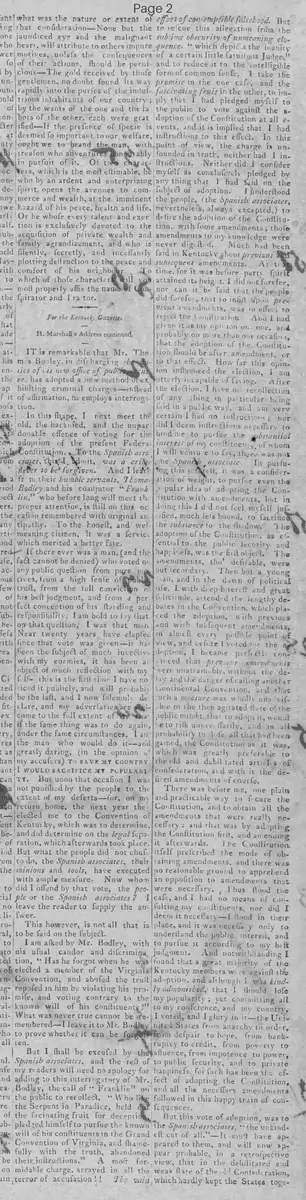
H. Marshall's Address continued.
IT is remarkable that Mr. Thomas Bodley in discharging the duties of his new office of public accuser, has adopted a new method of exhibiting criminal charges—instead of affirmation, he employs interrogation.
In this shape, I next meet this old, the hacknied, and the unpardonable offence of voting for the adoption of the present Federal Constitution.
To the Spanish associates, this I admit, was a crime never to be forgiven.
And I learn from their humble servants, Thomas Bodley and his coadjutor "Franklin," who before long will meet their proper attention, is still on this occasion remembered with original antipathy.
To the honest, and well meaning citizen, it was a service which merited a better fate.
If there ever was a man, (and the fact cannot be denied) who voted on any public question from pure motives, from a high sense of public trust, from the full conviction of his best judgment, and from a perfect conception of his standing and responsibility; I am bold to say that on that question; I was that man.
Near twenty years have elapsed since that vote was given—it has been the subject of much invective with my enemies, it has been a object of much reflection with myself—this is the first time I have noticed it publicly, and will probably be the last, and I now solemnly declare, and my adversaries are welcome to the full extent of that if the same thing was to do again, under the same circumstances, I am the man who would do it—and greatly daring, (in the opinion of my accusers) TO SAVE MY COUNTRY I WOULD SACRIFICE MY POPULARITY.
But upon that occasion I was not punished by the people to the extent of my deserts—for, on my return home, the next year they elected me to the Convention of Kentucky, which was to determine, and did determine on the legal separation, which afterwards took place.
But what the people did not choose to do, the Spanish associates, their minions and tools, have executed with ample measure.
Now whom did I offend by that vote, the people or the Spanish associates? I leave the reader to supply the answer.
This however, is not all that is to be said on the subject.
I am asked by Mr. Bodley, with his usual candor and discrimination, "Has he forgot when he was elected a member of the Virginia Convention, and abused the trust reposed in him by violating his promise, and voting contrary to the known will of his constituents?"
What was never true cannot be remembered—I leave it to Mr. Bodley to prove whether it can be forgotten.
But I shall be excused by the Spanish associates, and the rest of my readers will need no apology for adding to this interrogatory of Mr. Bodley, the call of "Franklin" on the public to recollect, "Who like the Serpent in Paradise, held out the fascinating fruit for deception. pledged himself to pursue the known will of his constituents in the Grand Convention of Virginia, and shamefully with the truth, abandoned their instructions."
A most formidable charge, arrayed in all the terror of accusation!! The vain effort of contemptible falsehood:: But sublime obscurity of unmeaning eloquence. "which depicts the vanity of a certain little fastidious Judge," and to reduce it to the intelligible form of common sense. I take the promise in the one case, and the fascinating fruit in the other, to imply that I had pledged myself to the public to vote against the adoption of the Constitution at all events, and it is implied that I had instructions to this effect.
In this point of view, the charge is unfounded in truth, neither had I instructions.
Neither did I consider myself as conclusively pledged by any thing that I had said on the subject of adoption.
I understood the people, (the Spanish associates, nevertheless, always excepted,) to desire the adoption of the Constitution, with some amendments; those amendments to my knowledge were never digested.
Much had been said in Kentucky about previous and subsequent amendments.
At that time, for it was before party spirit attained its height. I did not foresee, nor can it be said that the people did foresee, that to insist upon previous amendments, was in effect to reject the Constitution.
And I had given it as my opinion on one, and probably on more than one occasion, that the adoption of the Constitution should be after amendment, or to that effect.
How far this opinion influenced the election, I am utterly incapable of saying.
After the election, I have no recollection of any thing in particular being said in a public way, and am very certain I had no instructions; nor did I deem instructions necessary to bind me to pursue the substantial interest of my constituents, of whom I will venture to say, there was not one Spanish associate.
In pursuing this interest, it was a consideration of weight, to pursue even the popular idea of adopting the Constitution with amendments, but in doing this I did not feel myself justified, much less bound, to sacrifice the substance for the shadow.
The adoption of the Constitution. as essential to the public security and happiness, was the first object.
The amendments, tho' desirable, were but secondary.
Then but a young man, and in the dawn of political life, I with deep interest and great solicitude, attended the lengthy debates in the Convention. which placed the adoption, with previous and with subsequent amendments, in almost every possible point of view, and before I voted for the adoption, I became perfectly convinced that previous amendments were unattainable, without the delay and the danger of calling another Continental Convention, and that such a measure was wholly unadvisable in the then agitated state of the public mind: that to adopt it, would be to risk unnecessarily, and in all probability to lose all that had been gained, the Constitution as it was, which was greatly preferable to the old and debilitated articles of confederation, and with it the desired amendments of course.
There was before me, one plain and practicable way to cure the Constitution, and to obtain all the amendments that were really necessary : and that was by adopting the Constitution first, and amending it afterwards.
The Constitution itself prescribed the mode of obtaining amendments, and there was no reasonable ground to apprehend an opposition to amendments that were necessary.
Thus stood the case, and I had no means of consulting my constituents, nor did I deem it necessary—I stood in their place, and it was necessary only to understand the public interest, and to pursue it according to my best judgment.
And notwithstanding I found that a great majority of the Kentucky members were against the adoption, and although I was kindly admonished, that I should lose my popularity ; yet committing all to my conscience, and my country, I voted, and I glory in it—the United States from anarchy to order, from despair to hope, from bankruptcy to credit, from poverty to affluence, from impotence to power, to public security, and to private happiness. for such has been the effect of adopting the Constitution, and all the necessary amendments followed in this happy train of consequences.
But this vote of adoption, was to the Spanish associates, "the unkindest cut of all."—It must have appeared to them, and will now appear probable, in a retrospective view, that in the debilitated and weak state of the old Confederation. which hardly kept the States together.
there at that time; that but for the change of government, they might have carried their scheme into effect. On the subject of not receiving Kentucky into the Union, and on the subject of the navigation of the Mississippi, there is much reason to apprehend that the people of Kentucky might have been irritated into a declaration of Independence, and into a connection with Spain.
The adoption of a new and energetic government, which held out to the people the promise of those blessings which it has since realized was therefore to be deprecated by those who were intriguing for a dismemberment of the Union.
This new government not only held out to the people a new and interesting object of attachment, but it held up to the associates the image of power, which appalled them.
It was necessary to make, before the new government was put into motion, their utmost effort for a declaration of Independence, and accordingly it was made, and failed in 1788.
And thus did "an enterprise of great pith and moment" meet its merited fate, and almost lose the name of action; while Spanish pensions and Spanish titles "sunk into the baseless fabric of a vision," a few instances perhaps excepted.
For this vote of adoption, the Spanish junto raised the cry against me, and they have found yelpers to repeat it upon all suitable occasions, from that time down to the days of Thomas Bodley.
I shall close this paper with a vote which I really did give in the Convention.
VIRGINIA, to wit:
We the Delegates of the people of Virginia, duly elected in pursuance of a recommendation from the General Assembly, and now met in Convention, having fully and freely investigated and discussed the proceedings of the Federal Convention, and being prepared as well as the most mature deliberation hath enabled us, to decide thereon, do, in the name and in behalf of the people of Virginia, declare and make known that the powers granted under the Constitution, being derived from the people of the United States, may be resumed by them, whensoever the same shall be perverted to their injury or oppression, and that every power not granted thereby, remains with them, and at their will: that therefore, no right of any denomination can be cancelled, abridged, restrained or modified by the Congress, by the Senate or House of Representatives, acting in any Capacity, by the President, or by any department, or officer of the United States, except in those instances in which power is given by the Constitution for those purposes, and that among other essential rights, the liberty of conscience, and of the press, cannot be cancelled, abridged, restrained or modified, by any authority of the United States.
With these impressions, with a solemn appeal to the searcher of hearts, for the purity of our intentions, and under the conviction that whatsoever imperfections may exist in the Constitution, ought rather to be examined in the mode prescribed therein, than to bring the Union into danger by a delay, with a hope of obtaining amendments previous to the ratification.
We, the said Delegates, in the name and in behalf of the people of Virginia, do, by these presents, assent to, and ratify the Constitution recommended on the 17th day of September, 1787, by the Federal Convention, for the Government of the United States, hereby announcing to all those whom it may concern, that the said Constitution is binding upon the said people. &c.
Thus did I vote, and confirm myself a federalist.
There was a proposition, that previous to the ratification, a declaration of rights, together with amendments, ought to be referred to the other states for their consideration—this was offered by the anti-federalists, and was understood as a substitute for rejection. Many of the States had then adopted the Constitution, and there appeared no practicable mode suggested by which amendments could be thus incorporated. Against this idle and insufficient suggestion I voted.—
This was on the 25th of June, 1788.
On the 27th, the Convention adopted the form of a Bill of Rights, and amendments to be recommended to the first Congress—for these I voted, because in this way, they could be incorporated into the Constitution, and many of them have been agreed to, in substance, and now make a part of the Constitution of the United States.
Thus have I thought it useful to be rather prolix on this subject, that the public might see what were my views.
It is rather singular, that I should be reproached with betraying my trust, when I executed it completely in substance, when I had no instructions to the contrary, when reasoning upon what I understand to be the true principle of representation, which is that the representative stands in the place and stead of the represented; I could but infer, that were the people informed as I was, they would think as I thought, and doubting not that I was pursuing their real interests, I had a right to conclude that they willed me to pursue those interests, AND WOULD JUSTIFY ME IN SO DOING.
I took the responsibility upon myself—if public prosperity was the desire of the people, and if private happiness makes any consideration in the estimate of public measures, then I have a right to say, after eighteen years experience, that so far as my voice went in the adoption of the Federal Constitution, I have been the cause of a degree of private happiness, and of public prosperity to the citizens of the United States, unparalleled in the history of other countries. May my enemies forever reproach me with such crimes!
H. MARSHALL.
October 2, 1806.
What sub-type of article is it?
What keywords are associated?
What entities or persons were involved?
Editorial Details
Primary Topic
Defense Of Vote For Federal Constitution Ratification
Stance / Tone
Strong Federalist Defense Against Betrayal Accusations
Key Figures
Key Arguments