Thank you for visiting SNEWPapers!
Sign up free
Letter to Editor
May 9, 1848
The State Guard
Wetumpka, Elmore County, Alabama
What is this article about?
Cassius M. Clay writes from New York on April 13, 1848, urging Henry Clay not to run for president, arguing his past defeats, inconsistencies on slavery, and the Whig party's better chances with Zachary Taylor.
Clipping
OCR Quality
95%
Excellent
Full Text
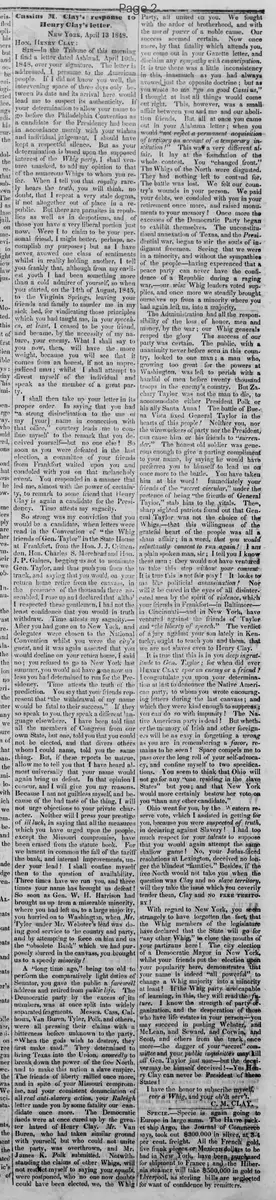
Cassius M. Clay's response to Henry Clay's letter.
New York, April 13 1848.
Hon. Henry Clay:
SIR--In the Tribune of this morning I find a letter dated Ashland, April 10th 1848, over your signature. The letter is addressed, I presume to the American people. If I did not know you well, the intervening space of three days only between its date and its arrival here would lead me to suspect its authenticity. If your determination to allow your name to go before the Philadelphia Convention as a candidate for the Presidency had been in accordance merely with your wishes and individual judgement, I should have kept a respectful silence. But as your determination is based upon the supposed interest of the Whig party, I shall venture unasked, to add my opinion to that of the numerous Whigs to whom you refer. When I tell you that royalty rarely hears the truth, you will think, no doubt, that I repeat a very stale dogma, if not altogether out of place in a republic. But there are parasites in republics as well as in despotisms, and, of those you have a very liberal portion just now. Were I to claim to be your personal friend, I might better, perhaps, accomplish my purposes; but as I have never avowed one class of sentiments whilst in reality holding another, I tell you frankly that, although from my earliest youth I had been something more than a cold admirer of yourself, so when you started, on the 14th of August, 1845, to the Virginia Springs, leaving your friends and family to murder me in my sick bed, for vindicating those principles which you had taught me, in your speeches, at least, I ceased to be your friend and became, by the necessity of my nature, your enemy. What I shall say to you now, then, will have the more weight, because you will see that it comes from an honest, if not an unprejudiced man; whilst I shall attempt to divest myself of the individual and speak as the member of a great party.
I shall then take up your letter in its proper order In saying that you had "a strong disinclination to the use of my [your] name in connection with that office," courtesy leads me to confine myself to the remark that you deceived yourself--but no one else! So soon as you were defeated in the last election, a committee of your friends from Frankfort waited upon you and condoled with you on that melancholy event. You responded in a manner that led me, almost with the power of certainty, to remark to some friend that Henry Clay is again a candidate for the Presidency. Time attests my sagacity.
So strong was my conviction that you would be a candidate, when letters were read in the Convention of "the Whig friends of Gen. Taylor" in the State House at Frankfort, from the Hon. J. J. Crittenden. Hon. Charles S. Morehead and Hon. J. P. Gaines, begging us not to nominate Gen. Taylor, and thus push you from the track, and saying that you would, on your return home retire from the canvass, in the presence of the thousands there assembled. I rose up and declared that altho' I respected these gentlemen. I had not the least confidence that you would in truth withdraw. Time attests my sagacity. After you had gone on to New York, and delegates were chosen to the National Convention whilst you were the city's guest, and it was again asserted that you would decline on your return home. I said no; you refused to go to New York last summer, you would not have gone now unless you had determined to run for the Presidency. Time attests the truth of the prediction. You say that your friends represent that "the withdrawal of my name would be fatal to their success." If they so speak to you. they speak a different language elsewhere. I have been told that all the members of Congress from our own State, but one, told you that you could not be elected, and that divers others whom I could name, told you the same thing. But, if these reports be untrue, allow me to tell you that I have heard almost universally that your name would again bring us defeat. In that opinion I concur, and I will give you my reasons.
Because I am not guiltless myself, and because of the bad taste of the thing, I will not urge objections to your private character. Neither will I press your prestige of ill luck, in saying that all the measures which you have urged upon the people, except the Missouri compromise, have been erased from the statute book. For we lament in common the fall of the tariff the bank, and internal improvements, under your lead! I shall confine myself then to the question of availability.
Three times have we run you, and three times your name has brought us defeat! So soon as Gen. W. H. Harrison had brought us up from a miserable minority, where you had left us, to a large majority. you hurried on to Washington, when Mr. Tyler under Mr. Webster's lead was doing good service to the country and party, and by attempting to force on him and us the "obsolete Bank" which we had purposely slurred in the canvass, you brought us to a speedy minority!
A "long time ago," being too old to perform the comparatively light duties of Senator, you gave the public a farewell address and retired from public life. The Democratic party by the excess of its numbers, was at once split into widely separated fragments. Messrs. Cass, Calhoun, Van Buren, Tyler, Polk, and others, were all pressing their claims with a bitterness before unknown to the party. "When the gods wish to destroy, they first make mad." They determined to bring Texas into the Union, avowedly to break down the power of the free North and to make this nation a slave empire. The friends of liberty rallied once more, and in spite of your Missouri compromise, and your consistent denunciation of all real anti-slavery action, your Raleigh letter made you by some fatality our candidate once more. The Democratic feuds were at once cured up by the greater hatred of Henry Clay. Mr. Van Buren, who had taken similar ground with yourself, but who could not unite the party, was overthrown, and Mr. James K. Polk submitted. Notwithstanding the claims of other Whigs, will not restrict myself to saying your equals, were postponed, who no one now doubts could have been elected, we, the Whig Party, all united on you. We fought with the ardor of brotherhood, and with the moral power of a noble cause. Our success seemed certain. Now once more, by that fatality which attends you, you come out in your Gazette letter, and disclaim any sympathy with emancipation. It is true there was a little inconsistency in this, inasmuch as you had always avowed just the opposite doctrine; but as you wrote to me "go on good Cassius," I thought at last all things would come out right. This, however, was a small affair between you and me and our abolition friends. But all at once you came out in your Alabama letter; when you would "not reject a permanent acquisition of territory on account of a temporary institution!" This was a very different affair. It lay at the foundation of the whole contest. You "changed front." The Whigs of the North were disgusted. They had nothing left to contend for. The battle was lost. We felt our country's wounds in your person. We paid your debts, we condoled with you in your retirement once more, and raised monuments to your memory! Once more the excesses of the Democratic Party began to exhibit themselves. The unconstitutional annexation of Texas, and the Presidential war, began to stir the souls of indignant freemen. Seeing that we were in a minority, and without the sympathies of the people—having experienced that a peace party can never have the confidence of a Republic during a raging war,—our wise Whig leaders voted supplies, and once more we steadily brought ourselves up from a minority where you had again left us, into a majority.
The Administration had all the responsibility of the loss of honor, men and money, by the war; our Whig generals reaped the glory The success of our party was certain. The public, with a unanimity never before seen in this country, looked to one man; a man who, growing too great for the powers at Washington, was left to perish with a handful of men before twenty thousand troops in the enemy's country. But Zachary Taylor was not the man to die, to accommodate either President Polk or his ally Santa Anna! The battle of Buena Vista fixed General Taylor in the hearts of this people! Neither you, nor the wireworkers of party nor the President, can cause him or his friends to surrender. The honest old soldier was generous enough to give a parting compliment to your name, by saying he would have preferred you to himself to lead us on once more to the battle. You have taken him at his word! Immediately your friends of the "secret circular," under the pretence of being "the friends of General Taylor," stab him to the vitals. Then, sharp sighted patriots found out that General Taylor was not the choice of the Whigs, -that this willingness of the grateful heart of the people was all a sham affair; in a word, that you would reluctantly consent to run again! I am a plain spoken man, sir; I tell you I know these men ; they would not have ventured to take this step without your consent It is true this is not fair play! It looks to me like political assassination! Nor will it be cured in the eyes of all disinterested men by the spirit of violence, which your friends in Frankfort--in Baltimore--in Cincinnati--and in New York, have ventured against the friends of Taylor and "the liberty of speech." The verdict of a jury against your son lately in Kentucky, ought to teach you and them, that we are not slaves even to Henry Clay It is true that this is in you deep ingratitude to Gen. Taylor; for when did ever Henry Clay spare an enemy or a friend ? I congratulate you upon your determination at last to denounce the Native American party, to whom you wrote encouraging letters during the last canvass; and which they were kind enough to suppress; you can do so with impunity! The Native American party is dead! But whether the memory of Irish and other foreigners will be as easy in forgetting a wrong as you are in remembering a favor, remains to be seen ! Space compels me to pass over the long roll of your self-advocacy, and confine myself to two specifications. You seem to think that Ohio will not go for any 'one residing in the slave States" but you; and that New York would more certainly bestow her vote on you "than any other candidate."
Ohio went for you, by the Western reserve vote, which I assisted in getting for you, because you were suspected of truth, in declaring against Slavery! I had too much respect for your talents to suppose that you would again attempt the same shallow game! No, your Judas-faced resolutions at Lexington, deceived no longer the blindest "fanatics." Besides, if the free North would not take you when the question was Clay and no slave territory, will they take the issue which you covertly tender theI, Clay and NO FREE TERRITORY?
With regard to New York, you seem strangely to have forgotten the fact, that the Whig members of the legislature have declared that the State will go for "any other Whig," to close the mouths of your partizans here! The city election of a Democratic Mayor in New York, whilst your friends put the election upon your popularity here, demonstrates that your name is indeed "all powerful", to change a Whig majority into a minority at least! If the Whig party are capable of learning, in this, they will read the future. I know the strength of party organization, and the desperation of those who have life estates in your person--you may succeed in pushing Webster, and McLean, and Seward, and Corwin, and Scott, and others from the track once more--the dagger of your "secret" committee and your public inquisitors may kill off Gen. Taylor just now--but the deceiver may be himself deceived !--Yes Henry Clay can never be President of these States!
I have the honor to subscribe myself, ever a Whig, and your ob'dt serv't.
C. M. CLAY
New York, April 13 1848.
Hon. Henry Clay:
SIR--In the Tribune of this morning I find a letter dated Ashland, April 10th 1848, over your signature. The letter is addressed, I presume to the American people. If I did not know you well, the intervening space of three days only between its date and its arrival here would lead me to suspect its authenticity. If your determination to allow your name to go before the Philadelphia Convention as a candidate for the Presidency had been in accordance merely with your wishes and individual judgement, I should have kept a respectful silence. But as your determination is based upon the supposed interest of the Whig party, I shall venture unasked, to add my opinion to that of the numerous Whigs to whom you refer. When I tell you that royalty rarely hears the truth, you will think, no doubt, that I repeat a very stale dogma, if not altogether out of place in a republic. But there are parasites in republics as well as in despotisms, and, of those you have a very liberal portion just now. Were I to claim to be your personal friend, I might better, perhaps, accomplish my purposes; but as I have never avowed one class of sentiments whilst in reality holding another, I tell you frankly that, although from my earliest youth I had been something more than a cold admirer of yourself, so when you started, on the 14th of August, 1845, to the Virginia Springs, leaving your friends and family to murder me in my sick bed, for vindicating those principles which you had taught me, in your speeches, at least, I ceased to be your friend and became, by the necessity of my nature, your enemy. What I shall say to you now, then, will have the more weight, because you will see that it comes from an honest, if not an unprejudiced man; whilst I shall attempt to divest myself of the individual and speak as the member of a great party.
I shall then take up your letter in its proper order In saying that you had "a strong disinclination to the use of my [your] name in connection with that office," courtesy leads me to confine myself to the remark that you deceived yourself--but no one else! So soon as you were defeated in the last election, a committee of your friends from Frankfort waited upon you and condoled with you on that melancholy event. You responded in a manner that led me, almost with the power of certainty, to remark to some friend that Henry Clay is again a candidate for the Presidency. Time attests my sagacity.
So strong was my conviction that you would be a candidate, when letters were read in the Convention of "the Whig friends of Gen. Taylor" in the State House at Frankfort, from the Hon. J. J. Crittenden. Hon. Charles S. Morehead and Hon. J. P. Gaines, begging us not to nominate Gen. Taylor, and thus push you from the track, and saying that you would, on your return home retire from the canvass, in the presence of the thousands there assembled. I rose up and declared that altho' I respected these gentlemen. I had not the least confidence that you would in truth withdraw. Time attests my sagacity. After you had gone on to New York, and delegates were chosen to the National Convention whilst you were the city's guest, and it was again asserted that you would decline on your return home. I said no; you refused to go to New York last summer, you would not have gone now unless you had determined to run for the Presidency. Time attests the truth of the prediction. You say that your friends represent that "the withdrawal of my name would be fatal to their success." If they so speak to you. they speak a different language elsewhere. I have been told that all the members of Congress from our own State, but one, told you that you could not be elected, and that divers others whom I could name, told you the same thing. But, if these reports be untrue, allow me to tell you that I have heard almost universally that your name would again bring us defeat. In that opinion I concur, and I will give you my reasons.
Because I am not guiltless myself, and because of the bad taste of the thing, I will not urge objections to your private character. Neither will I press your prestige of ill luck, in saying that all the measures which you have urged upon the people, except the Missouri compromise, have been erased from the statute book. For we lament in common the fall of the tariff the bank, and internal improvements, under your lead! I shall confine myself then to the question of availability.
Three times have we run you, and three times your name has brought us defeat! So soon as Gen. W. H. Harrison had brought us up from a miserable minority, where you had left us, to a large majority. you hurried on to Washington, when Mr. Tyler under Mr. Webster's lead was doing good service to the country and party, and by attempting to force on him and us the "obsolete Bank" which we had purposely slurred in the canvass, you brought us to a speedy minority!
A "long time ago," being too old to perform the comparatively light duties of Senator, you gave the public a farewell address and retired from public life. The Democratic party by the excess of its numbers, was at once split into widely separated fragments. Messrs. Cass, Calhoun, Van Buren, Tyler, Polk, and others, were all pressing their claims with a bitterness before unknown to the party. "When the gods wish to destroy, they first make mad." They determined to bring Texas into the Union, avowedly to break down the power of the free North and to make this nation a slave empire. The friends of liberty rallied once more, and in spite of your Missouri compromise, and your consistent denunciation of all real anti-slavery action, your Raleigh letter made you by some fatality our candidate once more. The Democratic feuds were at once cured up by the greater hatred of Henry Clay. Mr. Van Buren, who had taken similar ground with yourself, but who could not unite the party, was overthrown, and Mr. James K. Polk submitted. Notwithstanding the claims of other Whigs, will not restrict myself to saying your equals, were postponed, who no one now doubts could have been elected, we, the Whig Party, all united on you. We fought with the ardor of brotherhood, and with the moral power of a noble cause. Our success seemed certain. Now once more, by that fatality which attends you, you come out in your Gazette letter, and disclaim any sympathy with emancipation. It is true there was a little inconsistency in this, inasmuch as you had always avowed just the opposite doctrine; but as you wrote to me "go on good Cassius," I thought at last all things would come out right. This, however, was a small affair between you and me and our abolition friends. But all at once you came out in your Alabama letter; when you would "not reject a permanent acquisition of territory on account of a temporary institution!" This was a very different affair. It lay at the foundation of the whole contest. You "changed front." The Whigs of the North were disgusted. They had nothing left to contend for. The battle was lost. We felt our country's wounds in your person. We paid your debts, we condoled with you in your retirement once more, and raised monuments to your memory! Once more the excesses of the Democratic Party began to exhibit themselves. The unconstitutional annexation of Texas, and the Presidential war, began to stir the souls of indignant freemen. Seeing that we were in a minority, and without the sympathies of the people—having experienced that a peace party can never have the confidence of a Republic during a raging war,—our wise Whig leaders voted supplies, and once more we steadily brought ourselves up from a minority where you had again left us, into a majority.
The Administration had all the responsibility of the loss of honor, men and money, by the war; our Whig generals reaped the glory The success of our party was certain. The public, with a unanimity never before seen in this country, looked to one man; a man who, growing too great for the powers at Washington, was left to perish with a handful of men before twenty thousand troops in the enemy's country. But Zachary Taylor was not the man to die, to accommodate either President Polk or his ally Santa Anna! The battle of Buena Vista fixed General Taylor in the hearts of this people! Neither you, nor the wireworkers of party nor the President, can cause him or his friends to surrender. The honest old soldier was generous enough to give a parting compliment to your name, by saying he would have preferred you to himself to lead us on once more to the battle. You have taken him at his word! Immediately your friends of the "secret circular," under the pretence of being "the friends of General Taylor," stab him to the vitals. Then, sharp sighted patriots found out that General Taylor was not the choice of the Whigs, -that this willingness of the grateful heart of the people was all a sham affair; in a word, that you would reluctantly consent to run again! I am a plain spoken man, sir; I tell you I know these men ; they would not have ventured to take this step without your consent It is true this is not fair play! It looks to me like political assassination! Nor will it be cured in the eyes of all disinterested men by the spirit of violence, which your friends in Frankfort--in Baltimore--in Cincinnati--and in New York, have ventured against the friends of Taylor and "the liberty of speech." The verdict of a jury against your son lately in Kentucky, ought to teach you and them, that we are not slaves even to Henry Clay It is true that this is in you deep ingratitude to Gen. Taylor; for when did ever Henry Clay spare an enemy or a friend ? I congratulate you upon your determination at last to denounce the Native American party, to whom you wrote encouraging letters during the last canvass; and which they were kind enough to suppress; you can do so with impunity! The Native American party is dead! But whether the memory of Irish and other foreigners will be as easy in forgetting a wrong as you are in remembering a favor, remains to be seen ! Space compels me to pass over the long roll of your self-advocacy, and confine myself to two specifications. You seem to think that Ohio will not go for any 'one residing in the slave States" but you; and that New York would more certainly bestow her vote on you "than any other candidate."
Ohio went for you, by the Western reserve vote, which I assisted in getting for you, because you were suspected of truth, in declaring against Slavery! I had too much respect for your talents to suppose that you would again attempt the same shallow game! No, your Judas-faced resolutions at Lexington, deceived no longer the blindest "fanatics." Besides, if the free North would not take you when the question was Clay and no slave territory, will they take the issue which you covertly tender theI, Clay and NO FREE TERRITORY?
With regard to New York, you seem strangely to have forgotten the fact, that the Whig members of the legislature have declared that the State will go for "any other Whig," to close the mouths of your partizans here! The city election of a Democratic Mayor in New York, whilst your friends put the election upon your popularity here, demonstrates that your name is indeed "all powerful", to change a Whig majority into a minority at least! If the Whig party are capable of learning, in this, they will read the future. I know the strength of party organization, and the desperation of those who have life estates in your person--you may succeed in pushing Webster, and McLean, and Seward, and Corwin, and Scott, and others from the track once more--the dagger of your "secret" committee and your public inquisitors may kill off Gen. Taylor just now--but the deceiver may be himself deceived !--Yes Henry Clay can never be President of these States!
I have the honor to subscribe myself, ever a Whig, and your ob'dt serv't.
C. M. CLAY
What sub-type of article is it?
Political
Persuasive
Provocative
What themes does it cover?
Politics
Slavery Abolition
Military War
What keywords are associated?
Henry Clay
Presidential Candidacy
Whig Party
Slavery
Zachary Taylor
Anti Slavery
Mexican War
Political Defeat
What entities or persons were involved?
C. M. Clay
Hon. Henry Clay
Letter to Editor Details
Author
C. M. Clay
Recipient
Hon. Henry Clay
Main Argument
cassius m. clay opposes henry clay's presidential candidacy, arguing that clay's past defeats, shifts on slavery, and party manipulations harm the whig party's chances, and that zachary taylor is the stronger candidate.
Notable Details
References Raleigh Letter, Alabama Letter, Gazette Letter
Mentions Missouri Compromise, Texas Annexation, Buena Vista Battle
Criticizes Clay's Inconsistencies On Emancipation And Slavery Expansion