Thank you for visiting SNEWPapers!
Sign up free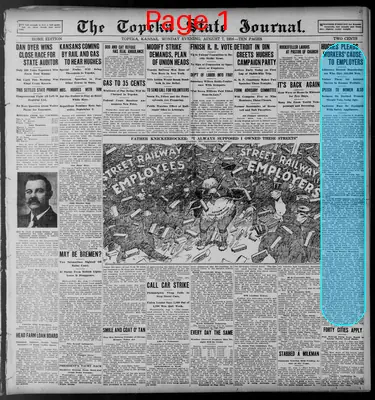
Story
August 7, 1916
The Topeka State Journal
Topeka, Shawnee County, Kansas
What is this article about?
Charles E. Hughes speaks in Detroit to manufacturers employing 100,000, praising welfare efforts and urging worker protections and cooperation between labor and capital; later addresses suffragists endorsing women's vote.
Clipping

OCR Quality
100%
Excellent
Full Text
HUGHES PLEADS WORKERS' CAUSE TO EMPLOYERS
Addresses Detroit Manufacturers Who Hire 100,000 Men.
Praises Them for Interest Shown in Human Welfare.
SPEECH TO WOMEN
Declares He Decided Women Should Vote, Long Ago.
Factories Must Be Equipped With Safety Appliances.
Detroit, Aug. 7.—Charles E. Hughes, speaking today to forty manufacturers of Detroit and vicinity, employing 100,000 men, congratulated them upon what they had done for the welfare of their employees, told them that the democracy of the United States would not stand for a continuation of this alleged strife between capital and labor and declared the American workingmen should not be regarded as a mere economic unit but as a fellow worker, a human being.
Mr. Hughes's address was impromptu and followed a brief speech by J. M. Eaton, spokesman for the manufacturers who outlined the welfare measures for employes taken by industrial concerns here and suggest that the nominee endorse a movement looking to the formation of a national welfare association of manufacturers. Mr. Hughes said he regarded the suggestion "very favorably."
A few minutes later Mr. Hughes spoke to a group of suffragists. The day was hot and the air of the little room where he received the manufacturers and the suffragettes was almost stifling. The nominee spoke with his wife standing behind him.
Formed Suff Opinion Long Ago.
Mr. Hughes reiterated in his address to the suffragists his declaration in New York that the suffragist question should be settled speedily by giving the vote to women all over the country. He added that he had formed this opinion long ago, before he thought that the time would ever come when he would have to announce his position publicly.
In his address to the manufacturers, Mr. Hughes said in part:
It is an awful mistake to think of the men through whose activity production is possible as mere economic units. They are human beings. We are all working men in this country. We are in different spheres of activity but we ought to have a sense of co-operation so that every man takes pride in what he is doing and in doing it to the best of his ability because he is working alongside of every other man for the good of the country.
"In your welfare work you are buttressing democracy. The human factor is, after all, the important factor. You may develop your physical plants, your physical instrumentalities, distribution and everything that goes to make up the material side of prosperity but you are absolutely hopeless without the human factor and in America, the land of free men, the man who is at work for a living must feel that the country is doing the right thing by him. He is entitled to be safe in his work to have every precaution taken against every sort of accident that can be prevented.
You Must Protect Workmen.
"A man is put at work. How can he refuse the job which stands between him and starvation? It is perfectly idle to say in our industrial conditions, that he can take or refuse the work according to his idea of the safety appliances which may be provided to protect him. You have got to protect him. No man can work in any position where his life, his limb or his health are subject to any unnecessary risk. That is good Americanism and that is good business.
"We are not materialists in this country; we are all idealists but the one thing that appeals to the working man is the idea that he is equal to some job in a first class way. That is what makes him proud; that is what makes him satisfied; and when you consider our great industrial manufactures and the enormous extension of our industrial markets, the hope that in all this there will be right, through it the spirit of human brotherhood, of fellowship and of co-operation is established so that managers and working men will feel that they are engaged in a common cause.
"And we will get through with this old strife between labor and capital. Democracy cannot stand it. We are not laborers and capitalists in this country. We are fellow citizens.
"That is what I stand for, and therefore, because you enrich our citizenship because you build permanent the foundation of our society, I greet you and I wish you the best success in your work."
Addresses Detroit Manufacturers Who Hire 100,000 Men.
Praises Them for Interest Shown in Human Welfare.
SPEECH TO WOMEN
Declares He Decided Women Should Vote, Long Ago.
Factories Must Be Equipped With Safety Appliances.
Detroit, Aug. 7.—Charles E. Hughes, speaking today to forty manufacturers of Detroit and vicinity, employing 100,000 men, congratulated them upon what they had done for the welfare of their employees, told them that the democracy of the United States would not stand for a continuation of this alleged strife between capital and labor and declared the American workingmen should not be regarded as a mere economic unit but as a fellow worker, a human being.
Mr. Hughes's address was impromptu and followed a brief speech by J. M. Eaton, spokesman for the manufacturers who outlined the welfare measures for employes taken by industrial concerns here and suggest that the nominee endorse a movement looking to the formation of a national welfare association of manufacturers. Mr. Hughes said he regarded the suggestion "very favorably."
A few minutes later Mr. Hughes spoke to a group of suffragists. The day was hot and the air of the little room where he received the manufacturers and the suffragettes was almost stifling. The nominee spoke with his wife standing behind him.
Formed Suff Opinion Long Ago.
Mr. Hughes reiterated in his address to the suffragists his declaration in New York that the suffragist question should be settled speedily by giving the vote to women all over the country. He added that he had formed this opinion long ago, before he thought that the time would ever come when he would have to announce his position publicly.
In his address to the manufacturers, Mr. Hughes said in part:
It is an awful mistake to think of the men through whose activity production is possible as mere economic units. They are human beings. We are all working men in this country. We are in different spheres of activity but we ought to have a sense of co-operation so that every man takes pride in what he is doing and in doing it to the best of his ability because he is working alongside of every other man for the good of the country.
"In your welfare work you are buttressing democracy. The human factor is, after all, the important factor. You may develop your physical plants, your physical instrumentalities, distribution and everything that goes to make up the material side of prosperity but you are absolutely hopeless without the human factor and in America, the land of free men, the man who is at work for a living must feel that the country is doing the right thing by him. He is entitled to be safe in his work to have every precaution taken against every sort of accident that can be prevented.
You Must Protect Workmen.
"A man is put at work. How can he refuse the job which stands between him and starvation? It is perfectly idle to say in our industrial conditions, that he can take or refuse the work according to his idea of the safety appliances which may be provided to protect him. You have got to protect him. No man can work in any position where his life, his limb or his health are subject to any unnecessary risk. That is good Americanism and that is good business.
"We are not materialists in this country; we are all idealists but the one thing that appeals to the working man is the idea that he is equal to some job in a first class way. That is what makes him proud; that is what makes him satisfied; and when you consider our great industrial manufactures and the enormous extension of our industrial markets, the hope that in all this there will be right, through it the spirit of human brotherhood, of fellowship and of co-operation is established so that managers and working men will feel that they are engaged in a common cause.
"And we will get through with this old strife between labor and capital. Democracy cannot stand it. We are not laborers and capitalists in this country. We are fellow citizens.
"That is what I stand for, and therefore, because you enrich our citizenship because you build permanent the foundation of our society, I greet you and I wish you the best success in your work."
What sub-type of article is it?
Historical Event
Biography
What themes does it cover?
Moral Virtue
Social Manners
Justice
What keywords are associated?
Hughes Speech
Detroit Manufacturers
Workers Welfare
Women Suffrage
Labor Cooperation
What entities or persons were involved?
Charles E. Hughes
J. M. Eaton
Where did it happen?
Detroit
Story Details
Key Persons
Charles E. Hughes
J. M. Eaton
Location
Detroit
Event Date
Aug. 7
Story Details
Charles E. Hughes congratulates Detroit manufacturers on employee welfare measures, advocates for treating workers as human beings with safety protections, and supports women's suffrage, stating he formed this opinion long ago.