Thank you for visiting SNEWPapers!
Sign up free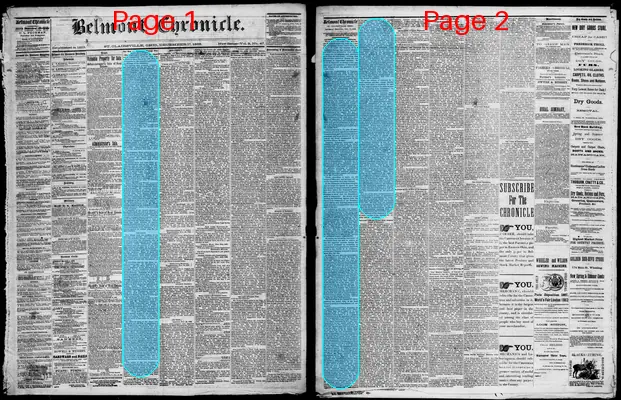
Belmont Chronicle
Saint Clairsville, Belmont County, Ohio
What is this article about?
In December 1868, both houses of Congress reacted with outrage to President Andrew Johnson's annual message, refusing to fully read it in the Senate and tabling it in the House without referral or printing, condemning its views on reconstruction, finance, and debt repudiation.
Merged-components note: This is a continuation of the article on Andrew Johnson's message and Congress's response, spanning pages with sequential content flow on the political topic.
Clippings

1 of 2
OCR Quality
Full Text
The country may properly congratulate itself upon having got the last of Andrew Johnson's annual messages. It is such a document as was never before sent to Congress, and it received such treatment as no other message received. The indignation it excited at the Capitol was something with which the people cannot help sympathizing, and the condemnation poured upon the head of the bad man whose name it bears will doubtless be echoed from one end of the land to the other.
The Senate received the message from the President's private Secretary at exactly one o'clock. There were not many persons in the galleries, for the populace expected a scene at the other end of the Capitol. The Clerk began its reading just as printed copies were distributed among the Senators. He had read about ten minutes, not having reached the atrocious paragraph in which the President advocates repudiation through nonpayment of interest on our bonds, when Mr. Conness rose and indignantly moved to dispense with the further reading of the document.
The wrath and contempt of Senators had been gradually rising. One could see that easily enough from the galleries. The proposition to quit reading was, however, no less novel than astounding. and at first a decided majority of Senators seemed to be opposed to such severe treatment of the emergency. Garret Davis caught at his breath, and managed to say that the motion was most extraordinary.
"Yes," responded Conness, "and the message is most extraordinary; such a one as no other President ever sent to Congress." Warming to his subject, he went on to say that it was a tirade of abuse an indecent attack upon Congress, a tissue of malignant falsehoods. This language caused a decided sensation. Several Senators rose to speak. Two or three appealed to Conness to withdraw his motion. Others urged him to press it to a vote, and there was some confusion.
Vice President Wade called for a vote on the motion to stop the reading and on the viva voce answer declared that it had carried. Mr. Davis and others wanted a yea and nay vote, and so that was ordered.
Meantime there had been some private consultation, and as its result Mr. Conness said he was willing to withdraw the motion if it was thought best. Mr. Cameron replied he would at once renew it, and so it was not withdrawn. Mr. Howe said: "The message was indecent in its character. The Constitution does not give the President any right to send us such a message, nor does it impose upon us the duty of listening to such a message."
Messrs. Morton and Wilson concurred in pronouncing it full of misrepresentation, but thought the Senate had better read it through. Mr. Cameron characterized it as unfit to go on the Senate Journal, and wanted it thrown upon the table at once. Gov. Morton reminded the Senate that the President had a right to communicate his views in his own way, adding that he himself thought the message as bad a one as it could be. Mr. Wilson spoke of it as the ravings of a bad, disappointed man. Mr. Drake characterized it as the last kick of a defeated executive, which it was not worth while to mind.
A majority of the Senate seemed to think otherwise, for when at this point Mr. Edmunds moved an adjournment it was carried without division. Thus the Senate, outraged beyond restraint, refused for the first time in its life to hear a Message from the White House. While there was some division of opinion among Republicans as to the propriety of allowing it to be read, there was none in condemnation of its doctrines, or in protest against its wicked plea for the late rebellion.
THE HOUSE.
The House took the reading of the message very quietly. The men's gallery was crowded, though evidently not so much to hear the document read as to see how it was received by the representatives. Clerk McPherson seemed impressed with the gravity of his mission, and read the pages in a loud and clear voice, easily filling the Chamber. Very few members paid any attention to him, however. Many of them left the floor; others wrote letters; several read newspapers, little knots gathered for laughter and conversation, and there was a buzz of small talk throughout the Hall.
As the Clerk read the last lines, several members rose. Mr. Washburne, of Illinois, got the floor, and in a few grave, measured words denounced the message for its repudiation doctrines, speaking of the document as disgraceful in the extreme. Fernando Wood, that pink of propriety, called him to order holding that he had no right to use the word disgraceful in connection with any message from the President. The Speaker ruled of course that any member had a right to speak of it as he pleased, so long as he kept within the bounds of decorum. Messrs. Wood, Randall and Eldridge all tried to speak at once, all evidently meaning to raise further points of order. Mr. Washburne refused to yield the floor and the Speaker was obliged to sharply rap them to order and direct them to take their seats.
Mr. Broomall wanted the floor to offer a resolution against repudiation in any form, and Mr. Washburne yielded. These three Democrats and others at once jumped to their feet, and with a good deal of confusion got in a point of order that Mr. Broomall at this juncture couldn't have his resolution read by the Clerk. "Very well," said Broomall "I read it myself, as part of my remarks." And so he did, walking to the Clerk's desk and reading it from where Thad. Stevens stood in late years to make his speeches.
Mr. Schenck then, of the dozen who wanted to, got the floor by permission of Mr. Washburne, and for the Ways and Means Committee denounced the message as the most gross, shameful and infamous document ever emanating from a public officer. He compared it to the Oregon resolutions which the House refused to enter upon its journal, saying it was like them, impertinent and scandalous, entirely unfit to be printed. Half a dozen members of the opposition tried to speak, but the House refused to hear any apology or justification, and then under lead of Washburne and Schenck, by a vote of 128 to 38, flung the message upon the table to lie there with other dead things, as Mr. Higby, of California, said. As if this great proceeding was not enough, it next refused to let the message be printed for general circulation, and also refused to refer it in the ordinary way to the appropriate committees for examination.
This action of the two branches of Congress thus recorded is the theme of conversation in all circles to-night. The general judgment seems to be, that so far as the President is concerned he was served just right, though some persons regret that the Senate and House could find no other way of expressing their righteous indignation.
EXTRACTS FROM THE MESSAGE.
We have not the room if we had a desire to publish entire the stale and malignant message of the "last of the Bourbons." It bears the impress of that vindictive feeling that usually actuates bad men when defeated in their efforts to carry out bad schemes, and contains aside from its impudence, nothing that has not been published during the last campaign in copperhead speeches. To show its character we extract a few passages upon the questions of Reconstruction, Finance and the payment of the Public Debt.
Upon the re-assembling of Congress, it again becomes my duty to call your attention to the state of the Union and its disorganized condition under the various laws which have been passed upon the subject of reconstruction. It may be safely assumed as an axiom in the government of the States, that the greatest wrongs inflicted upon a people are caused by unjust and arbitrary legislation or by the unrelenting decrees of despotic rulers, and that the timely repeal of injurious and oppressive measures is the greatest good that can be conferred upon a nation. The legislator or the ruler who has the wisdom and magnanimity to retrace his steps when convinced of his error, will, sooner or later, be rewarded with the respect and gratitude of an intelligent and patriotic people.
Our own history, although embracing a period less than a century, affords abundant proof that most, if not all, of our domestic troubles are directly traceable to violations of the organic law and to excessive legislation. The most striking illustrations of this fact are furnished by the enactments of the past three years upon the question of reconstruction. After a fair trial they have substantially failed and proved pernicious in their results, and there seems to be no good reason why they should longer remain upon the statute book.
After eulogizing A. J.'s plan of reconstruction which is regarded as eminently Constitutional, and denouncing the Congressional plan as productive of all the evils at the South inaugurated by the Ku-Klux Klans, he says:
Congress, however, intervened, and refusing to perfect the work so nearly consummated, declined to admit members from the States; adopted a course of measures which arrested the progress of restoration, and frustrated all that had been successfully accomplished, and after three years of agitation and strife, has left the country further from the attainment of union and fraternal feeling than at the inception of the Congressional plan of reconstruction. It needs no argument to show that legislation which has produced such consequences should be abrogated or else made to conform to the genuine principles of republican government. Under the influence of party passion and sectional prejudice, other acts have been passed, not warranted by the Constitution. These, according to Andy, are the tenure of office law, and military bill by which his powers have been limited.
In the discussion of the financial question he arrays his figures to show that the expense of the government is greater now than before the Democratic rebellion, and, like Seymour and Pendleton, attempts to show that the Republican party is responsible. He cannot avoid quoting the following figures from the report of the Secretary of the Treasury and it will be seen that they show a very rapid reduction of expenditure since the close of the war.
It is shown by the able and comprehensive report of the Secretary of the Treasury, that the receipts for the fiscal year ending June 30th, 1868, were $405,638,083, and that the expenditures for the same period were $377,340,284, leaving in the Treasury a surplus of $28,297,799. It is estimated that the receipts during the present fiscal year ending June 30th, 1869, will be $341,392,868, and the expenditures $336,152,470 showing a small balance of $5,240,398 in favor of the government. For the fiscal year ending June 30th, 1870, it is estimated that the receipts will amount to $327,000,000, and the expenditures to $303,000,000, leaving an estimated surplus of $24,000,000.
He makes the following statement of the Public Debt, but fails to inform us that the apparent increase during the past year is produced by including, as indebtedness of the government, the bonds issued to the Pacific R. R. Company, which that Company is bound to redeem when they fall due.
In 1860, the year after the termination of an expensive war with Mexico, we found ourselves involved in a debt of sixty-four millions, and this was the amount owed by the Government just prior to the outbreak of the rebellion. In the spring of 1861 our civil war commenced. Each year of its continuance made an enormous addition to the debt, and when, in the spring of 1865, the nation successfully emerged from the conflict, the obligations of the Government had reached the immense sum of $2,873,992,909. The Secretary of the Treasury shows that on the 1st day of November, 1867, this amount had been reduced to $2,491,504,450, but at the same time his report exhibits an increase during the past year of $35,625,102; for the debt on the 1st day of November last, is stated to have been $2,527,129,552. It is estimated by the Secretary that the returns for the past month will add to our liabilities the further sum of eleven millions, making a total increase during thirteen months of forty-six and a half millions.
The following as his method of extinguishing the public debt, is the most infamous method of repudiation yet advocated.
Various plans have been proposed for the payment of the public debt. However they may have varied as to the time and mode in which it should be redeemed, there seems to be a general concurrence as to the propriety and justice of a reduction in the present rate of interest. The Secretary of the Treasury in his report recommends five per cent. Congress in its bill passed prior to the adjournment on the twenty-seventh of July last, agreed upon four and four and a half per cent., while by many, three per cent, is held to be an amply sufficient return for the investment. The general impression as to the exorbitancy of the existing rate of interest has led to an inquiry by the public mind, respecting the consideration which the Government has actually received for its bonds, and the conclusion becoming prevalent that the amount which it obtained was, per cent. less than the obligations which it issued in return. It cannot be denied that we are paying an extravagant percentage for the use of the money borrowed, which was paper depreciated below the value of coin.
This fact is made apparent, when we consider that bondholders receive from the treasury upon each dollar they own in Government Securities, six per cent in gold, which is nearly or quite equal to nine per cent in currency; that the bonds are then converted into capital for the National Banks, upon which these institutions bearing six per cent interest, and that they are exempt from taxation by the Government and the States, and thereby enhanced two per cent in the hands of the holder; we have thus aggregated seventeen per cent.; which may be received upon each dollar by the owner of Government securities. A system that produces such results, is justly regarded as favoring a few at the expense of the many, and has led to the further inquiry whether our bondholders, in view of the large profits which they have enjoyed, would themselves be averse to a settlement of our indebtedness upon a plan which would yield them a fair remuneration, and at the same time be just to the tax-payers of the nation. Our national credit should be sacredly observed, but in making provision for our creditors, we should not forget what is due to the masses of the people. It may be assumed that the holders of our securities have already received upon their bonds a larger amount than their original investment, measured by a gold standard. Upon this statement of facts it would seem just and equitable that the six per cent. interest now paid by the government should be applied to the reduction of the principal in semi-annual installments, which in sixteen years and eight months could liquidate the entire national debt. Six per cent. in gold would at present rates be equal to nine per cent. in currency, and equivalent to the payment of the debt one and a half times in a fraction less than seventeen years. This, in connection with all the other advantages derived from their investments, would afford to the public creditors a fair and liberal compensation for the use of their capital, and with this they should be satisfied.
Upon the subject of currency, he is more rational, and few, except Pendletonites, will object to anything he says on that subject unless it be what he says about "excluding from circulation" by law all notes under twenty dollars.
"The time has come, however, when the Government and national banks should be required to take the most efficient steps and make all necessary arrangements for resumption of specie payments. Let specie payments once be earnestly inaugurated by the government and banks, and the value of the paper circulation would directly approximate to a specie standard. Specie payments having been resumed by the government and the banks, all notes or bills of paper issued by either, of a less denomination than twenty dollars, should by law be excluded from circulation, so that the people may have the benefit and convenience of a gold and silver currency, which in all their business transactions will be uniform in value at home and abroad. Every man of property or industry, every man who desires to preserve what he honestly possesses, or to obtain what he can honestly earn, has a direct interest in maintaining a safe circulating medium as shall be real and substantial, not liable to vibrate with opinions, not subject to be blown up or blown down by the brutes or speculation, but to be made stable and secure. A disordered currency is one of the greatest political evils. It undermines the virtues necessary for the support of the social system, and encourages propensities destructive of its happiness. It wars against industry, frugality, and economy; and it fosters the evil spirits of extravagance and speculation. It has been asserted by one of our profoundest and most gifted statesmen, that of all the contrivances for cheating the laboring classes of mankind, none has been more effectual than that which deludes them with paper money. This is the most effectual of inventions to fertilize the rich man's fields by the sweat of the poor man's brow. Ordinary tyranny, oppression, excessive taxation, these bear lightly on the happiness of the masses of the community compared with a fraudulent currency and with robberies committed by depreciated paper. Our own history has recorded for our own instruction enough, and more than enough, of the demoralizing tendency, the injustice and the intolerable oppression on the virtuous and well-disposed, of a degraded paper currency authorized by law or any way countenanced by the government.
It is one of the most successful devices in times of peace or war, of expansions or revolutions, to accomplish the transfer of all the precious metals from the great mass of the people into the hands of the few. So here they are hoarded in secret places, or deposited under bolts and bars, while the people are left to endure all the inconveniences, sacrifices and demoralization resulting from the use of depreciated and worthless paper.
The balance of the message is occupied with a review of the department reports, and foreign affairs.
What sub-type of article is it?
What keywords are associated?
What entities or persons were involved?
Where did it happen?
Domestic News Details
Primary Location
Washington
Event Date
Upon The Re Assembling Of Congress
Key Persons
Outcome
senate refused to hear the full message and adjourned; house read it but tabled it by vote of 128 to 38, refused printing and referral to committees
Event Details
Both houses of Congress expressed outrage at President Andrew Johnson's annual message, criticizing its content on reconstruction, finance, and debt repayment; Senate moved to stop reading after partial delivery; House denounced it and rejected further action