Thank you for visiting SNEWPapers!
Sign up free
New York Tribune
New York, New York County, New York
What is this article about?
London theater notes from April 14 detail Frederic Clay's new comic opera 'The Merry Duchess' with George R. Sims; Henry Irving's US tour prep; performances at Haymarket and Lyceum with celebrities; Irving's historic suppers and Duke of Norfolk anecdote; upcoming shows by Lingard, Calhoun, and Pinero; Farquhar's role and Mrs. Maddick's debut. (248 chars)
Clipping
OCR Quality
Full Text
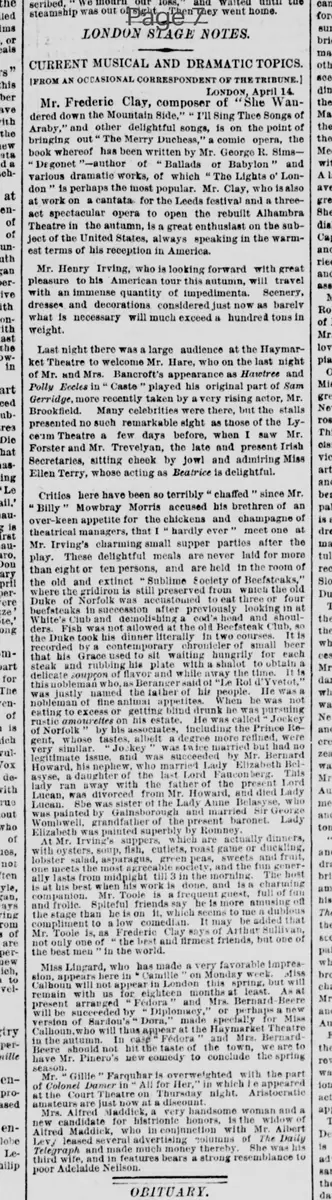
CURRENT MUSICAL AND DRAMATIC TOPICS
[FROM AN OCCASIONAL CORRESPONDENT OF THE TRIBUNE.]
London, April 14.
Mr. Frederic Clay, composer of "She Wandered down the Mountain Side," "I'll Sing Thee Songs of Araby," and other delightful songs, is on the point of bringing out "The Merry Duchess," a comic opera, the book whereof has been written by Mr. George R. Sims— "Dagonet"—author of "Ballads of Babylon" and various dramatic works, of which "The Lights o' London" is perhaps the most popular.
Mr. Clay, who is also at work on a cantata for the Leeds festival and a three-act spectacular opera to open the rebuilt Alhambra Theatre in the autumn, is a great enthusiast on the subject of the United States, always speaking in the warmest terms of his reception in America.
Mr. Henry Irving, who is looking forward with great pleasure to his American tour this autumn, will travel with an immense quantity of impedimenta. Scenery, dresses and decorations considered just now as barely what is necessary will much exceed a hundred tons in weight.
Last night there was a large audience at the Haymarket Theatre to welcome Mr. Hare, who on the last night of Mr. and Mrs. Bancroft's appearance as Hawtree and Polly Eccles in "Caste" played his original part of Sam Gerridge, more recently taken by a very rising actor, Mr. Brookfield.
Many celebrities were there, but the stalls presented no such remarkable sight as those of the Lyceum Theatre a few days before, when I saw Mr. Forster and Mr. Trevelyan, the late and present Irish Secretaries, sitting cheek by jowl and admiring Miss Ellen Terry, whose acting as Beatrice is delightful.
Critics here have been so terribly "chaffed" since Mr. "Billy" Mowbray Morris accused his brethren of an over-keen appetite for the chickens and champagne of theatrical managers, that I "hardly ever" meet one at Mr. Irving's charming small supper parties after the play.
These delightful meals are never laid for more than eight or ten persons, and are held in the rooms of the old and extinct "Sublime Society of Beefsteaks," where the gridiron is still preserved from which the old Duke of Norfolk was accustomed to eat three or four beefsteaks in succession after previously looking in at White's Club and demolishing a cod's head and shoulders.
Fish was not allowed at the old Beefsteak Club, so the Duke took his dinner literally in two courses. It is recorded by a contemporary chronicler of small beer that his Grace used to sit waiting hungrily for each steak and rubbing his plate with a shallot to obtain a delicate soupçon of flavor and while away the time.
It is this nobleman who, as Béranger said of "Le Roi d'Yvetot," was justly named the father of his people. He was a nobleman of fine animal appetites. When he was not eating to excess or getting blind drunk he was pursuing rustic amourettes on his estate. He was called "Jockey of Norfolk" by his associates, including the Prince Regent, whose tastes, albeit a degree more refined, were very similar.
"Jockey" was twice married but had no legitimate issue, and was succeeded by Mr. Bernard Howard, his nephew, who married Lady Elizabeth Belasyse, a daughter of the last Lord Fauconberg. This lady ran away with the father of the present Lord Lucan, was divorced from Mr. Howard, and died Lady Lucan. She was sister of the Lady Anne Belasyse, who was painted by Gainsborough and married Sir George Wombwell, grandfather of the present baronet. Lady Elizabeth was painted superbly by Romney.
At Mr. Irving's suppers, which are actually dinners, with oysters, soup, fish, cutlets, roast game or duckling, lobster salad, asparagus, green peas, sweets and fruit, one meets the most agreeable society, and the fun generally lasts from midnight till 3 in the morning. The host is at his best when his work is done, and is a charming and frolic companion.
Mr. Toole is a frequent guest, full of fun, a compliment to a low comedian. It may be added that off the stage he is a better man than he is on it, which seems to me a dubious compliment. Mr. Toole is, as Frederic Clay says of Arthur Sullivan, not only one of "the best and firmest friends, but one of the best men " in the world.
Miss Lingard, who has made a very favorable impression, appears here in "Camille" on Monday week.
Miss Calhoun will not appear in London this spring, but will present arranged "Fedora" and Mrs. Bernard-Beere remain with us for eighteen months at least. As it will be succeeded by "Diplomacy," or perhaps a new version of Sardou's "Dora," made specially for Miss Calhoun, who will thus appear at the Haymarket Theatre in the autumn.
In case "Fedora" and Mrs. Bernard- Beere should not hit the taste of the town, we are to have Mr. Pinero's new comedy to conclude the spring season.
Mr. "Gillie" Farquhar is overweighted with the part of Colonel Damer in "All for Her," in which I saw him appear at the Court Theatre on Thursday night.
Aristocratic amateurs are just now at a discount. A new candidate for histrionic honors is the widow of Mrs. Alfred Maddick, a very handsome woman and a Alfred Maddick, who in conjunction with Mr. Albert Levy leased several advertising columns of The Daily Telegraph and made much money thereby. She was his third wife, and in features bears a strong resemblance to poor Adelaide Neilson.
What sub-type of article is it?
What themes does it cover?
What keywords are associated?
What entities or persons were involved?
Where did it happen?
Story Details
Key Persons
Location
London
Event Date
April 14
Story Details
Article covers upcoming works by composer Frederic Clay, including comic opera 'The Merry Duchess' with libretto by George R. Sims; Clay's enthusiasm for America; Henry Irving's preparations for US tour; theater performances and audiences at Haymarket and Lyceum; anecdote on critics and Irving's suppers in historic Beefsteak Society rooms, including history of Duke of Norfolk; descriptions of suppers and guests like Toole; upcoming appearances by Lingard in 'Camille', Calhoun in 'Fedora' or 'Dora', and Pinero's new comedy; notes on Farquhar in 'All for Her' and Mrs. Alfred Maddick's theater aspirations.