Thank you for visiting SNEWPapers!
Sign up free
The National Intelligencer And Washington Advertiser
Washington, District Of Columbia
What is this article about?
An editorial from the Boston Chronicle defends American elective democracies as superior to European monarchies and aristocracies, arguing they provide greater security, happiness, and dignity. It critiques the miseries of governments in Spain, France, Germany, Poland, Sweden, Denmark, Russia, Holland, Italy, and Britain, contrasting them with the successes of U.S. republics despite insurrections.
Merged-components note: Continuation of the article 'ON DEMOCRACY' from the Boston Chronicle, extending the discussion to England and other monarchies; relabeled to editorial due to its opinionated advocacy for republican government.
Clippings
1 of 2
OCR Quality
Full Text
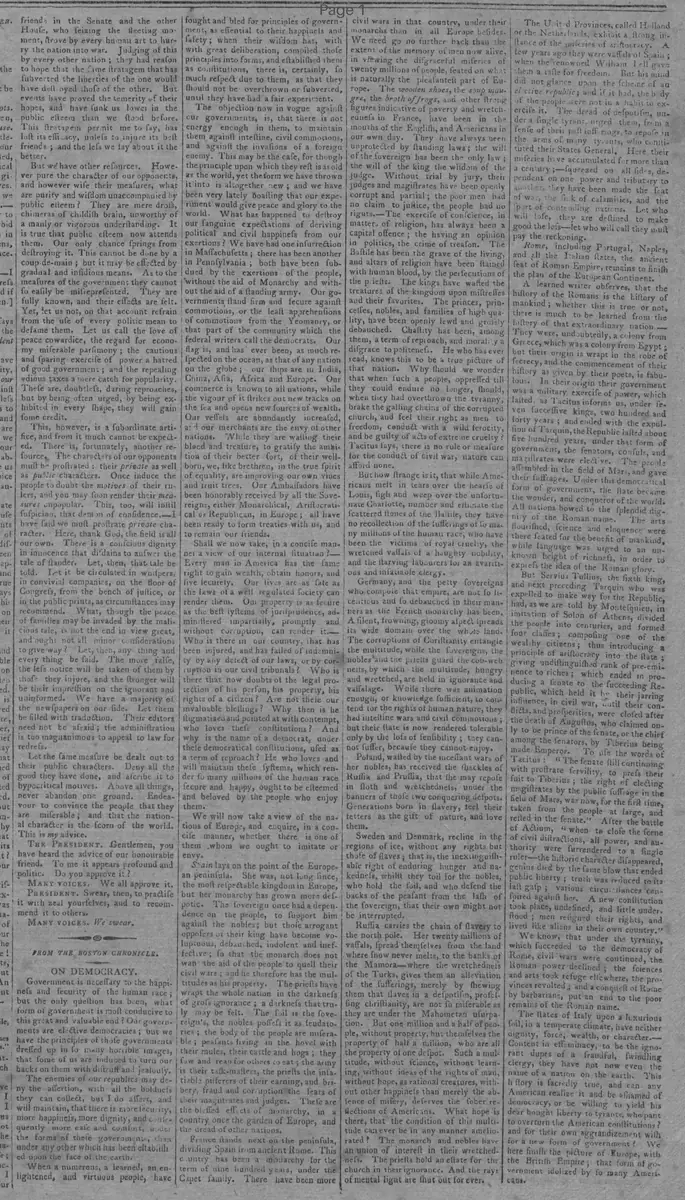
ON DEMOCRACY.
Government is necessary to the happiness and security of the human race; but the only question has been, what form of government is most conducive to this great and valuable end? Our governments are elective democracies; but we have the principles of those governments dressed up in so many horrible images, that some of us are induced to turn our backs on them with distrust and jealousy. The enemies of our republics may deny the assertion, with all the boldness they can collect, but I do assert, and will maintain, that there is more security, more happiness, more dignity, and consequently more ease and comfort, under the forms of these governments, than under any other which has been established on the face of the earth.
When a numerous, a learned, an enlightened, and virtuous people, have fought and bled for principles of government, as essential to their happiness and safety; when their wisdom has, with great deliberation, compiled those principles into forms, and established them as constitutions, there is, certainly, so much respect due to them, as that they should not be overthrown or subverted, until they have had a fair experiment.
The objection now in vogue against our governments, is, that there is not energy enough in them, to maintain them against intestine, civil commotions, and against the invasions of a foreign enemy. This may be the case, for though the principle upon which they rest is as old as the world, yet the form we have thrown it into is altogether new; and we have been very lately boasting that our experiment would give peace and glory to the world. What has happened to destroy our sanguine expectations of deriving political and civil happiness from our exertions? We have had one insurrection in Massachusetts; there has been another in Pennsylvania; both have been subdued by the exertions of the people, without the aid of Monarchy and without the aid of a standing army. Our governments stand firm and secure against commotions, or the least apprehensions of commotions from the Yeomanry, or that part of the community which the federal writers call the democrats. Our flag is, and has ever been, as much respected on the ocean, as that of any nation on the globe; our ships are in India, China, Asia, Africa and Europe. Our commerce is known to all nations, while the vigour of it strikes out new tracks on the sea and opens new sources of wealth. Our vessels are abundantly increased, and our merchants are the envy of other nations. While they are wasting their blood and treasure, to gratify the ambition of their better sort, of their well-born, we, like brethren, in the true spirit of equality, are improving our own vines and fruit trees. Our Ambassadors have been honorably received by all the Sovereigns, either Monarchical, Aristocratical or Republican, in Europe; all have been ready to form treaties with us, and to remain our friends.
Shall we now take, in a concise manner, a view of our internal situation? Every man in America has the same right to gain wealth, obtain honors, and live securely. Our lives are as safe as the laws of a well regulated society can render them. Our property is as secure as the best systems of jurisprudence, administered impartially, promptly and without corruption, can render it.—
Who is there in our country, that has been injured, and has failed of indemnity by any defect of our laws, or by corruption in our civil tribunals? Who is there that now doubts of the legal protection of his person, his property, his rights of a citizen? Are not these our invaluable blessings? Why then is he stigmatized and pointed at with contempt, who loves these constitutions? And why is the name of a democrat, under these democratical constitutions, used as a term of reproach? He who loves and will maintain these systems, which render so many millions of the human race secure and happy, ought to be esteemed and beloved by the people who enjoy them.
We will now take a view of the nations of Europe, and enquire, in a concise manner, whether there is one of them whom we ought to imitate or envy.
Spain lies on the point of the European peninsula. She was, not long since, the most respectable kingdom in Europe, but her monarchy has grown more despotic. The sovereign once had a dependence on the people, to support him against the nobles; but those arrogant opposers of their king have become voluptuous, debauched, indolent and ineffective; so that the monarch does not want the aid of the people to quell their civil wars; and he therefore has the multitudes as his property. The priests have wrapt the whole nation in the darkness of gross ignorance; a darkness that truly may be felt. The soil is the sovereign's, the nobles possess it as feudatories; the body of the people are miserable; peasants living in the hovel with their mules, their cattle and hogs; they sow and reap for others to eat; the army is their task-masters, the priests the insatiate pilferers of their earning, and bribery, fraud and corruption the feats of their magistrates and judges. These are the blessed effects of monarchy, in a country once the garden of Europe, and the dread of other nations.
France stands next on the peninsula, dividing Spain from ancient Rome. This country has been a monarchy for the term of nine hundred years, under the Capet family. There have been more civil wars in that country, under their monarchs than in all Europe besides. We need go no further back than the extent of the memory of men now alive, in viewing the disgraceful miseries of twenty millions of people, seated on what is naturally the pleasantest part of Europe. The wooden shoes, the soup maigre, the broth of frogs, and other strong figures indicative of poverty and wretchedness in France, have been in the mouths of the English, and Americans in our own day. They have always been unprotected by standing laws: the will of the sovereign has been the only law; the will of the king the wisdom of the judge. Without trial by jury, their judges and magistrates have been openly corrupt and partial; the poor men had no claim to justice, the people had no rights.—The exercise of conscience, in matters of religion, has always been a capital offence; the having an opinion in politics, the crime of treason. The Bastile has been the grave of the living. and altars of religion have been stained with human blood, by the persecutions of the priests. The kings have wasted the treasures of the kingdom upon mistresses and their favorites. The princes, princesses, nobles, and families of high quality, have been openly lewd and grossly debauched. Chastity has been, among them, a term of reproach, and morality a disgrace to politeness. He who has ever read, knows this to be a true picture of that nation. Why should we wonder that when such a people, oppressed till they could endure no longer, should, when they had overthrown the tyranny, break the galling chains of the corrupted church, and feel their right as men to freedom, conduct with a wild ferocity, and be guilty of acts of extreme cruelty?
Tacitus says, there is no rule or measure for the conduct of civil war, nature can afford none.
But how strange is it, that while Americans melt in tears over the hearse of Louis, sigh and weep over the unfortunate Charlotte, number and estimate the scattered bones of the Bastile, they have no recollection of the sufferings of so many millions of the human race, who have been the victims of royal cruelty, the wretched vassals of a haughty nobility, and the starving labourers for an avaritious and insatiate clergy.
Germany, and the petty sovereigns who compose that empire, are not so licentious and so debauched in their manners as the French monarchy has been. A silent, frowning, gloomy aspect spreads its wide domain over the whole land. The corruptions of Christianity entangle the multitude, while the sovereigns, the nobles and the priests guard the cob-web nets, by which the multitude, hungry and wretched, are held in ignorance and vassalage. While there was animation enough, or knowledge sufficient, to contend for the rights of human nature, they had intestine wars and civil commotions; but their state is now rendered tolerable only by the loss of sensibility; they cannot suffer, because they cannot enjoy.
Poland, wasted by the incessant wars of her nobles, has received the shackles of Russia and Prussia, that she may repose in sloth and wretchedness, under the banners of those two conquering despots. Generations born in slavery, feel their fetters as the gift of nature, and love them.
Sweden and Denmark, recline in the regions of ice, without any rights but those of slaves; that is, the inextinguishable right of enduring hunger and nakedness, whilst they toil for the nobles, who hold the soil, and who defend the backs of the peasant from the lash of the sovereign, that their own might not be interrupted.
Russia carries the chain of slavery to the north pole. Her twenty millions of vassals, spread themselves from the land where snow never melts, to the banks of the Marmora—where the wretchedness of the Turks, gives them an alleviation of the sufferings, merely by shewing them that slaves in a despotism, professing christianity, are not so miserable as they are under the Mahometan usurpation. But one million and a half of people, without property, hunt themselves the property of half a million, who are all the property of one despot. Such a multitude, without science, without learning, without ideas of the rights of man, without hope, as rational creatures, without other happiness than merely the absence of misery, deserves the sober reflections of Americans. What hope is there, that the condition of this multitude can ever be in any manner ameliorated? The monarch and nobles have an union of interest in their wretchedness. The priests hold an estate for the church in their ignorance. And the rays of mental light are shut out for ever.
The United Provinces, called Holland or the Netherlands, exhibit a strong instance of the miseries of aristocracy. A few years ago they were vassals of Spain; when the renowned William I fell, gave them a taste for freedom. But his mind did not glance upon the scheme of an elective republic; and if it had, the body of the people were not in a habit to exercise it. The dread of despotism, under a single tyrant, urged them, from a sense of their past sufferings, to repose in the arms of many tyrants, who constituted their States General. Here their miseries have accumulated for more than a century;—squeezed on all sides, dependent on one power and tributary to another, they have been made the seat of war, the sink of calamities, and the sport of contending nations. Let who will lose, they are destined to make good the loss—let who will call they must pay the reckoning.
Rome, including Portugal, Naples, and all the Italian states, the ancient seat of Roman Empire, remains to finish the plan of the European Continent.
A learned writer observes, that the history of the Romans is the history of mankind; whether this is true or not, there is much to be learned from the history of that extraordinary nation.—They were, undoubtedly, a colony from Greece, which was a colony from Egypt; but their origin is wrapt in the robe of secrecy, and the commencement of their history as given by their poets, is fabulous. In their origin their government was a military exercise of power, which lasted, as Tacitus informs us, under even twelve kings, two hundred and forty years; and ended with the expulsion of Tarquin, the Republic lasted about five hundred years, under that form of government, the senators, consuls, and magistrates were elective. The people assembled in the field of Mars, and gave their suffrages. Under this democratical form of government, the State became the wonder, and conqueror of the world. All nations bowed to the splendid dignity of the Roman name. The arts flourished, science and eloquence were there seated for the benefit of mankind, while language was urged to an unknown height of richness, in order to express the idea of the Roman glory.
But Servius Tullius, the sixth king, and next preceding Tarquin who was expelled to make way for the Republic, had, as we are told by Montequieu, in imitation of Solon of Athens, divided the people into centuries, and formed four classes; composing one of the wealthy citizens; thus introducing a principle of aristocracy into the state; giving undistinguished rank of pre-eminence to riches; which ended in producing a senate to the succeeding Republic, which held it by their jarring influence, in civil war, until their conflicts. and properties, were closed after the death of Augustus, who claimed only to be prince of the senate, or the chief among the senators, by Tiberius being made Emperor. To use the words of Tacitus: "The senate still continuing with prostrate servility, to press their suit to Tiberius; the right of electing magistrates by the public suffrage in the field of Mars, was now, for the first time, taken from the people at large, and rested in the senate." After the battle of Actium, "when to close the scene of civil distractions, all power, and authority were surrendered to a single ruler—the historic character disappeared, genius died by the same blow that ended public liberty: truth was reduced to its last gasp; various circumstances conspired against her. A new constitution took place, undefined, and little understood; men resigned their rights, and lived like aliens in their own country."
We know, that under the tyranny which succeeded to the democracy of Rome, civil wars were continued, the Roman power declined: the sciences and arts took refuge elsewhere, the provinces revolted; and a conquest of Rome by barbarians, put an end to the poor remains of the Roman name.
The states of Italy upon a luxurious soil, in a temperate climate, have neither dignity, force, wealth, or character.—Content in effeminacy, to be the ignorant dupes of a craftful, swindling clergy, they have not now even the name of a nation on the earth. This history is sacredly true, and can any American realize it and be ashamed of democracy, or be willing to yield his dear bought liberty to tyrants, who pant to overturn the American constitutions? and for their own aggrandizement with for a new form of government? We here finish the picture of Europe, with the British Empire; that form of government idolized by so many Americans.
About eight hundred years ago, England, including Scotland, and Ireland, were conquered by foreigners. Their form of government was feudal. The soil parcelled out to a few who held the multitude as slaves. The wars between their kings, and between the several kings and nobles, gave the people some share of knowledge, because they were useful to those ferocious warriors. By various conflicts, charters, and claims, they arrived to such a point of privilege, that their wealthy land holders must elect one branch of the legislature; and thus they gained what they called a mixed monarchy.
But examine their history, and view their condition; and see if you envy it, or covet their situation. Their lands are holden by a very few, a small part of the nation; and the people instead of being hungry vassals, as heretofore, are wretched tenants to a haughty aristocracy; having no voice in elections, but being governed by laws, to which they give no consent. It is true, that their tribunals of justice do them honor as a nation, and the subjects find protection in the laws. But a standing army, continual wars, the extravagance of royalty, and the expense of favorites of the ministry, drain them of all the wealth, which a well managed and rich commerce affords them. The arts flourish there, to raise taxes; the sciences bloom to exhibit and describe the folly of the rulers, and the wretchedness of the subjects. Their government, though eulogized by some Americans, does not afford internal security. There have been frequently civil wars, intestine commotions, and bloody contests among them; notwithstanding their boasted constitution. Their Edwards and their Henrys, have deluged the islands in blood. Elizabeth usurped the throne of Mary, and starved her in a dungeon— James her successor, was no more than a vassal of France. Charles his son, was brought to the block, by the voice of an injured and insulted nation. Cromwell tyrannized to support his own usurpation. Charles the second succeeded for a few years in disgrace and misery.— James his brother, was expelled to make room for William, who usurped his throne without the voice of the people, until a new Parliament was called, which under the influence of an army, established him. A civil, and bloody war, vexed Queen Anne in 1715. The civil war of 1745, (and a bloody one it was) came soon upon that. The foreign war, which ended in 1763, having been virtually continued from 1745, made way for a civil contest with their colonies; it began in the Stamp Act, in 1765, and ended in 1783; in the acknowledged independence of the United States. To this succeeded Lord George Gordon's insurrection; which buried the Metropolis of the Empire in terror, spread wasting conflagations through the Capitol; and attacked the very Arcana of state. The civil war in Ireland soon Succeeded to that; where the blood of thousands washed the sod which had been often wet with the tears of their miseries and oppressions; and even now, treason and conspiracies, are stalking forth, while the terror under which the monarch cringes, is every day proclaimed from the gallows. Six hundred millions of debt, oppresses the devoted islands—their resources are exhausted—the art of financing has given up its pursuit and an accumulation of the public burden then, by new and increased loans, serves as an opiate, where there is no cure for broken, worn out, and injured constitution.
What sub-type of article is it?
What keywords are associated?
What entities or persons were involved?
Editorial Details
Primary Topic
Defense Of American Elective Democracies Against Monarchical And Aristocratic Forms
Stance / Tone
Strongly Pro Democracy And Anti Monarchy
Key Figures
Key Arguments