Thank you for visiting SNEWPapers!
Sign up free
Literary
May 31, 1864
Juliet Signal
Juliet, Joliet, Will County County, Illinois
What is this article about?
In this sentimental short story, orphan Amy Lynn is forced by her dying father to marry the uneducated Ashly Lee. He leaves to improve himself, returns years later as a refined gentleman, and they reunite in genuine love, remarrying happily. Amy becomes a renowned musician.
Clipping
OCR Quality
85%
Good
Full Text
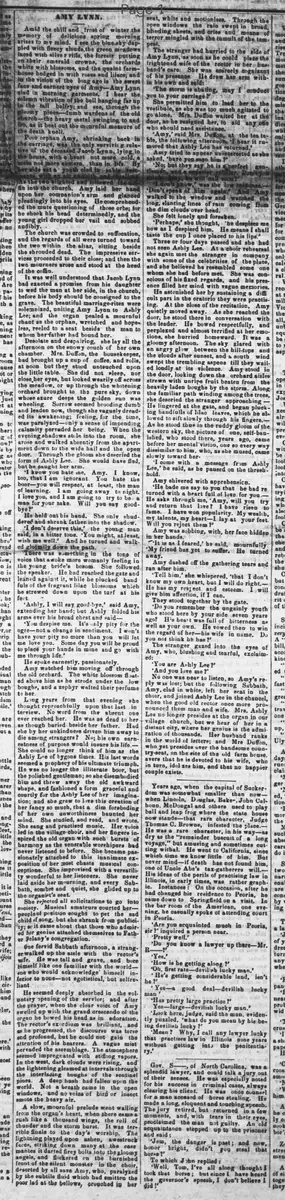
Amid the chill and frost of winter the memory of delicious spring mornings arises to my mind. I see the blue sky dappled with fleecy clouds, the green meadows laced with silver rills, the forests putting on their emerald crowns, the orchards white with blossoms, and the quaint farm-house hedged in with roses and lilacs; and in the vision of the long ago is the sweet face and earnest eyes of Amy—Amy Lynn clad in morning garments. I hear the solemn vibration of the bell hanging far up in the tall belfry; and see, through the gloomy pines dumb wardens of the old church—the heavy metal swinging to and fro, as it beat out the mournful measure of the death knell.
Poor orphan Amy, shrinking back in the carriage, was the only surviving relative of the deceased Jacob Lynn, lying in the house, with a heart not more cold, a mien not more austere, than in life. By her side sat a youth clad in sable garments—satin and crape mourning.
As the two alighted and followed the coffin into the church. Amy laid her hand upon her companion's arm and glanced pleadingly into his eyes. He comprehended the mute questioning of those orbs; for he shook his head determinedly, and the young girl dropped her veil and sobbed audibly.
The church was crowded to suffocation, and the regards of all were turned toward the two within the altar, sitting beside the shrouded dead. The impressive services proceeded to their close; and then the two mourners arose and stood at the head of the coffin.
It was well understood that Jacob Lyon had exacted a promise from his daughter to wed the man at her side, in the church, before his body should be consigned to the grave. The beautiful marriage-rites were solemnized, uniting Amy Lyon to Ashly Lee; and the organ pealed a mournful chant as the orphan, wretched and hopeless, reeled to a seat beside the man to whom her father had bound her.
Desolate and despairing, she lay all the afternoon on the snowy couch of her own chamber. Mrs. Duffon, the housekeeper, had brought up a cup of coffee, and rolls, at noon but they stood untouched upon the little table. She did not sleep, nor close her eyes, but looked wearily off across the meadow, or up through the whitening orchard brought to the pure sky, down whose azure deeps the golden sun was wheeling. Sorrow seemed brooding dumb and leaden now, though she vaguely dreaded its awakening; feeling, for the time, was paralyzed—only a sense of impending calamity pervaded her being. When the evening shadows stole into the room, she arose and walked absently from the apartment down to the wide hall and the open door. Through the gloom she descried the form of Ashly Lee. She would have fled, but he caught her arm.
'I know you hate me, Amy. I know, too, that I am ignorant. You hate the boor—you will respect, at least, the man of learning. I am going away to-night. I love you, and I am going to try to be a man for your sake. Will you say good-bye?'
He held out his hand. She only shuddered and shrank farther into the shadow.
'I don't deserve this,' the young man said, in a bitter tone. 'You might, at least, wish me well.' And he turned and walked gloomily down the path.
There was something in the tone of voice that awoke more womanly feeling in the young bride's bosom. She followed the speaker. He had reached the gate and leaned against it, while he plucked handfuls of the fragrant lilac blossoms which he strewed down upon the turf at his feet.
'Ashly, I will say good-bye,' said Amy, extending her hand; but Ashly folded his arms over his broad chest and said—
'You despise me. It's only pity for the ogre—not a change in sentiment. I won't have your pity no more than you will let me love you. Some day you will be proud to place your hands in mine and go with me through life.'
He spoke earnestly, passionately.
Amy watched him moving off through the old orchard. The white blossoms floated above him as he strode under the low boughs, and a zephyr wafted their perfume to her.
Long years from that evening she thought reproachfully upon that last interview. No word from the absent one ever reached her. He was as dead to her as though buried beside her father. Had she by her unkindness driven him away to die among strangers? No; his own earnestness of purpose would insure his life.— She could no longer think of him as the Ashly Lee of bygone times. His last words seemed a prophecy of his ultimate triumph. He was no longer the illiterate boor, but the polished gentleman; so she disembodied him and threw away the old awkward shape, and fashioned a form graceful and courtly for the Ashly Lee of her imagination; and she grew to love this creation of her fancy so much, that a dim foreboding of her own unworthiness haunted her mind. She studied, and read, and wrote. She sang and practiced music. Her voice led in the village-choir, and her fingers inspired the old organ with such bursts of harmony as the venerable worshipers had never listened to before. She became passionately attached to this inanimate expression of her most chaste musical conceptions. She improvised with a versatility wonderful to her listeners. She never laid aside her mourning, and every Sabbath, sombre and quiet, she glided up to the organist's seat.
She rejected all solicitations to go into society. Musical amateurs courted her—people of position sought to pet the sad child of song, but she shrank from publicity; so it came about that those who admired her genius attached themselves to Father Pelany's congregation.
One fervid Sabbath afternoon, a stranger walked up the aisle with the rector's wife. He was tall and grave, and bore himself like one familiar with the world—one who would acknowledge himself inferior to none—not egotistical, but self-reliant. He seemed deeply absorbed in the voluntary opening of the service; and after the prayer, when the clear voice of Amy swelled up with the grand crescendo of the organ he bowed his head as in adoration.
The rector's exordium was brilliant, and as he progressed, the discourse was terse and profound, but he could not gain the attention of his bearers. A vague mist pervaded the assemblage. The atmosphere seemed impregnated with stifling vapors. In the west, dark clouds were rising, and the lightning gleamed at intervals through the interlacing boughs of the sentinel pines. A deep hush had fallen upon the world. Not a breath came in the open windows, and no voice of bird or insect smote the heavy air.
A slow, mournful prelude went wailing from the organ's heart, when there came a rush like a thousand wings, the roll of thunder and the storm burst. It was a terrible finale to the day's worship. The lightning played upon ashen, sweet-struck faces, striking down many at the casements it darted fiery bolts into the gloomy angels, and flickered on the burnished front of the silent monster in the choir, deserted by all save Amy, who, paralyzed by the subtile fluid which had smitten the poor lad at the bellows, crouched in her seat, white and motionless. Through the open windows the rain swept in broad, blinding sheets, and cries and moans of terror mingled with the tumult of the tempest.
The stranger had hurried to the side of Amy Lynn, as soon as he could place the frightened wife of the rector in her husband's care. She was scarcely cognizant of his presence. He drew her arm within his own and said:
The storm is abating, may I conduct you to your carriage
She permitted him to lead her to the vestibule, as she was too much agitated to go alone. Mrs. Duffon waited her at the door, so he resigned her, to aid any one who should need assistance.
Amy,' said Mrs. Duffon; at the tea table, the following afternoon 'I hear it rumored that Ashly Lee has returned.'
Amy tried to appear uninterested as she asked, 'have you seen him?'
'No; but they say he is a perfect gentleman, and a superior athlete. I believe he will call soon?'
'I don't know' was the low response.—
Don't speak of him again.' And Amy walked to the window and watched the long, slanting lines of rain coming from the dim clouds overhead.
She felt lonely and forsaken. 'Perhaps,' she thought, 'he despises me now as I despised him. He means I shall taste the cup I once placed to his lips.'
Three or four days passed and she had not seen Ashly Lee. At a choir rehearsal she again met the stranger in company with some of the celebrities of the place, and she believed he resembled some one whom she had before met. She was conscious of his fixed regards, and his presence filled her mind with vague memories. He astonished her by sustaining a difficult part in the oratorio they were practicing. At the close of the recitation, Amy quietly moved away. As she reached the door, he stood there in conversation with the leader. He bowed respectfully, and perplexed and almost terrified at her emotions, she hurried homeward. It was a gloomy afternoon. The sky glared with an angry glow between the hill-tops and the clouds after sunset, and a south wind swept the trembling aspens till they wailed loudly at its violence. Amy stood in the door, looking down the orchard aisles strewn with unripe fruit beaten from the heavily laden boughs by the storm. Along the familiar path winding among the trees, she descried the stranger approaching— He lingered at the gate, and began plucking handfuls of lilac leaves, which he allowed to sift slowly through his fingers.— As he stood thus in the ruddy gloom of the western sky, the picture of one, self-banished, who stood there, years ago, came before her mental vision, one so every way dissimilar to him, who, as she mused, came slowly toward her.
'I come with a message from Ashly Lee,' he said, as he paused on the threshold.
Amy shivered with apprehension.
'He bade me say to you that he had returned with a heart full of love for you.— He asks through me, Amy, will you try and return that love? I have risen to fame. I have won popularity. My wealth, my talents, my heart—I lay at your feet. Will you reject them?'
Amy was sobbing, with her face hidden in her hands.
'It is as I feared,' he said, mournfully: 'My friend has yet to suffer.' He turned away.
Amy dashed off the gathering tears and ran after him.
'Tell him,' she whispered, 'that I don't know my own heart, but I will do right.— He has my respect and esteem. I will give him affection, if I can.'
They stood together by the gate.
'Do you remember the ungainly youth who stood here by your side seven years ago? His heart was full of bitterness as well as your own. He vowed then to win the regard of her—his wife in name. Do you not think he has?'
The stranger gazed into the eyes of Amy, who, blushing and tearful, exclaimed:
'You are Ashly Lee?'
'And you love me?'
No one was near to listen, so Amy's reply was lost; but the following Sabbath, Amy, clad in white, left her seat in the choir, and joined Ashly Lee in the chancel, when the good old rector once more pronounced them man and wife. Mrs. Ashly Lee no longer presides at the organ in our village church, but we hear of her in a distant city, where her genius is the admiration of thousands. Her husband ranks in the world of letters; and Mrs. Duffon, who yet presides over the handsome country-seat, on the site of the old farm house, avers that he is devoted to his wife, who in turn, idolizes him, and that no happier couple exists.
Poor orphan Amy, shrinking back in the carriage, was the only surviving relative of the deceased Jacob Lynn, lying in the house, with a heart not more cold, a mien not more austere, than in life. By her side sat a youth clad in sable garments—satin and crape mourning.
As the two alighted and followed the coffin into the church. Amy laid her hand upon her companion's arm and glanced pleadingly into his eyes. He comprehended the mute questioning of those orbs; for he shook his head determinedly, and the young girl dropped her veil and sobbed audibly.
The church was crowded to suffocation, and the regards of all were turned toward the two within the altar, sitting beside the shrouded dead. The impressive services proceeded to their close; and then the two mourners arose and stood at the head of the coffin.
It was well understood that Jacob Lyon had exacted a promise from his daughter to wed the man at her side, in the church, before his body should be consigned to the grave. The beautiful marriage-rites were solemnized, uniting Amy Lyon to Ashly Lee; and the organ pealed a mournful chant as the orphan, wretched and hopeless, reeled to a seat beside the man to whom her father had bound her.
Desolate and despairing, she lay all the afternoon on the snowy couch of her own chamber. Mrs. Duffon, the housekeeper, had brought up a cup of coffee, and rolls, at noon but they stood untouched upon the little table. She did not sleep, nor close her eyes, but looked wearily off across the meadow, or up through the whitening orchard brought to the pure sky, down whose azure deeps the golden sun was wheeling. Sorrow seemed brooding dumb and leaden now, though she vaguely dreaded its awakening; feeling, for the time, was paralyzed—only a sense of impending calamity pervaded her being. When the evening shadows stole into the room, she arose and walked absently from the apartment down to the wide hall and the open door. Through the gloom she descried the form of Ashly Lee. She would have fled, but he caught her arm.
'I know you hate me, Amy. I know, too, that I am ignorant. You hate the boor—you will respect, at least, the man of learning. I am going away to-night. I love you, and I am going to try to be a man for your sake. Will you say good-bye?'
He held out his hand. She only shuddered and shrank farther into the shadow.
'I don't deserve this,' the young man said, in a bitter tone. 'You might, at least, wish me well.' And he turned and walked gloomily down the path.
There was something in the tone of voice that awoke more womanly feeling in the young bride's bosom. She followed the speaker. He had reached the gate and leaned against it, while he plucked handfuls of the fragrant lilac blossoms which he strewed down upon the turf at his feet.
'Ashly, I will say good-bye,' said Amy, extending her hand; but Ashly folded his arms over his broad chest and said—
'You despise me. It's only pity for the ogre—not a change in sentiment. I won't have your pity no more than you will let me love you. Some day you will be proud to place your hands in mine and go with me through life.'
He spoke earnestly, passionately.
Amy watched him moving off through the old orchard. The white blossoms floated above him as he strode under the low boughs, and a zephyr wafted their perfume to her.
Long years from that evening she thought reproachfully upon that last interview. No word from the absent one ever reached her. He was as dead to her as though buried beside her father. Had she by her unkindness driven him away to die among strangers? No; his own earnestness of purpose would insure his life.— She could no longer think of him as the Ashly Lee of bygone times. His last words seemed a prophecy of his ultimate triumph. He was no longer the illiterate boor, but the polished gentleman; so she disembodied him and threw away the old awkward shape, and fashioned a form graceful and courtly for the Ashly Lee of her imagination; and she grew to love this creation of her fancy so much, that a dim foreboding of her own unworthiness haunted her mind. She studied, and read, and wrote. She sang and practiced music. Her voice led in the village-choir, and her fingers inspired the old organ with such bursts of harmony as the venerable worshipers had never listened to before. She became passionately attached to this inanimate expression of her most chaste musical conceptions. She improvised with a versatility wonderful to her listeners. She never laid aside her mourning, and every Sabbath, sombre and quiet, she glided up to the organist's seat.
She rejected all solicitations to go into society. Musical amateurs courted her—people of position sought to pet the sad child of song, but she shrank from publicity; so it came about that those who admired her genius attached themselves to Father Pelany's congregation.
One fervid Sabbath afternoon, a stranger walked up the aisle with the rector's wife. He was tall and grave, and bore himself like one familiar with the world—one who would acknowledge himself inferior to none—not egotistical, but self-reliant. He seemed deeply absorbed in the voluntary opening of the service; and after the prayer, when the clear voice of Amy swelled up with the grand crescendo of the organ he bowed his head as in adoration.
The rector's exordium was brilliant, and as he progressed, the discourse was terse and profound, but he could not gain the attention of his bearers. A vague mist pervaded the assemblage. The atmosphere seemed impregnated with stifling vapors. In the west, dark clouds were rising, and the lightning gleamed at intervals through the interlacing boughs of the sentinel pines. A deep hush had fallen upon the world. Not a breath came in the open windows, and no voice of bird or insect smote the heavy air.
A slow, mournful prelude went wailing from the organ's heart, when there came a rush like a thousand wings, the roll of thunder and the storm burst. It was a terrible finale to the day's worship. The lightning played upon ashen, sweet-struck faces, striking down many at the casements it darted fiery bolts into the gloomy angels, and flickered on the burnished front of the silent monster in the choir, deserted by all save Amy, who, paralyzed by the subtile fluid which had smitten the poor lad at the bellows, crouched in her seat, white and motionless. Through the open windows the rain swept in broad, blinding sheets, and cries and moans of terror mingled with the tumult of the tempest.
The stranger had hurried to the side of Amy Lynn, as soon as he could place the frightened wife of the rector in her husband's care. She was scarcely cognizant of his presence. He drew her arm within his own and said:
The storm is abating, may I conduct you to your carriage
She permitted him to lead her to the vestibule, as she was too much agitated to go alone. Mrs. Duffon waited her at the door, so he resigned her, to aid any one who should need assistance.
Amy,' said Mrs. Duffon; at the tea table, the following afternoon 'I hear it rumored that Ashly Lee has returned.'
Amy tried to appear uninterested as she asked, 'have you seen him?'
'No; but they say he is a perfect gentleman, and a superior athlete. I believe he will call soon?'
'I don't know' was the low response.—
Don't speak of him again.' And Amy walked to the window and watched the long, slanting lines of rain coming from the dim clouds overhead.
She felt lonely and forsaken. 'Perhaps,' she thought, 'he despises me now as I despised him. He means I shall taste the cup I once placed to his lips.'
Three or four days passed and she had not seen Ashly Lee. At a choir rehearsal she again met the stranger in company with some of the celebrities of the place, and she believed he resembled some one whom she had before met. She was conscious of his fixed regards, and his presence filled her mind with vague memories. He astonished her by sustaining a difficult part in the oratorio they were practicing. At the close of the recitation, Amy quietly moved away. As she reached the door, he stood there in conversation with the leader. He bowed respectfully, and perplexed and almost terrified at her emotions, she hurried homeward. It was a gloomy afternoon. The sky glared with an angry glow between the hill-tops and the clouds after sunset, and a south wind swept the trembling aspens till they wailed loudly at its violence. Amy stood in the door, looking down the orchard aisles strewn with unripe fruit beaten from the heavily laden boughs by the storm. Along the familiar path winding among the trees, she descried the stranger approaching— He lingered at the gate, and began plucking handfuls of lilac leaves, which he allowed to sift slowly through his fingers.— As he stood thus in the ruddy gloom of the western sky, the picture of one, self-banished, who stood there, years ago, came before her mental vision, one so every way dissimilar to him, who, as she mused, came slowly toward her.
'I come with a message from Ashly Lee,' he said, as he paused on the threshold.
Amy shivered with apprehension.
'He bade me say to you that he had returned with a heart full of love for you.— He asks through me, Amy, will you try and return that love? I have risen to fame. I have won popularity. My wealth, my talents, my heart—I lay at your feet. Will you reject them?'
Amy was sobbing, with her face hidden in her hands.
'It is as I feared,' he said, mournfully: 'My friend has yet to suffer.' He turned away.
Amy dashed off the gathering tears and ran after him.
'Tell him,' she whispered, 'that I don't know my own heart, but I will do right.— He has my respect and esteem. I will give him affection, if I can.'
They stood together by the gate.
'Do you remember the ungainly youth who stood here by your side seven years ago? His heart was full of bitterness as well as your own. He vowed then to win the regard of her—his wife in name. Do you not think he has?'
The stranger gazed into the eyes of Amy, who, blushing and tearful, exclaimed:
'You are Ashly Lee?'
'And you love me?'
No one was near to listen, so Amy's reply was lost; but the following Sabbath, Amy, clad in white, left her seat in the choir, and joined Ashly Lee in the chancel, when the good old rector once more pronounced them man and wife. Mrs. Ashly Lee no longer presides at the organ in our village church, but we hear of her in a distant city, where her genius is the admiration of thousands. Her husband ranks in the world of letters; and Mrs. Duffon, who yet presides over the handsome country-seat, on the site of the old farm house, avers that he is devoted to his wife, who in turn, idolizes him, and that no happier couple exists.
What sub-type of article is it?
Prose Fiction
What themes does it cover?
Love Romance
Moral Virtue
Social Manners
What keywords are associated?
Forced Marriage
Self Improvement
Romantic Reunion
Village Life
Musical Genius
Redemption
Literary Details
Key Lines
'I Know You Hate Me, Amy. I Know, Too, That I Am Ignorant. You Hate The Boor—You Will Respect, At Least, The Man Of Learning. I Am Going Away To Night. I Love You, And I Am Going To Try To Be A Man For Your Sake. Will You Say Good Bye?'
'You Despise Me. It's Only Pity For The Ogre—Not A Change In Sentiment. I Won't Have Your Pity No More Than You Will Let Me Love You. Some Day You Will Be Proud To Place Your Hands In Mine And Go With Me Through Life.'
'I Come With A Message From Ashly Lee,' He Said, As He Paused On The Threshold.
'Do You Remember The Ungainly Youth Who Stood Here By Your Side Seven Years Ago? His Heart Was Full Of Bitterness As Well As Your Own. He Vowed Then To Win The Regard Of Her—His Wife In Name. Do You Not Think He Has?'
Mrs. Ashly Lee No Longer Presides At The Organ In Our Village Church, But We Hear Of Her In A Distant City, Where Her Genius Is The Admiration Of Thousands.