Thank you for visiting SNEWPapers!
Sign up free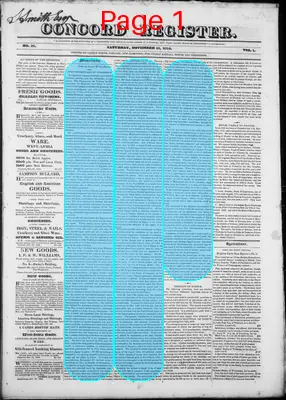
Concord Register
Concord, Merrimack County, New Hampshire
What is this article about?
The London Weekly Express article explores the instability of commerce through history, focusing on Muhammad Ali's efforts to revive Egyptian trade. It details the 1819 Mahmoudiyah Canal construction, booming cotton production since 1822, and its potential to rival U.S. supplies, benefiting British commerce while challenging American exports.
Clipping
OCR Quality
Full Text
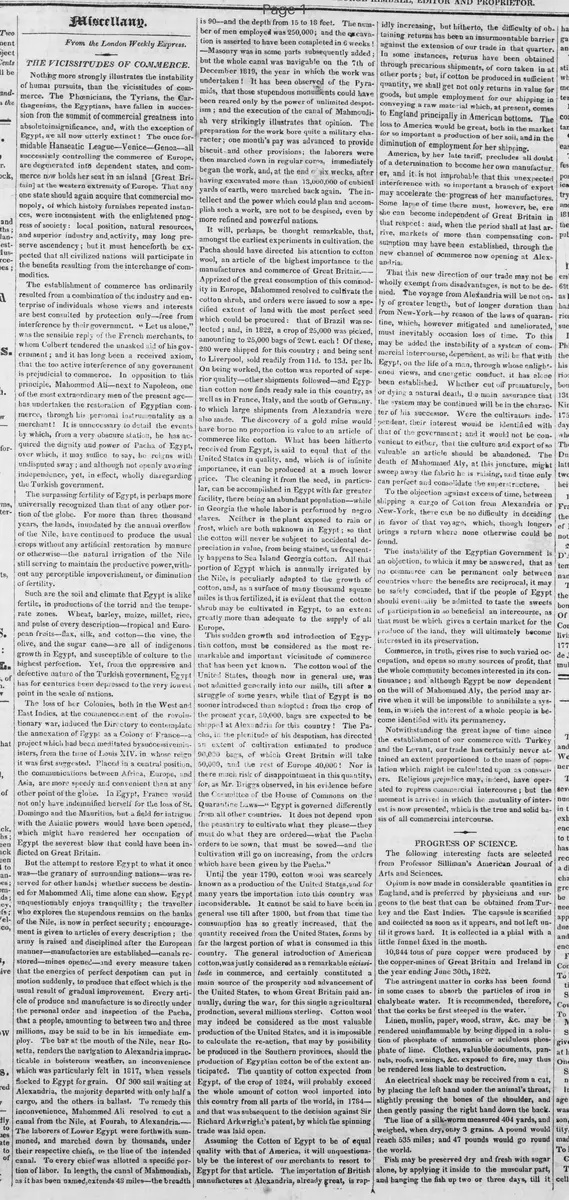
From the London Weekly Express.
THE VICISSITUDES OF COMMERCE.
Nothing more strongly illustrates the instability
of human pursuits, than the vicissitudes of com-
merce. The Phœnicians, the Tyrians, the Car-
thagenians, the Egyptians, have fallen in succes-
sion from the summit of commercial greatness into
absolute insignificance, and, with the exception of
Egypt, are all now utterly extinct! The once for-
midable Hanseatic League—Venice—Genoa—all
successively controlling the commerce of Europe,
are degenerated into dependent states, and com-
merce now holds her seat in an island [Great Bri-
tain] at the western extremity of Europe. That any
one state should again acquire that commercial mo-
nopoly, of which history furnishes repeated instan-
ces, were inconsistent with the enlightened prog-
ress of society: local position, natural resources,
and superior industry and activity, may long pre-
serve ascendency; but it must henceforth be ex-
pected that all civilized nations will participate in
the benefits resulting from the interchange of com-
modities.
The establishment of commerce has ordinarily
resulted from a combination of the industry and en-
terprise of individuals whose views and interests
are best consulted by protection only—free from
interference by their government. "Let us alone,"
was the sensible reply of the French merchants, to
whom Colbert tendered the unasked aid of his gov-
vernment; and it has long been a received axiom,
that the too active interference of any government
is prejudicial to commerce. In opposition to this
principle, Mahommed Ali—next to Napoleon, one
of the most extraordinary men of the present age
has undertaken the restoration of Egyptian com-
merce, through his personal instrumentality as a
merchant! It is unnecessary to detail the events
by which, from a very obscure station, he has ac-
quired the dignity and power of Pacha of Egypt,
over which, it may suffice to say, he reigns with
undisputed sway; and although not openly avowing
independence, yet, in effect, wholly disregarding
the Turkish government.
The surpassing fertility of Egypt, is perhaps more
universally recognized than that of any other por-
tion of the globe. For more than three thousand
years, the lands, inundated by the annual overflow
of the Nile, have continued to produce the usual
crops without any artificial restoration by manure
or otherwise—the natural irrigation of the Nile
still serving to maintain the productive power, with-
out any perceptible impoverishment, or diminution
of fertility.
Such are the soil and climate that Egypt is alike
fertile, in productions of the torrid and the tempe-
rate zones. Wheat, barley, maize, millet, rice,
and pulse of every description—tropical and Euro-
pean fruits—flax, silk, and cotton—the vine, the
olive, and the sugar cane—are all of indigenous
growth in Egypt, and susceptible of culture to the
highest perfection. Yet, from the oppressive and
defective nature of the Turkish government, Egypt
has for centuries been depressed to the very lowest
point in the scale of nations.
The loss of her Colonies, both in the West and
East Indies, at the commencement of the revolu-
tionary war, induced the Directory to contemplate
the annexation of Egypt as a Colony of France—a
project which had been meditated by successive mi-
nisters, from the time of Louis XIV. in whose reign
it was first suggested. Placed in a central position,
the communications between Africa, Europe, and
Asia, are more speedy and convenient than at any
other point of the globe. In Egypt, France would
not only have indemnified herself for the loss of St.
Domingo and the Mauritius, but a field for intrigue
with the Asiatic powers would have been opened,
which might have rendered her occupation of
Egypt the severest blow that could have been in-
flicted on Great Britain.
But the attempt to restore Egypt to what it once
was—the granary of surrounding nations—was re-
served for other hands; whether success be destin-
ed for Mahommed Ali, time alone can show. Egypt
unquestionably enjoys tranquillity; the traveller
who explores the stupendous remains on the banks
of the Nile, is now in perfect security; encourage-
ment is given to articles of every description; the
army is raised and disciplined after the European
manner—manufactories are established—canals re-
stored—mines opened—and every measure taken
that the energies of perfect despotism can put in
motion suddenly, to produce that effect which is the
usual result of gradual improvement. Every arti-
cle of produce and manufacture is so directly under
the personal order and inspection of the Pacha,
that a people, amounting to between two and three
millions, may be said to be in his immediate em-
ploy. The bar at the mouth of the Nile, near Ro-
setta, renders the navigation to Alexandria imprac-
ticable in boisterous weather, an inconvenience
which was particularly felt in 1817, when vessels
flocked to Egypt for grain. Of 300 sail waiting at
Alexandria, the majority departed with only half a
cargo, and the others in ballast. To remedy this
inconvenience, Mahommed Ali resolved to cut a
canal from the Nile, at Fouah, to Alexandria.
The laborers of Lower Egypt were forthwith sum-
moned, and marched down by thousands, under
their respective chiefs, to the line of the intended
canal. To every chief was allotted a specific por-
tion of labor. In length, the canal of Mahmoudiah,
as it has been named, extends 48 miles—the breadth
is 90—and the depth from 15 to 18 feet. The num-
ber of men employed was 250,000; and the excava-
tion is asserted to have been completed in 6 weeks!
—Masonry was in some parts subsequently added;
but the whole canal was navigable on the 7th of
December 1819, the year in which the work was
undertaken! It has been observed of the Pyra-
mids, that those stupendous monuments could have
been reared only by the power of unlimited despo-
tism; and the execution of the canal of Mahmoudi-
ah very strikingly illustrates that opinion. The
preparation for the work bore quite a military cha-
racter; one month's pay was advanced to provide
biscuit—and other provisions; the laborers were
then marched down in regular corps, immediately
began the work, and, at the end of six weeks, after
having excavated more than 13,000,000 of cubical
yards of earth, were marched back again. The in-
tellect and the power which could plan and accom-
plish such a work, are not to be despised, even by
more refined and powerful nations.
It will, perhaps, be thought remarkable, that,
amongst the earliest experiments in cultivation, the
Pacha should have directed his attention to cotton
wool, an article of the highest importance to the
manufactures and commerce of Great Britain.
Apprized of the great consumption of this commod-
ity in Europe, Mahommed resolved to cultivate the
cotton shrub, and orders were issued to sow a spe-
cified extent of land with the most perfect seed
which could be procured: that of Brazil was se-
lected; and, in 1822, a crop of 25,000 was picked,
amounting to 25,000 bags of 2 cwt. each! Of these,
280 were shipped for this country; and being sent
to Liverpool, sold readily from 11d. to 13d. per lb.
On being worked, the cotton was reported of supe-
rior quality—other shipments followed—and Egyp-
tian cotton now finds ready sale in this country, as
well as in France, Italy, and the south of Germany,
to which large shipments from Alexandria were
also made. The discovery of a gold mine would
have borne no proportion in value to an article of
commerce like cotton. What has been hitherto
received from Egypt, is said to equal that of the
United States in quality, and, which is of infinite
inportance, it can be produced at a much lower
price. The cleaning it from the seed, in particu-
lar, can be accomplished in Egypt with far greater
facility, there being an abundant population—while
in Georgia the whole labor is performed by negro
slaves. Neither is the plant exposed to rain or
frost, which are both unknown in Egypt; so that
the cotton will never be subject to accidental de-
preciation in value, from being stained, as frequent-
ly happens to Sea Island Georgia cotton. All that
portion of Egypt which is annually irrigated by
the Nile, is peculiarly adapted to the growth of
cotton, and, as a surface of many thousand square
miles is thus fertilized, it is evident that the cotton
shrub may be cultivated in Egypt, to an extent
greatly more than adequate to the supply of all
Europe.
This sudden growth and introduction of Egyp-
tian cotton, must be considered as the most re-
markable and important vicissitude of commerce
that has been yet known. The cotton wool of the
United States, though now in general use, was
not admitted generally into our mills, till after a
struggle of some years, while that of Egypt is no
sooner introduced than adopted: from the crop of
the present year, 50,000 bags are expected to be
shipped at Alexandria for this country! The Pa-
cha, in the plenitude of his despotism, has directed
an extent of cultivation estimated to produce
90,000 bags, of which Great Britain will take
50,000, and the rest of Europe 40,000! Nor is
there much risk of disappointment in this quantity,
for, as Mr. Briggs observed, in his evidence before
the Committee of the House of Commons on the
Quarantine Laws—“Egypt is governed differently
from all other countries. It does not depend upon
the peasantry to cultivate what they please—they
must do what they are ordered—what the Pacha
orders to be sown, that must be sowed—and the
cultivation will go on increasing, from the orders
which have been given by the Pacha.”
Until the year 1790, cotton wool was scarcely
known as a production of the United States, and for
many years the importation into this country was
inconsiderable. It cannot be said to have been in
general use till after 1800, but from that time the
consumption has so greatly increased, that the
quantity received from the United States, forms by
far the largest portion of what is consumed in this
country. The general introduction of American
cotton, was justly considered as a remarkable vicissi-
tude in commerce, and certainly constituted a
main source of the prosperity and advancement of
the United States, to whom Great Britain paid an-
nually, during the war, for this single agricultural
prodnction, several millions sterling. Cotton wool
may indeed be considered as the most valuable
production of the United States, and it is impossible
to calculate the re-action, that may by possibility
be produced in the Southern provinces, should the
production of Egyptian cotton be of the extent an-
ticipated. The quantity of cotton expected from
Egypt, of the crop of 1824, will probably exceed
the whole amount of cotton wool imported into
this country from all parts of the world, in 1784—
and that was subsequent to the decision against Sir
Richard Arkwright's patent, by which the spinning
trade was laid open.
Assuming the Cotton of Egypt to be of equal
quality with that of America, it will unquestiona-
bly be the interest of our merchants to resort to
Egypt for that article. The importation of British
manufactures at Alexandria, already great, is rap-
idly increasing, but hitherto, the difficulty of ob-
taining returns has been an insurmountable barrier
against the extension of our trade in that quarter.
In some instances, returns have been obtained
through precarious shipments, of corn taken in at
other ports; but, if cotton be produced in sufficient
quantity, we shall get not only returns in value for
goods, but ample employment for our shipping in
conveying a raw material which, at present, comes
to England principally in American bottoms. The
loss to America would be great, both in the market
for so important a production of her soil, and in the
diminution of employment for her shipping.
America, by her late tariff, precludes all doubt
of a determination to become her own manufactur-
er, and it is not improbable that this unexpected
interference with so important a branch of export
may accelerate the progress of her manufactures.
Some lapse of time there must, however, be, ere
she can become independent of Great Britain in
that respect: and, when the period shall at last ar-
rive, markets of more than compensating con-
sumption may have been established, through the
new channel of commerce now opening at Alex-
andria.
That this new direction of our trade may not be
wholly exempt from disadvantages, is not to be de-
nied. The voyage from Alexandria will be not on-
ly of greater length, but of longer duration than
from New-York—by reason of the laws of quaran-
tine, which, however mitigated and ameliorated,
must inevitably occasion loss of time. To this
may be added the instability of a system of com-
mercial intercourse, dependent, as will be that with
Egypt, on the life of a man, through whose enlight-
ened views, and energetic conduct, it has alone
been established. Whether cut off prematurely,
or dying a natural death, the main assurance that
the system may be continued will be in the charac-
ter of his successor. Were the cultivators inde-
pendent, their interest would be identified with
that of the government; and it would not be con-
venient to either, that the culture and export of so
valuable an article should be abandoned. The
death of Mahommed Ali, at this juncture, might
sweep away the fabric he is raising, and time only
can perfect and consolidate the superstructure.
To the objection against excess of time, between
shipping a cargo of Cotton from Alexandria or
New-York, there can be no difficulty in deciding
in favor of that voyage, which, though longer,
brings a return where none otherwise could be
found.
The instability of the Egyptian Government is
an objection, to which it may be answered, that as
no commerce can be permanent only between
countries where the benefits are reciprocal, it may
be safely concluded, that if the people of Egypt
should eventually be admitted to taste the sweets
of participation in so beneficial an intercourse, as
that must be which gives a certain market for the
produce of the land, they will ultimately become
interested in its preservation.
Commerce, in truth, gives rise to such varied oc-
cupation, and opens so many sources of profit, that
the whole community becomes interested in its con-
tinuance; and although Egypt be now dependent
on the will of Mahommed Ali, the period may ar-
rive when it will be impossible to annihilate a sys-
tem, in which the interest of a whole people is be-
come identified with its permanency.
Notwithstanding the great lapse of time since
the establishment of our commerce with Turkey
and the Levant, our trade has certainly never at-
tained an extent proportioned to the mass of popu-
lation which might be calculated upon as consum-
ers. Religious prejudice may, indeed, have oper-
ated to repress commercial intercourse; but the
moment is arrived in which the mutuality of inter-
est is now presented, which is the true and solid ba-
sis of all commercial intercourse.
What sub-type of article is it?
What keywords are associated?
What entities or persons were involved?
Where did it happen?
Foreign News Details
Primary Location
Egypt
Event Date
1817 1824
Key Persons
Outcome
construction of mahmoudiyah canal completed in 1819; cotton production reached 25,000 bags in 1822, expected 90,000 bags by 1824, rivaling u.s. supplies and boosting british trade while potentially harming american exports.
Event Details
The article examines historical shifts in global commerce, emphasizing Muhammad Ali's despotic reforms in Egypt to revive trade, including building the Mahmoudiyah Canal to improve navigation, promoting cotton cultivation using Brazilian seeds, and establishing manufactories, leading to increased exports to Europe and implications for British and American economies.