Thank you for visiting SNEWPapers!
Sign up free
The Daily Union
Washington, District Of Columbia
What is this article about?
Preparations for building a U.S. government floating battery for harbor defense are advancing at Hoboken under contractor Robert L. Stevens, featuring a 400-foot excavation with a temporary dam for launching.
Clipping
OCR Quality
Full Text
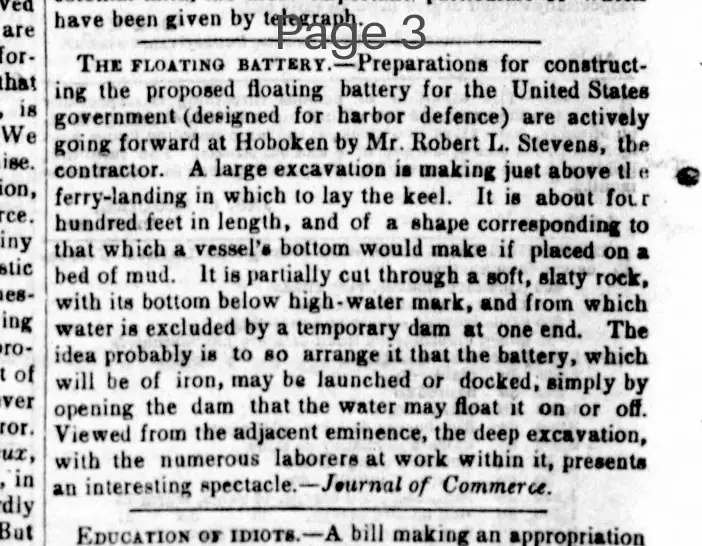
Preparations for constructing the proposed floating battery for the United States government (designed for harbor defence) are actively going forward at Hoboken by Mr. Robert L. Stevens, the contractor. A large excavation is making just above the ferry-landing in which to lay the keel. It is about four hundred feet in length, and of a shape corresponding to that which a vessel's bottom would make if placed on a bed of mud. It is partially cut through a soft, slaty rock, with its bottom below high-water mark, and from which water is excluded by a temporary dam at one end. The idea probably is to so arrange it that the battery, which will be of iron, may be launched or docked, simply by opening the dam that the water may float it on or off. Viewed from the adjacent eminence, the deep excavation, with the numerous laborers at work within it, presents an interesting spectacle.--Journal of Commerce.
What sub-type of article is it?
What keywords are associated?
What entities or persons were involved?
Where did it happen?
Domestic News Details
Primary Location
Hoboken
Key Persons
Event Details
Preparations for constructing the proposed floating battery for the United States government (designed for harbor defence) are actively going forward at Hoboken by Mr. Robert L. Stevens, the contractor. A large excavation is making just above the ferry-landing in which to lay the keel. It is about four hundred feet in length, and of a shape corresponding to that which a vessel's bottom would make if placed on a bed of mud. It is partially cut through a soft, slaty rock, with its bottom below high-water mark, and from which water is excluded by a temporary dam at one end. The idea probably is to so arrange it that the battery, which will be of iron, may be launched or docked, simply by opening the dam that the water may float it on or off. Viewed from the adjacent eminence, the deep excavation, with the numerous laborers at work within it, presents an interesting spectacle.