Thank you for visiting SNEWPapers!
Sign up free
El Paso Herald
El Paso, El Paso County, Texas
What is this article about?
Journalistic piece by Frank G. Menke debunking the myth of big league baseball as a gold mine, revealing average 6-7% returns based on New York Giants' 1910-1914 profits of ~$80,000/year, while lesser teams earn ~$20,000 on $300,000 investments.
Clipping
OCR Quality
Full Text
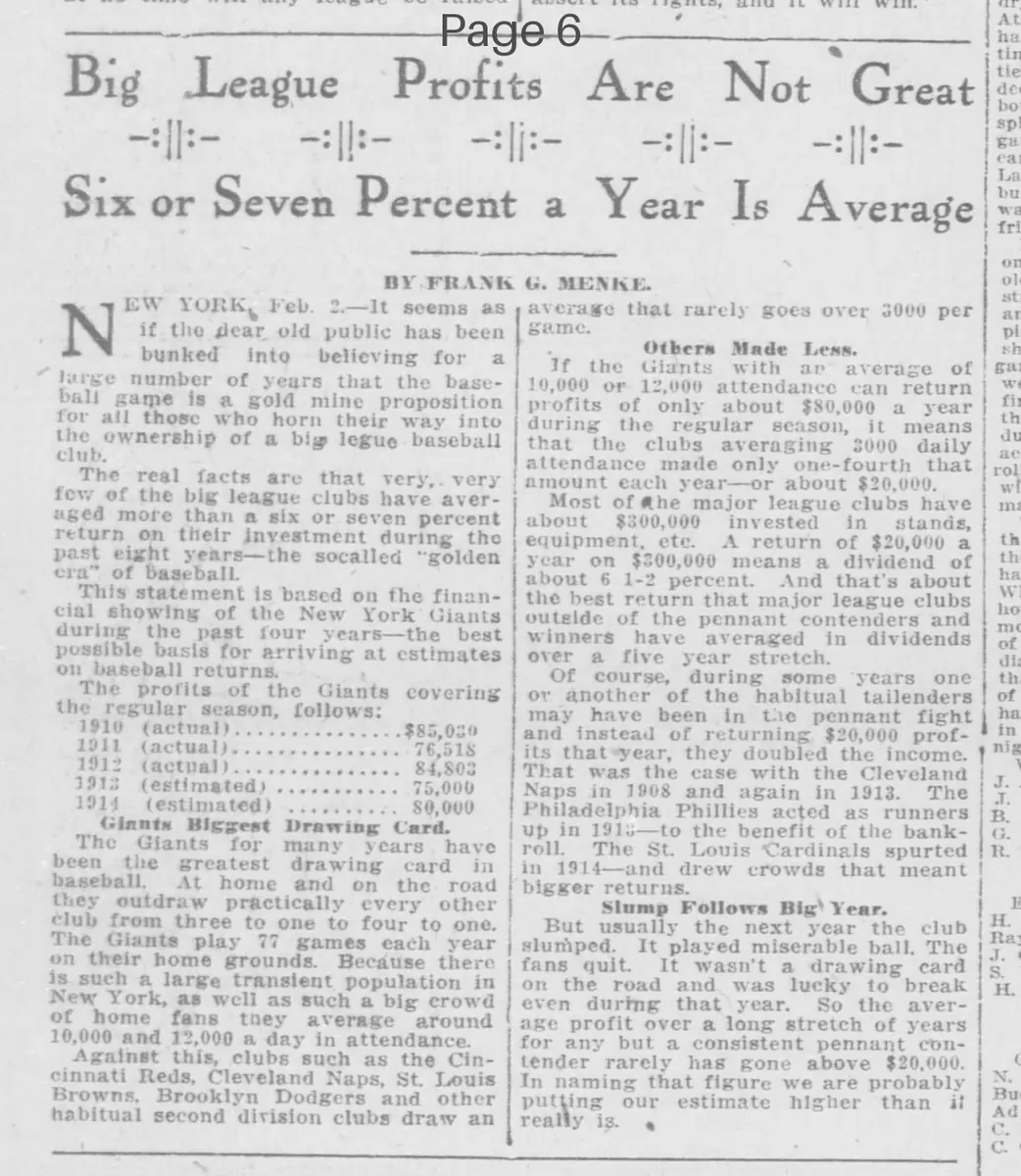
Six or Seven Percent a Year Is Average
BY FRANK G. MENKE.
NEW YORK, Feb. 2.—It seems the average attendance rarely goes over 3000 per game.
The dear old public has been bunked into believing for a large number of years that the baseball game is a gold mine proposition for all those who horn their way into the ownership of a big league baseball club.
The real facts are that very, very few of the big league clubs have averaged more than a six or seven percent return on their investment during the past eight years—the so-called "golden era" of baseball.
This statement is based on the financial showing of the New York Giants during the past four years—the best possible basis for arriving at estimates on baseball returns.
The profits of the Giants covering the regular season, follows:
1910 (actual) .. $85,030
1911 (actual) .. 76,518
1912 (actual) . 84,803
1913 (estimated) 75,000
1914 (estimated) 80,000
Giants Biggest Drawing Card.
The Giants for many years have been the greatest drawing card in baseball.
At home and on the road they outdraw practically every other club from three to one to four to one.
The Giants play 77 games each year on their home grounds. Because there is such a large transient population in New York, as well as such a big crowd of home fans they average around 10,000 and 12,000 a day in attendance.
Against this, clubs such as the Cincinnati Reds, Cleveland Naps, St. Louis Browns, Brooklyn Dodgers and other habitual second division clubs draw an average of 3000 daily attendance.
If the Giants with an average of 10,000 or 12,000 attendance can return profits of only about $80,000 a year during the regular season, it means that the clubs averaging 3000 daily attendance made only one-fourth that amount each year—or about $20,000.
Most of the major league clubs have about $300,000 invested in stands, equipment, etc. A return of $20,000 a year on $300,000 means a dividend of about 6 1-2 percent. And that's about the best return that major league clubs outside of the pennant contenders and winners have averaged in dividends over a five year stretch.
Of course, during some years one or another of the habitual tailenders may have been in the pennant fight and instead of returning $20,000 profits that year, they doubled the income.
That was the case with the Cleveland Naps in 1908 and again in 1913. The Philadelphia Phillies acted as runners up in 1911—to the benefit of the bankroll. The St. Louis Cardinals spurted in 1914—and drew crowds that meant bigger returns.
Slump Follows Big Year.
But usually the next year the club slumped. It played miserable ball. The fans quit. It wasn't a drawing card on the road and was lucky to break even during that year. So the average profit over a long stretch of years for any but a consistent pennant contender rarely has gone above $20,000.
In naming that figure we are probably putting our estimate higher than it really is.
What sub-type of article is it?
What themes does it cover?
What keywords are associated?
What entities or persons were involved?
Where did it happen?
Story Details
Key Persons
Location
New York, Major League Baseball
Event Date
1910 1914
Story Details
The public has been misled into thinking big league baseball club ownership is highly profitable, but few clubs average more than 6-7% return on investment over eight years. Using New York Giants' finances as basis, with profits around $80,000 annually on $300,000 investment and average attendance of 10,000-12,000, lesser clubs drawing 3,000 make about $20,000, yielding 6.5%. Pennant contenders may double profits some years, but slumps follow, keeping long-term averages low.