Thank you for visiting SNEWPapers!
Sign up free
Story
April 29, 1957
The Home Journal
Charlotte Amalie, Saint Thomas County, Virgin Islands
What is this article about?
Journalist Max Lerner meets Eric Williams, Trinidad's new Chief Minister, shortly after his election victory. Lerner describes Williams as a scholarly politician focused on national issues, independent of unions, and key to West Indian Federation plans.
Clipping
OCR Quality
98%
Excellent
Full Text
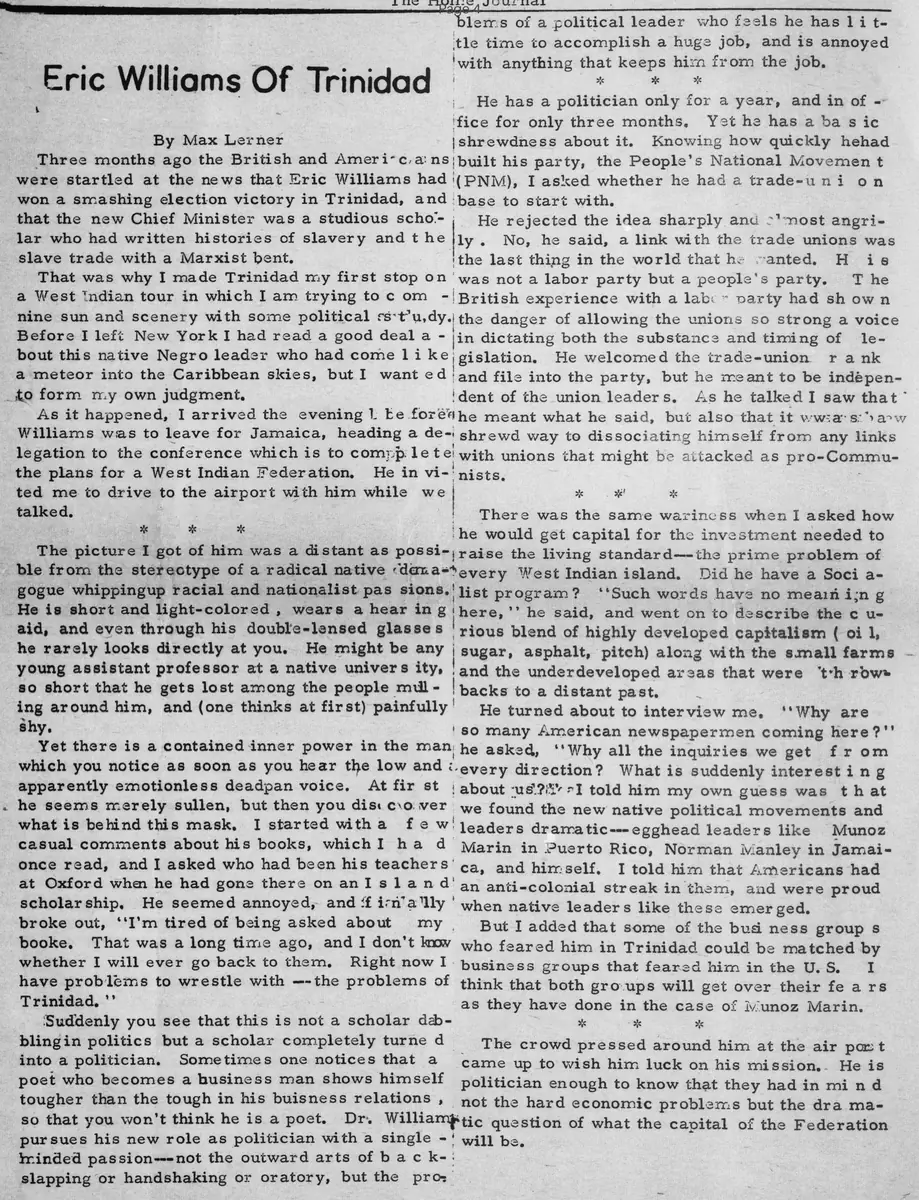
Eric Williams Of Trinidad
By Max Lerner
Three months ago the British and Americans were startled at the news that Eric Williams had won a smashing election victory in Trinidad, and that the new Chief Minister was a studious scholar who had written histories of slavery and the slave trade with a Marxist bent.
That was why I made Trinidad my first stop on a West Indian tour in which I am trying to combine sun and scenery with some political study.
Before I left New York I had read a good deal about this native Negro leader who had come like a meteor into the Caribbean skies, but I wanted to form my own judgment.
As it happened, I arrived the evening before Williams was to leave for Jamaica, heading a delegation to the conference which is to complete the plans for a West Indian Federation. He invited me to drive to the airport with him while we talked.
The picture I got of him was as distant as possible from the stereotype of a radical native demagogue whipping up racial and nationalist passions.
He is short and light-colored, wears a hearing aid, and even through his double-lensed glasses he rarely looks directly at you. He might be any young assistant professor at a native university, so short that he gets lost among the people milling around him, and (one thinks at first) painfully shy.
Yet there is a contained inner power in the man which you notice as soon as you hear the low and apparently emotionless deadpan voice. At first he seems merely sullen, but then you discover what is behind this mask. I started with a few casual comments about his books, which I had once read, and I asked who had been his teachers at Oxford when he had gone there on an Island scholarship. He seemed annoyed, and finally broke out, "I'm tired of being asked about my books. That was a long time ago, and I don't know whether I will ever go back to them. Right now I have problems to wrestle with --the problems of Trinidad."
Suddenly you see that this is not a scholar dabbling in politics but a scholar completely turned into a politician. Sometimes one notices that a poet who becomes a business man shows himself tougher than the tough in his business relations, so that you won't think he is a poet. Dr. Williams pursues his new role as politician with a single-minded passion--not the outward arts of back-slapping or handshaking or oratory, but the problems of a political leader who feels he has little time to accomplish a huge job, and is annoyed with anything that keeps him from the job.
He has been a politician only for a year, and in office for only three months. Yet he has a basic shrewdness about it. Knowing how quickly he had built his party, the People's National Movement (PNM), I asked whether he had a trade-union base to start with.
He rejected the idea sharply and almost angrily. No, he said, a link with the trade unions was the last thing in the world that he wanted. His was not a labor party but a people's party. The British experience with a labor party had shown the danger of allowing the unions so strong a voice in dictating both the substance and timing of legislation. He welcomed the trade-union rank and file into the party, but he meant to be independent of the union leaders. As he talked I saw that he meant what he said, but also that it was a shrewd way to dissociate himself from any links with unions that might be attacked as pro-Communists.
There was the same wariness when I asked how he would get capital for the investment needed to raise the living standard---the prime problem of every West Indian island. Did he have a Socialist program? "Such words have no meaning here," he said, and went on to describe the curious blend of highly developed capitalism (oil, sugar, asphalt, pitch) along with the small farms and the underdeveloped areas that were throwbacks to a distant past.
He turned about to interview me. "Why are so many American newspapermen coming here?" he asked. Why all the inquiries we get from every direction? What is suddenly interesting about us? I told him my own guess was that we found the new native political movements and leaders dramatic---egghead leaders like Munoz Marin in Puerto Rico, Norman Manley in Jamaica, and himself. I told him that Americans had an anti-colonial streak in them, and were proud when native leaders like these emerged.
But I added that some of the business groups who feared him in Trinidad could be matched by business groups that feared him in the U. S. I think that both groups will get over their fears as they have done in the case of Munoz Marin.
The crowd pressed around him at the airport came up to wish him luck on his mission. He is politician enough to know that they had in mind not the hard economic problems but the dramatic question of what the capital of the Federation will be.
By Max Lerner
Three months ago the British and Americans were startled at the news that Eric Williams had won a smashing election victory in Trinidad, and that the new Chief Minister was a studious scholar who had written histories of slavery and the slave trade with a Marxist bent.
That was why I made Trinidad my first stop on a West Indian tour in which I am trying to combine sun and scenery with some political study.
Before I left New York I had read a good deal about this native Negro leader who had come like a meteor into the Caribbean skies, but I wanted to form my own judgment.
As it happened, I arrived the evening before Williams was to leave for Jamaica, heading a delegation to the conference which is to complete the plans for a West Indian Federation. He invited me to drive to the airport with him while we talked.
The picture I got of him was as distant as possible from the stereotype of a radical native demagogue whipping up racial and nationalist passions.
He is short and light-colored, wears a hearing aid, and even through his double-lensed glasses he rarely looks directly at you. He might be any young assistant professor at a native university, so short that he gets lost among the people milling around him, and (one thinks at first) painfully shy.
Yet there is a contained inner power in the man which you notice as soon as you hear the low and apparently emotionless deadpan voice. At first he seems merely sullen, but then you discover what is behind this mask. I started with a few casual comments about his books, which I had once read, and I asked who had been his teachers at Oxford when he had gone there on an Island scholarship. He seemed annoyed, and finally broke out, "I'm tired of being asked about my books. That was a long time ago, and I don't know whether I will ever go back to them. Right now I have problems to wrestle with --the problems of Trinidad."
Suddenly you see that this is not a scholar dabbling in politics but a scholar completely turned into a politician. Sometimes one notices that a poet who becomes a business man shows himself tougher than the tough in his business relations, so that you won't think he is a poet. Dr. Williams pursues his new role as politician with a single-minded passion--not the outward arts of back-slapping or handshaking or oratory, but the problems of a political leader who feels he has little time to accomplish a huge job, and is annoyed with anything that keeps him from the job.
He has been a politician only for a year, and in office for only three months. Yet he has a basic shrewdness about it. Knowing how quickly he had built his party, the People's National Movement (PNM), I asked whether he had a trade-union base to start with.
He rejected the idea sharply and almost angrily. No, he said, a link with the trade unions was the last thing in the world that he wanted. His was not a labor party but a people's party. The British experience with a labor party had shown the danger of allowing the unions so strong a voice in dictating both the substance and timing of legislation. He welcomed the trade-union rank and file into the party, but he meant to be independent of the union leaders. As he talked I saw that he meant what he said, but also that it was a shrewd way to dissociate himself from any links with unions that might be attacked as pro-Communists.
There was the same wariness when I asked how he would get capital for the investment needed to raise the living standard---the prime problem of every West Indian island. Did he have a Socialist program? "Such words have no meaning here," he said, and went on to describe the curious blend of highly developed capitalism (oil, sugar, asphalt, pitch) along with the small farms and the underdeveloped areas that were throwbacks to a distant past.
He turned about to interview me. "Why are so many American newspapermen coming here?" he asked. Why all the inquiries we get from every direction? What is suddenly interesting about us? I told him my own guess was that we found the new native political movements and leaders dramatic---egghead leaders like Munoz Marin in Puerto Rico, Norman Manley in Jamaica, and himself. I told him that Americans had an anti-colonial streak in them, and were proud when native leaders like these emerged.
But I added that some of the business groups who feared him in Trinidad could be matched by business groups that feared him in the U. S. I think that both groups will get over their fears as they have done in the case of Munoz Marin.
The crowd pressed around him at the airport came up to wish him luck on his mission. He is politician enough to know that they had in mind not the hard economic problems but the dramatic question of what the capital of the Federation will be.
What sub-type of article is it?
Biography
Historical Event
What themes does it cover?
Triumph
Fortune Reversal
What keywords are associated?
Eric Williams
Trinidad Election
West Indian Federation
Political Leader
Scholar Politician
What entities or persons were involved?
Eric Williams
Max Lerner
Munoz Marin
Norman Manley
Where did it happen?
Trinidad
Story Details
Key Persons
Eric Williams
Max Lerner
Munoz Marin
Norman Manley
Location
Trinidad
Story Details
Journalist Max Lerner interviews Eric Williams, the newly elected Chief Minister of Trinidad, discussing his background as a scholar, his political independence from unions, economic challenges, and role in West Indian Federation.