Thank you for visiting SNEWPapers!
Sign up free
Literary
March 2, 1839
Review And Telegraph
Hartford, Hartford County, Connecticut
What is this article about?
A reflective poem personifying the closing days of winter as gloomy and melancholic, yet essential, with anticipation of spring's light, life, and joy replacing it.
Clipping
OCR Quality
98%
Excellent
Full Text
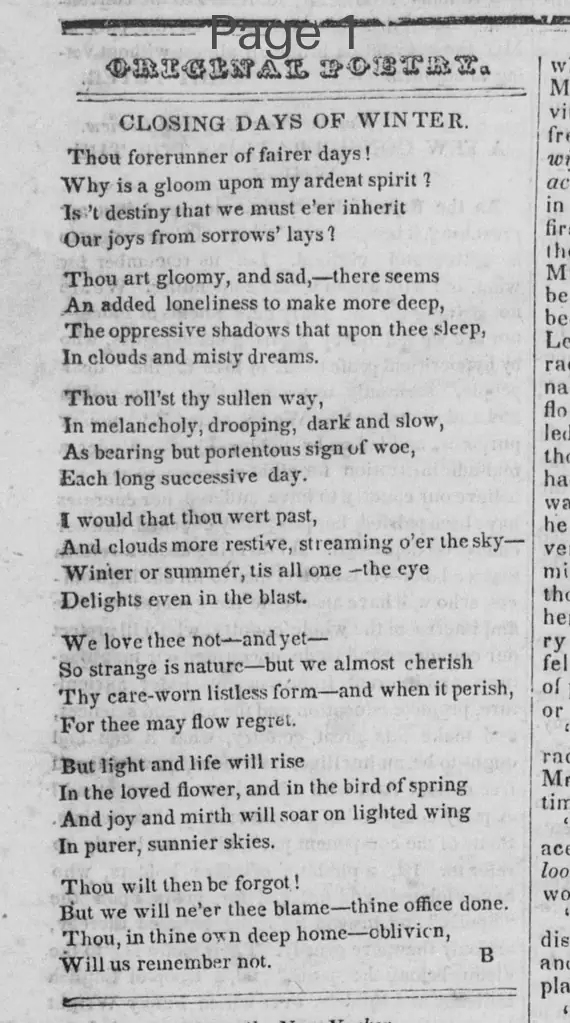
ORIGINAL POETRY.
CLOSING DAYS OF WINTER
Thou forerunner of fairer days!
Why is a gloom upon my ardent spirit?
Is't destiny that we must e'er inherit
Our joys from sorrows' laws?
Thou art gloomy, and sad,—there seems
An added loneliness to make more deep
The oppressive shadows that upon thee sleep
In clouds and misty dreams.
Thou roll'st thy sullen way
In melancholy, drooping, dark and slow,
As bearing but portentous sign of woe,
Each long successive day.
I would that thou wert past,
And clouds more restive, streaming o'er the sky—
Winter or summer, 'tis all one—the eye
Delights even in the blast.
We love thee not—and yet—
So strange is nature—but we almost cherish
Thy care-worn listless form—and when it perish,
For thee may flow regret.
But light and life will rise
In the loved flower, and in the bird of spring;
And joy and mirth will soar on lighted wing
In purer, sunnier skies.
Thou wilt then be forgot!
But we will ne'er thee blame—thine office done.
Thou, in thine own deep home—oblivion,
Wilt us remember not.
B
CLOSING DAYS OF WINTER
Thou forerunner of fairer days!
Why is a gloom upon my ardent spirit?
Is't destiny that we must e'er inherit
Our joys from sorrows' laws?
Thou art gloomy, and sad,—there seems
An added loneliness to make more deep
The oppressive shadows that upon thee sleep
In clouds and misty dreams.
Thou roll'st thy sullen way
In melancholy, drooping, dark and slow,
As bearing but portentous sign of woe,
Each long successive day.
I would that thou wert past,
And clouds more restive, streaming o'er the sky—
Winter or summer, 'tis all one—the eye
Delights even in the blast.
We love thee not—and yet—
So strange is nature—but we almost cherish
Thy care-worn listless form—and when it perish,
For thee may flow regret.
But light and life will rise
In the loved flower, and in the bird of spring;
And joy and mirth will soar on lighted wing
In purer, sunnier skies.
Thou wilt then be forgot!
But we will ne'er thee blame—thine office done.
Thou, in thine own deep home—oblivion,
Wilt us remember not.
B
What sub-type of article is it?
Poem
What themes does it cover?
Nature
Seasonal Cycle
What keywords are associated?
Winter
Spring
Seasons
Melancholy
Nature
What entities or persons were involved?
B
Literary Details
Title
Closing Days Of Winter
Author
B
Subject
Closing Days Of Winter
Key Lines
Thou Forerunner Of Fairer Days!
But Light And Life Will Rise
In The Loved Flower, And In The Bird Of Spring;
Thou Wilt Then Be Forgot!
But We Will Ne'er Thee Blame—Thine Office Done.