Thank you for visiting SNEWPapers!
Sign up free
The Cincinnati Daily Star
Cincinnati, Hamilton County, Ohio
What is this article about?
Invalid orphan Arthur Morton believes guardian Crosby lost his fortune. Urged by Dr. Weston, he sails as supercargo, restoring health through labor. After two years, learns Weston and Crosby schemed to cure his wasting illness by faking ruin. Regains wealth and marries Grace Melburne.
Merged-components note: Continuation of the short story 'Happily Ruined' across sequential reading orders on the same page.
Clipping
OCR Quality
Full Text
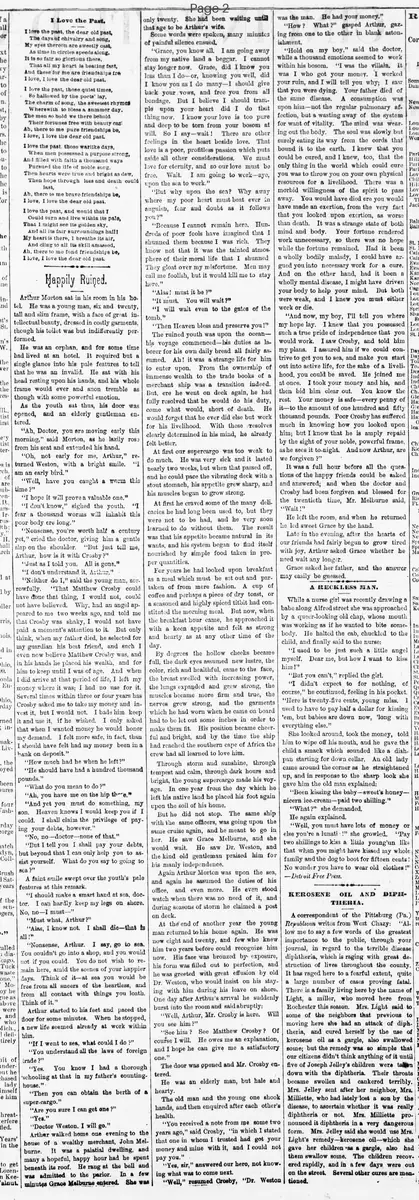
Arthur Morton sat in his room in his hotel. He was a young man, six and twenty, tall and slim frame, with a face of great intellectual beauty, dressed in costly garments, though his toilet was but indifferently performed.
He was an orphan, and for some time had lived at an hotel. It required but a single glance into his pale features to tell that he was an invalid. He sat with his head resting upon his hands, and his whole frame would ever and anon tremble as though with some powerful emotion.
As the youth sat thus, his door was opened, and an elderly gentleman entered.
"Ah, Doctor, you are moving early this morning," said Morton, as he lazily rose from his seat and extended his hand.
"Oh, not early for me, Arthur," returned Weston, with a bright smile. "I am an early bird."
"Well, have you caught a worm this time?"
"I hope it will prove a valuable one."
"I don't know," sighed the youth. "I fear a thousand worms will inhabit this poor body ere long."
"Nonsense, you're worth half a century yet," cried the doctor, giving him a gentle slap on the shoulder. "But just tell me, Arthur, how is it with Crosby?"
"'Just as I told you. All is gone."
"I don't understand it, Arthur."
"Neither do I," said the young man, sorrowfully.
"That Matthew Crosby could have done that thing, I would not, could not have believed. Why, had an angel appeared to me two weeks ago, and told me that Crosby was shaky, I would not have paid a moment's attention to it. But only think, when my father died, he selected for my guardian his best friend, and such I even now believe Matthew Crosby was, and in his hands he placed his wealth, and for him to keep until I was of age. And when I did arrive at that period of life, I left my money where it was; I had no use for it. Several times within three or four years has Crosby asked me to take my money and invest it, but I would not. I bade him keep it and use it, if he wished. I only asked that when I wanted money he would honor my demand. I felt more safe, in fact, than I should have felt had my money been in a bank on deposit."
"How much had he when he left?"
"He should have had a hundred thousand pounds."
"What do you mean to do?"
"Ah, you have me on the hip there."
"And yet you must do something, my son. Heaven knows I would keep you if I could. I shall claim the privilege of paying your debts, however."
"No, no—doctor—none of that."
"But I tell you I shall pay your debts, but beyond that I can only help you to assist yourself. What do you say to going to sea?"
A faint smile swept over the youth's pale features at this remark.
"I should make a smart hand at sea, doctor. I can hardly keep my legs on shore. No, no—I must—"
"Must what, Arthur?"
"Alas, I know not. I shall die—that is all!"
"Nonsense, Arthur. I say, go to sea. You couldn't go into a shop, and you would not if you could. You do not wish to remain here, amid the scenes of your happier days. Think of it—at sea you would be free from all sneers of the heartless, and from all contact with things you loath. Think of it."
Arthur started to his feet and paced the floor for some minutes. When he stopped, a new life seemed already at work within him.
"If I went to sea, what could I do?"
"You understand all the laws of foreign trade?"
"Yes. You know I had a thorough schooling at that in my father's counting-house."
"Then you can obtain the berth of a super-cargo."
"Are you sure I can get one?"
"Yes."
"Doctor Weston, I will go."
Arthur walked home one evening to the house of a wealthy merchant, John Melburne. It was a palatial dwelling, and many a hopeful, happy hour had he spent beneath its roof. He rang at the bell and was admitted to the parlor. In a few minutes Grace Melburne entered. She was only twenty. She had been waiting until that age to be Arthur's wife.
Some words were spoken, many minutes of painful silence ensued.
"Grace, you know all. I am going away from my native land a beggar. I cannot stay longer now. Grace, did I know you less than I do—or, knowing you well, did I know you as I do many—I should give back your vows, and free you from all bondage. But I believe I should trample upon your heart did I do that thing now. I know your love is too pure and deep to be torn from your bosom at will. So I say—wait! There are other feelings in the heart beside love. That love is a poor, profitless passion which puts aside all other considerations. We must love for eternity, and so our love must be free.
Wait. I am going to work—aye, upon the sea to work."
"But why upon the sea? Why away where my poor heart must beat ever in anguish, fear and doubt as it follows you?"
"Because I cannot remain here. Hundreds of poor fools have imagined that I shunned them because I was rich. They know not that it was the tainted atmosphere of their moral life that I shunned. They gloat over my misfortune. Men may call me foolish, but it would kill me to stay here."
"Alas! must it be?"
"It must. You will wait?"
"I will wait even to the gates of the tomb."
"Then Heaven bless and preserve you!"
The ruined youth was upon the ocean—his voyage commenced—his duties as laborer for his own daily bread all fairly assumed. Ah! it was a strange life for him to enter upon. From the ownership of immense wealth to the trade books of a merchant ship was a transition indeed.
But, ere he went on deck again, he had fully resolved that he would do his duty, come what would, short of death. He would forget that he ever did else but work for his livelihood. With these resolves clearly determined in his mind, he already felt better.
At first our supercargo was too weak to do much. He was very sick and it lasted nearly two weeks, but when that passed off, and he could pace the vibrating deck with a stout stomach, his appetite grew sharp, and his muscles began to grow strong.
At first he craved some of the many delicacies he had long been used to, but they were not to be had, and he very soon learned to do without them. The result was that his appetite became natural in its wants, and his system began to find itself nourished by simple food taken in proper quantities.
For years he had looked upon breakfast as a meal which must be set out and partaken of from mere fashion. A cup of coffee and perhaps a piece of dry toast, or a seasoned and highly spiced titbit had constituted the morning meal. But now, when the breakfast hour came, he approached it with a keen appetite and felt as strong and hearty as at any other time of the day.
By degrees the hollow cheeks became full, the dark eyes assumed new lustre, the color, rich and healthful, came to the face, the breast swelled with increasing power, the lungs expanded and grew strong, the muscles became more firm and true, the nerves grew strong, and the garments which he had worn when he came on board had to be let out some inches in order to make them fit. His position became cheerful and bright, and by the time the ship had reached the southern cape of Africa the crew had all learned to love him.
Through storm and sunshine, through tempest and calm, through dark hours and bright, the young supercargo made his voyage. In one year from the day which he left his native land he placed his foot again upon the soil of his home.
But he did not stop. The same ship with the same officers, was going upon the same cruise again, and he meant to go in her. He saw Grace Melburne, and she would wait. He saw Dr. Weston, and the kind old gentleman praised him for his manly independence.
Again Arthur Morton was upon the sea, and again he assumed the duties of his office, and even more. He even stood watch when there was no need of it, and during seasons of storm he claimed a post on deck.
At the end of another year the young man returned to his home again. He was now eight and twenty, and few who knew him two years before could recognize him now. His face was bronzed by exposure, his form was filled out to perfection, and he was greeted with great effusion by old Dr. Weston, who would insist on his staying with him during his leave on shore.
One day after Arthur's arrival he suddenly burst into the room and said abruptly:
"Well, Arthur, Mr. Crosby is here. Will you see him?"
"See him? See Matthew Crosby? Of course I will. He owes me an explanation, and I hope he can give me a satisfactory one."
The door was opened and Mr. Crosby entered.
He was an elderly man, but hale and hearty.
The old man and the young one shook hands, and then enquired after each other's health.
"You received a note from me some two years ago," said Crosby, "in which I stated that one in whom I trusted had got your money and mine with it, and I could not pay you."
"Yes, sir," answered our hero, not knowing what was to come next.
"Well," resumed Crosby, "Dr. Weston was the man. He had your money."
"How? What?" gasped Arthur, gazing from one to the other in blank astonishment.
"Hold on my boy," said the doctor, while a thousand emotions seemed to work within his bosom. "I was the villain. It was I who got your money. I worked your ruin, and I will tell you why; I saw that you were dying. Your father died of the same disease. A consumption was upon him—not the regular pulmonary affection, but a wasting away of the system for want of vitality. The mind was wearing out the body. The soul was slowly but surely eating its way from the cords that bound it to the earth. I knew that you could be cured, and I knew, too, that the only thing in the world which could cure you was to throw you on your own physical resources for a livelihood. There was a morbid willingness of the spirit to pass away.
You would have died ere you would have made an exertion, from the very fact that you looked upon exertion as worse than death. It was a strange state of both mind and body. Your fortune rendered work unnecessary, so there was no hope while the fortune remained. Had it been a wholly bodily malady, I could have argued you into necessary work for a cure. And on the other hand, had it been a wholly mental disease, I might have driven your body to help your mind. But both were weak, and I knew you must either work or die.
"And now, my boy, I'll tell you where my hope lay. I knew that you possessed such a true pride of independence that you would work. I saw Crosby, and told him my plans. I assured him if we could contrive to get you to sea, and make you start out into active life, for the sake of a livelihood, you could be saved. He joined me at once. I took your money and his, and then bid him clear out. You know the rest. Your money is safe—every penny of it—to the amount of one hundred and fifty thousand pounds. Poor Crosby has suffered much in knowing how you looked upon him; but I know that he is amply repaid by the sight of your noble, powerful frame as he sees it to-night. And now Arthur, are we forgiven?"
It was a full hour before all the questions of the happy friends could be asked and answered: and when the doctor and Crosby had been forgiven and blessed for the twentieth time, Mr. Melburne said,
"Wait!"
He left the room, and when he returned he led sweet Grace by the hand.
Late in the evening, after the hearts of our friends had fairly begun to grow tired with joy, Arthur asked Grace whether he need wait any longer.
Grace asked her father, and the answer may easily be guessed.
What sub-type of article is it?
What themes does it cover?
What keywords are associated?
What entities or persons were involved?
Where did it happen?
Story Details
Key Persons
Location
Hotel, Ocean, Native Land, House Of John Melburne
Story Details
Arthur Morton, an invalid orphan, believes guardian Matthew Crosby lost his 100,000 pounds fortune. On Dr. Weston's urging, he becomes ship's supercargo, regains health through work and sea life over two years. Learns Weston and Crosby faked loss to cure his wasting disease by forcing self-reliance. Regains wealth, reunites with fiancée Grace.