Thank you for visiting SNEWPapers!
Sign up free
Editorial
August 28, 1816
The Alexandria Herald
Alexandria, Virginia
What is this article about?
A letter to the Herald editors defends Gen. Mason against attacks in the Washingtonian newspaper, which uses his college speech on universal suffrage to damage his reputation amid his potential Senate resignation and House candidacy. The author argues the speech was a youthful debate exercise, not indicative of his current views.
Clipping
OCR Quality
95%
Excellent
Full Text
To the Editors of the Herald.
"The creature's at its dirty work again."
UNIVERSAL SUFFRAGE.
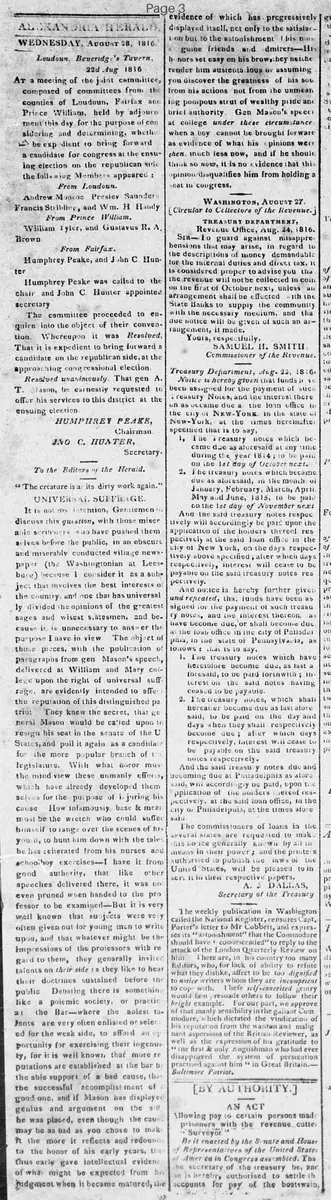
It is not my intention, Gentlemen, to discuss this question, with those miserable scribblers who have pushed their lucubrations before the public, in an obscure and miserably conducted village newspaper (the Washingtonian at Leesburg) because I consider it as a subject that involves the best interests of the country, and one that has universally divided the opinions of the greatest sages and wisest statesmen, and because it is unnecessary to answer the purpose I have in view. The object of those pieces, with the publication of paragraphs from Gen. Mason's speech, delivered at William and Mary college upon the right of universal suffrage, are evidently intended to affect the reputation of this distinguished patriot. They knew the secret, that General Mason would be called upon to resign his seat in the senate of the United States, and politick again as a candidate for the more popular branch of the legislature. With what horror must the mind view these unmanly efforts, which have already developed themselves for the purpose of injuring his cause. How infamously base & mean must be the wretch who could suffer himself to range over the scenes of his youth, to hunt him down with the tales he has reiterated from his nurses and schoolboy exercises—I have it from good authority, that like other speeches delivered there, it was not even pruned when handed to the professor to be examined—But it is very well known that subjects were very often given out for young men to write upon, and that whatever might be the impressions of the professors with regard to them, they generally invited talents on their side if they like to hear their doctrines sustained before the public. Debating there is something like a polemic society, or practice at the Bar—where the ablest talents are very often enlisted or selected for the weak side, to afford an opportunity for exercising their ingenuity, for it is well known that more reputations are established at the bar by the able support of a bad cause, than the successful accomplishment of a good one, and if Mason has displayed genius and argument on the side he was placed, even though the cause may be as bad as you chose to make it, the more it reflects and redounds to the honor of his early years, that thus early gave intellectual evidence of what might be expected from his judgment when it became matured, the evidence of which has progressively displayed itself, not only to the satisfaction but to the astonishment of his most sanguine friends and admirers—His honors sit easy on his brow; they neither render him ostentatious or assuming. You discover the greatness of his soul from his actions not from the unmeaning pompous strut of wealthy pride and brief authority. Gen. Mason's speech at college under these circumstances when a boy cannot be brought forward as evidence of what his opinions were then, much less now, and if he should think so now, it is no evidence that this opinion disqualifies him from holding a seat in congress.
"The creature's at its dirty work again."
UNIVERSAL SUFFRAGE.
It is not my intention, Gentlemen, to discuss this question, with those miserable scribblers who have pushed their lucubrations before the public, in an obscure and miserably conducted village newspaper (the Washingtonian at Leesburg) because I consider it as a subject that involves the best interests of the country, and one that has universally divided the opinions of the greatest sages and wisest statesmen, and because it is unnecessary to answer the purpose I have in view. The object of those pieces, with the publication of paragraphs from Gen. Mason's speech, delivered at William and Mary college upon the right of universal suffrage, are evidently intended to affect the reputation of this distinguished patriot. They knew the secret, that General Mason would be called upon to resign his seat in the senate of the United States, and politick again as a candidate for the more popular branch of the legislature. With what horror must the mind view these unmanly efforts, which have already developed themselves for the purpose of injuring his cause. How infamously base & mean must be the wretch who could suffer himself to range over the scenes of his youth, to hunt him down with the tales he has reiterated from his nurses and schoolboy exercises—I have it from good authority, that like other speeches delivered there, it was not even pruned when handed to the professor to be examined—But it is very well known that subjects were very often given out for young men to write upon, and that whatever might be the impressions of the professors with regard to them, they generally invited talents on their side if they like to hear their doctrines sustained before the public. Debating there is something like a polemic society, or practice at the Bar—where the ablest talents are very often enlisted or selected for the weak side, to afford an opportunity for exercising their ingenuity, for it is well known that more reputations are established at the bar by the able support of a bad cause, than the successful accomplishment of a good one, and if Mason has displayed genius and argument on the side he was placed, even though the cause may be as bad as you chose to make it, the more it reflects and redounds to the honor of his early years, that thus early gave intellectual evidence of what might be expected from his judgment when it became matured, the evidence of which has progressively displayed itself, not only to the satisfaction but to the astonishment of his most sanguine friends and admirers—His honors sit easy on his brow; they neither render him ostentatious or assuming. You discover the greatness of his soul from his actions not from the unmeaning pompous strut of wealthy pride and brief authority. Gen. Mason's speech at college under these circumstances when a boy cannot be brought forward as evidence of what his opinions were then, much less now, and if he should think so now, it is no evidence that this opinion disqualifies him from holding a seat in congress.
What sub-type of article is it?
Suffrage
Partisan Politics
What keywords are associated?
Universal Suffrage
Gen Mason
Political Attack
College Speech
William And Mary
Senate Resignation
House Candidacy
What entities or persons were involved?
Gen. Mason
Washingtonian At Leesburg
William And Mary College
Editorial Details
Primary Topic
Defense Of Gen. Mason Against Attacks On His Universal Suffrage Views
Stance / Tone
Strongly Supportive Of Gen. Mason, Condemnatory Of Political Detractors
Key Figures
Gen. Mason
Washingtonian At Leesburg
William And Mary College
Key Arguments
Universal Suffrage Divides Great Statesmen, Unworthy Of Debate With Obscure Scribblers
Attacks Aim To Damage Mason's Reputation During His Senate Resignation And House Candidacy
Speech Was A Youthful College Exercise, Not Reflective Of Mature Opinions
Debates Assign Sides, Even Weak Ones, To Exercise Ingenuity
Mason's Performance Shows Early Genius, Enhancing His Honor
Current Actions Demonstrate His Greatness And Maturity
Past Speech Does Not Disqualify Him From Congress