Thank you for visiting SNEWPapers!
Sign up free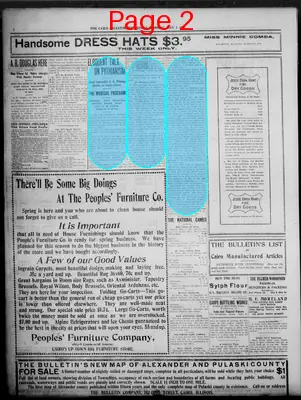
Story
May 3, 1905
The Cairo Bulletin
Cairo, Alexander County County, Illinois
What is this article about?
Dr. James G. Whiting, Grand Chancellor of Illinois Knights of Pythias, delivers an eloquent oration on Pythian principles to a large audience in Cairo, preceded by musical program and tribute to late John A. Miller.
Clipping
OCR Quality
95%
Excellent
Full Text
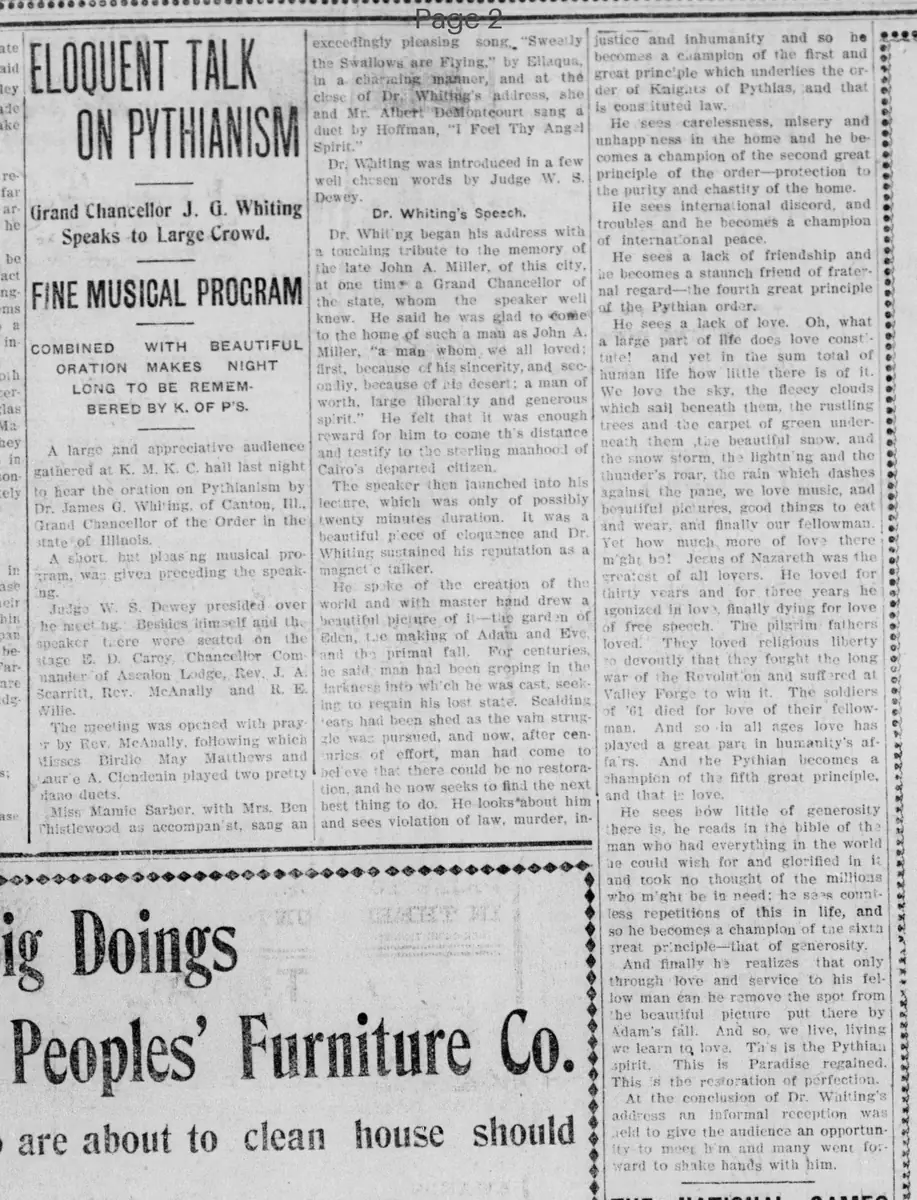
ELOQUENT TALK ON PYTHIANISM
Grand Chancellor J. G. Whiting Speaks to Large Crowd.
FINE MUSICAL PROGRAM COMBINED WITH BEAUTIFUL ORATION MAKES NIGHT LONG TO BE REMEMBERED BY K. OF P'S.
A large and appreciative audience gathered at K. M. K. C. hall last night to hear the oration on Pythianism by Dr. James G. Whiting, of Canton, Ill., Grand Chancellor of the Order in the state of Illinois.
A short but pleasing musical program was given preceding the speaking.
Judge W. S. Dewey presided over the meeting. Besides himself and the speaker there were seated on the stage E. D. Carey Chancellor Commander of Ascalon Lodge, Rev. J. A. Scarritt, Rev. McAnally and R. E. Wille.
The meeting was opened with prayer by Rev. McAnally, following which Misses Birdie May Matthews and Laura A. Clendenin played two pretty piano duets.
Miss Mamie Sarber, with Mrs. Ben Thistlewood as accompanist, sang an exceedingly pleasing song, "Sweetly the Swallows are Flying," by Ellaqua, in a charming manner, and at the close of Dr. Whiting's address, she and Mr. Albert DeMontebello sang a duet by Hoffman, "I Feel Thy Angel Spirit."
Dr. Whiting was introduced in a few well chosen words by Judge W. S. Dewey.
Dr. Whiting's Speech.
Dr. Whiting began his address with a touching tribute to the memory of the late John A. Miller, of this city, at one time a Grand Chancellor of the state, whom the speaker well knew. He said he was glad to come to the home of such a man as John A. Miller, "a man whom we all loved: first, because of his sincerity, and secondly, because of his desert: a man of worth, large liberality and generous spirit." He felt that it was enough reward for him to come this distance and testify to the sterling manhood of Cairo's departed citizen.
The speaker then launched into his lecture, which was only of possibly twenty minutes duration. It was a beautiful piece of eloquence and Dr. Whiting sustained his reputation as a magnetic talker.
He spoke of the creation of the world and with master hand drew a beautiful picture of the garden of Eden, the making of Adam and Eve, and the primal fall. For centuries, he said man had been groping in the darkness into which he was cast, seeking to regain his lost state. Scalding tears had been shed as the vain struggle was pursued, and now, after centuries of effort, man had come to believe that there could be no restoration, and he now seeks to find the next best thing to do. He looks about him and sees violation of law, murder, injustice and inhumanity and so he becomes a champion of the first and great principle which underlies the order of Knights of Pythias, and that is constituted law.
He sees carelessness, misery and unhappiness in the home and he becomes a champion of the second great principle of the order-protection to the purity and chastity of the home.
He sees international discord, and troubles and he becomes a champion of international peace.
He sees a lack of friendship and he becomes a staunch friend of fraternal regard-the fourth great principle of the Pythian order.
He sees a lack of love. Oh, what a large part of life does love constitute! and yet in the sum total of human life how little there is of it. We love the sky, the fleecy clouds which sail beneath them, the rustling trees and the carpet of green underneath them, the beautiful snow, and the snow storm, the lightning and the thunder's roar, the rain which dashes against the pane, we love music, and beautiful pictures, good things to eat and wear, and finally our fellowman. Yet how much more of love there might be! Jesus of Nazareth was the greatest of all lovers. He loved for thirty years and for three years he agonized in love finally dying for love of his fellow man. The pilgrim fathers loved. They loved religious liberty so devoutly that they fought the long war of the Revolution and suffered at Valley Forge to win it. The soldiers of '61 died for love of their fellow man. And so in all ages love has played a great part in humanity's affairs. And the Pythian becomes a champion of the fifth great principle, and that is love.
He sees how little of generosity there is, he reads in the bible of the man who had everything in the world he could wish for and glorified in it and took no thought of the millions who might be in need: he sees countless repetitions of this in life, and so he becomes a champion of the sixth great principle-that of generosity.
And finally he realizes that only through love and service to his fellow man can he remove the spot from the beautiful picture put there by Adam's fall. And so, we live, living we learn to love. This is the Pythian spirit. This is Paradise regained. This is the restoration of perfection.
At the conclusion of Dr. Whiting's address an informal reception was held to give the audience an opportunity to meet him and many went forward to shake hands with him.
Grand Chancellor J. G. Whiting Speaks to Large Crowd.
FINE MUSICAL PROGRAM COMBINED WITH BEAUTIFUL ORATION MAKES NIGHT LONG TO BE REMEMBERED BY K. OF P'S.
A large and appreciative audience gathered at K. M. K. C. hall last night to hear the oration on Pythianism by Dr. James G. Whiting, of Canton, Ill., Grand Chancellor of the Order in the state of Illinois.
A short but pleasing musical program was given preceding the speaking.
Judge W. S. Dewey presided over the meeting. Besides himself and the speaker there were seated on the stage E. D. Carey Chancellor Commander of Ascalon Lodge, Rev. J. A. Scarritt, Rev. McAnally and R. E. Wille.
The meeting was opened with prayer by Rev. McAnally, following which Misses Birdie May Matthews and Laura A. Clendenin played two pretty piano duets.
Miss Mamie Sarber, with Mrs. Ben Thistlewood as accompanist, sang an exceedingly pleasing song, "Sweetly the Swallows are Flying," by Ellaqua, in a charming manner, and at the close of Dr. Whiting's address, she and Mr. Albert DeMontebello sang a duet by Hoffman, "I Feel Thy Angel Spirit."
Dr. Whiting was introduced in a few well chosen words by Judge W. S. Dewey.
Dr. Whiting's Speech.
Dr. Whiting began his address with a touching tribute to the memory of the late John A. Miller, of this city, at one time a Grand Chancellor of the state, whom the speaker well knew. He said he was glad to come to the home of such a man as John A. Miller, "a man whom we all loved: first, because of his sincerity, and secondly, because of his desert: a man of worth, large liberality and generous spirit." He felt that it was enough reward for him to come this distance and testify to the sterling manhood of Cairo's departed citizen.
The speaker then launched into his lecture, which was only of possibly twenty minutes duration. It was a beautiful piece of eloquence and Dr. Whiting sustained his reputation as a magnetic talker.
He spoke of the creation of the world and with master hand drew a beautiful picture of the garden of Eden, the making of Adam and Eve, and the primal fall. For centuries, he said man had been groping in the darkness into which he was cast, seeking to regain his lost state. Scalding tears had been shed as the vain struggle was pursued, and now, after centuries of effort, man had come to believe that there could be no restoration, and he now seeks to find the next best thing to do. He looks about him and sees violation of law, murder, injustice and inhumanity and so he becomes a champion of the first and great principle which underlies the order of Knights of Pythias, and that is constituted law.
He sees carelessness, misery and unhappiness in the home and he becomes a champion of the second great principle of the order-protection to the purity and chastity of the home.
He sees international discord, and troubles and he becomes a champion of international peace.
He sees a lack of friendship and he becomes a staunch friend of fraternal regard-the fourth great principle of the Pythian order.
He sees a lack of love. Oh, what a large part of life does love constitute! and yet in the sum total of human life how little there is of it. We love the sky, the fleecy clouds which sail beneath them, the rustling trees and the carpet of green underneath them, the beautiful snow, and the snow storm, the lightning and the thunder's roar, the rain which dashes against the pane, we love music, and beautiful pictures, good things to eat and wear, and finally our fellowman. Yet how much more of love there might be! Jesus of Nazareth was the greatest of all lovers. He loved for thirty years and for three years he agonized in love finally dying for love of his fellow man. The pilgrim fathers loved. They loved religious liberty so devoutly that they fought the long war of the Revolution and suffered at Valley Forge to win it. The soldiers of '61 died for love of their fellow man. And so in all ages love has played a great part in humanity's affairs. And the Pythian becomes a champion of the fifth great principle, and that is love.
He sees how little of generosity there is, he reads in the bible of the man who had everything in the world he could wish for and glorified in it and took no thought of the millions who might be in need: he sees countless repetitions of this in life, and so he becomes a champion of the sixth great principle-that of generosity.
And finally he realizes that only through love and service to his fellow man can he remove the spot from the beautiful picture put there by Adam's fall. And so, we live, living we learn to love. This is the Pythian spirit. This is Paradise regained. This is the restoration of perfection.
At the conclusion of Dr. Whiting's address an informal reception was held to give the audience an opportunity to meet him and many went forward to shake hands with him.
What sub-type of article is it?
Historical Event
What themes does it cover?
Moral Virtue
Love
What keywords are associated?
Knights Of Pythias
Pythianism
Oration
Dr James G Whiting
Cairo
Musical Program
What entities or persons were involved?
Dr. James G. Whiting
Judge W. S. Dewey
John A. Miller
E. D. Carey
Rev. Mcanally
Miss Mamie Sarber
Where did it happen?
K. M. K. C. Hall, Cairo
Story Details
Key Persons
Dr. James G. Whiting
Judge W. S. Dewey
John A. Miller
E. D. Carey
Rev. Mcanally
Miss Mamie Sarber
Location
K. M. K. C. Hall, Cairo
Event Date
Last Night
Story Details
Dr. Whiting delivers oration on Pythian principles including law, home protection, peace, friendship, love, and generosity, following musical program and tribute to late John A. Miller.