Thank you for visiting SNEWPapers!
Sign up free
Editorial
April 4, 1927
The Milwaukee Leader
Milwaukee, Milwaukee County, Wisconsin
What is this article about?
Editorial discusses ideal age for physical child punishment (ages 2-8 per Dr. Blanton), alternatives like psychological discipline for older children, and the need for immediate, forgotten punishment. Author supports whippings for teen smoking despite expert opposition.
Clipping
OCR Quality
95%
Excellent
Full Text
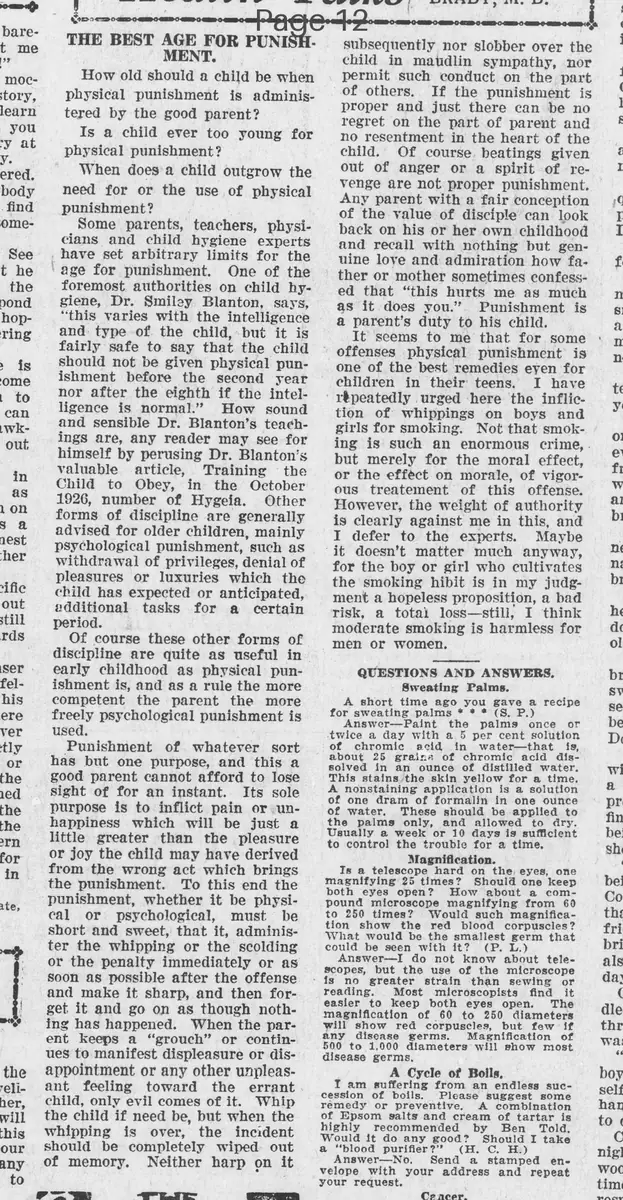
The Best Age for Punishment.
How old should a child be when physical punishment is administered by the good parent?
Is a child ever too young for physical punishment?
When does a child outgrow the need for or the use of physical punishment?
Some parents, teachers, physicians and child hygiene experts have set arbitrary limits for the age for punishment. One of the foremost authorities on child hygiene, Dr. Smiley Blanton, says, this varies with the intelligence and type of the child, but it is fairly safe to say that the child should not be given physical punishment before the second year nor after the eighth if the intelligence is normal. How sound and sensible Dr. Blanton's teachings are, any reader may see for himself by perusing Dr. Blanton's valuable article, Training the Child to Obey, in the October 1926, number of Hygeia. Other forms of discipline are generally advised for older children, mainly psychological punishment, such as withdrawal of privileges, denial of pleasures or luxuries which the child has expected or anticipated, additional tasks for a certain period.
Of course these other forms of discipline are quite as useful in early childhood as physical punishment is, and as a rule the more competent the parent the more freely psychological punishment is used.
Punishment of whatever sort has but one purpose, and this a good parent cannot afford to lose sight of for an instant. Its sole purpose is to inflict pain or unhappiness which will be just a little greater than the pleasure or joy the child may have derived from the wrong act which brings the punishment. To this end the punishment, whether it be physical or psychological, must be short and sweet, that it, administer the whipping or the scolding or the penalty immediately or as soon as possible after the offense and make it sharp, and then forget it and go on as though nothing has happened. When the parent keeps a "grouch" or continues to manifest displeasure or disappointment or any other unpleasant feeling toward the errant child, only evil comes of it. Whip the child if need be, but when the whipping is over, the incident should be completely wiped out of memory. Neither harp on it subsequently nor slobber over the child in maudlin sympathy, nor permit such conduct on the part of others. If the punishment is proper and just there can be no regret on the part of parent and no resentment in the heart of the child. Of course beatings given out of anger or a spirit of revenge are not proper punishment.
Any parent with a fair conception of the value of discipline can look back on his or her own childhood and recall with nothing but genuine love and admiration how father or mother sometimes confessed that "this hurts me as much as it does you." Punishment is a parent's duty to his child.
It seems to me that for some offenses physical punishment is one of the best remedies even for children in their teens. I have repeatedly urged here the infliction of whippings on boys and girls for smoking. Not that smoking is such an enormous crime, but merely for the moral effect, or the effect on morale, of vigorous treatment of this offense.
However, the weight of authority is clearly against me in this, and I defer to the experts. Maybe it doesn't matter much anyway, for the boy or girl who cultivates the smoking habit is in my judgment a hopeless proposition, a bad risk, a total loss—still, I think moderate smoking is harmless for men or women.
How old should a child be when physical punishment is administered by the good parent?
Is a child ever too young for physical punishment?
When does a child outgrow the need for or the use of physical punishment?
Some parents, teachers, physicians and child hygiene experts have set arbitrary limits for the age for punishment. One of the foremost authorities on child hygiene, Dr. Smiley Blanton, says, this varies with the intelligence and type of the child, but it is fairly safe to say that the child should not be given physical punishment before the second year nor after the eighth if the intelligence is normal. How sound and sensible Dr. Blanton's teachings are, any reader may see for himself by perusing Dr. Blanton's valuable article, Training the Child to Obey, in the October 1926, number of Hygeia. Other forms of discipline are generally advised for older children, mainly psychological punishment, such as withdrawal of privileges, denial of pleasures or luxuries which the child has expected or anticipated, additional tasks for a certain period.
Of course these other forms of discipline are quite as useful in early childhood as physical punishment is, and as a rule the more competent the parent the more freely psychological punishment is used.
Punishment of whatever sort has but one purpose, and this a good parent cannot afford to lose sight of for an instant. Its sole purpose is to inflict pain or unhappiness which will be just a little greater than the pleasure or joy the child may have derived from the wrong act which brings the punishment. To this end the punishment, whether it be physical or psychological, must be short and sweet, that it, administer the whipping or the scolding or the penalty immediately or as soon as possible after the offense and make it sharp, and then forget it and go on as though nothing has happened. When the parent keeps a "grouch" or continues to manifest displeasure or disappointment or any other unpleasant feeling toward the errant child, only evil comes of it. Whip the child if need be, but when the whipping is over, the incident should be completely wiped out of memory. Neither harp on it subsequently nor slobber over the child in maudlin sympathy, nor permit such conduct on the part of others. If the punishment is proper and just there can be no regret on the part of parent and no resentment in the heart of the child. Of course beatings given out of anger or a spirit of revenge are not proper punishment.
Any parent with a fair conception of the value of discipline can look back on his or her own childhood and recall with nothing but genuine love and admiration how father or mother sometimes confessed that "this hurts me as much as it does you." Punishment is a parent's duty to his child.
It seems to me that for some offenses physical punishment is one of the best remedies even for children in their teens. I have repeatedly urged here the infliction of whippings on boys and girls for smoking. Not that smoking is such an enormous crime, but merely for the moral effect, or the effect on morale, of vigorous treatment of this offense.
However, the weight of authority is clearly against me in this, and I defer to the experts. Maybe it doesn't matter much anyway, for the boy or girl who cultivates the smoking habit is in my judgment a hopeless proposition, a bad risk, a total loss—still, I think moderate smoking is harmless for men or women.
What sub-type of article is it?
Moral Or Religious
Education
Social Reform
What keywords are associated?
Child Punishment
Physical Discipline
Parenting Methods
Psychological Punishment
Teen Smoking
Moral Effect
What entities or persons were involved?
Dr. Smiley Blanton
Hygeia
Editorial Details
Primary Topic
Optimal Age And Methods For Child Physical Punishment
Stance / Tone
Advisory With Deference To Experts And Personal Opinion Favoring Physical Punishment For Teen Smoking
Key Figures
Dr. Smiley Blanton
Hygeia
Key Arguments
Physical Punishment Should Not Be Given Before The Second Year Nor After The Eighth For Normal Intelligence
Other Forms Of Discipline Like Withdrawal Of Privileges Are Advised For Older Children
Punishment's Purpose Is To Inflict Slightly Greater Pain Than The Pleasure From The Wrong Act
Punishment Must Be Immediate, Sharp, And Then Forgotten Without Lingering Resentment
Physical Punishment Can Be Effective For Teens, Such As Whippings For Smoking, For Moral Effect
Moderate Smoking Is Harmless For Adults But Smoking Youth Are A Bad Risk