Thank you for visiting SNEWPapers!
Sign up free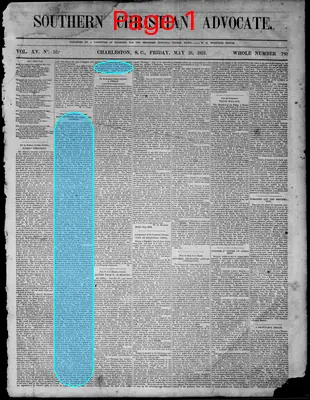
Story
May 28, 1852
Southern Christian Advocate
Charleston, Charleston County, South Carolina
What is this article about?
Reminiscences of early Cherokee, Georgia settlers detail isolation, Indian threats, and the brutal Bowman family murder by George Tooke and accomplices, leading to executions of Jim Graves and Tooke.
Clipping
OCR Quality
98%
Excellent
Full Text
For the Southern Christian Advocate.
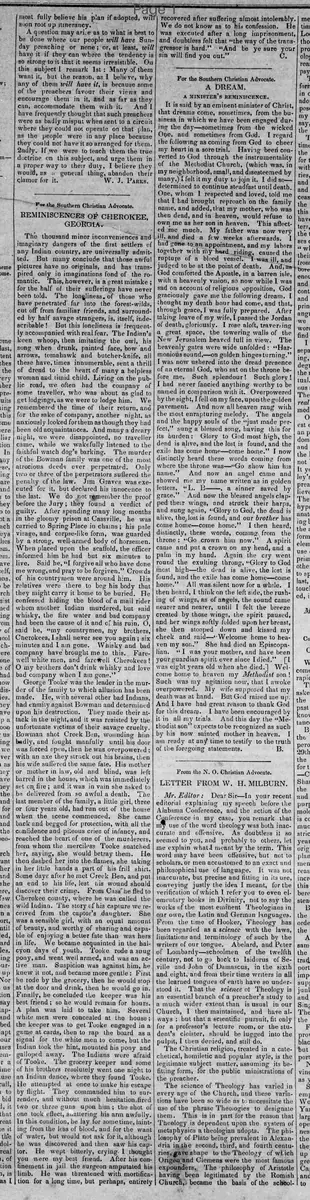
REMINISCENCES OF CHEROKEE,
GEORGIA.
The thousand minor inconveniences and imaginary dangers of the first settlers of any Indian country, are universally admitted. But many conclude that those awful pictures have no originals, and has transpired only in imaginations fond of the romantic. This, however, is a great mistake; for the half of their sufferings have never been told. The loneliness. of those who have penetrated far into the forest-wilds, cut off from familiar friends, and surrounded by half savage strangers, is, itself, indescribable! But this loneliness is frequently accompanied with real fear. The Indian's keen whoop, then imitating the owl, his song when drunk, painted face, bow and arrows, tomahawk and butcher-knife, all these have, times innumerable, sent a thrill of dread to the heart of many a helpless woman and timid child. Living on the public road, we often had the company of some traveller, who was about as glad to get lodgings, as we were to lodge him. We remembered the time of their return, and for the sake of company, another night, as anxiously looked for them as though they had been old acquaintances. And many a dreary night, we were disappointed, no traveller came, while we wakefully listened to the faithful watch dog's barking. The murder of the Bowman family was one of the most atrocious deeds ever perpetrated. Only two or three of the perpetrators suffered the penalty of the law. Jim Graves was executed for it, but declared his innocence to the last. We do not remember the proof before the Jury; they found a verdict of guilty. After spending many long months in the gloomy prison at Cassville, he was carried to Spring Place in chains; his pale visage, and corpse-like form, was guarded by a strong, well-armed body of horsemen. When placed upon the scaffold, the officer informed him he had but six minutes to live. Said he, "I forgive all who have done me wrong, and pray to be forgiven." Crowds of his countrymen were around him. His relatives were there to beg his body that they might carry it home to be buried. He confessed hiding the blood of a mail rider whom another Indian murdered, but said whisky, the fire water and bad company had been the cause of it and of his ruin. O, said he, "my countrymen, my brothers, Cherokees, I shall never see you again; six minutes and I am gone. Whisky and bad company have brought me to this. Farewell white men, and farewell Cherokees! O my brothers don't drink whisky and love bad company when I am gone."
George Tooke was the leader in the murder of the family to which allusion has been made. He, with several other bad Indians, had enmity against Bowman and determined upon his destruction. They made their attack in the night, and it was resisted by the unfortunate victims of their savage cruelty. Bowman shot Creek Ben, wounding him badly, and fought manfully until his door was forced open, then he was overpowered; with an axe they struck out his brains, then his wife suffered the same fate. His mother or mother in law, old and blind, was left barred in the house, which was immediately set on fire; and it was in vain she asked to be delivered from so awful a death. The last member of the family, a little girl, three or four years old, had run out of the house when the scene commenced. She came back and begged for protection, with all the confidence and piteous cries of infancy, and reached the heart of one of the murderers, from whom the merciless Tooke snatched her, saying, she would betray them. He then dashed her into the flames, she taking in her little hands a part of his frill shirt. Some days after he met Creek Ben, and put an end to his life, lest his wound should discover their crime. From Cass he fled to Cherokee county, where he was called the wild Indian. The story of his capture we received from the captor's daughter. She was a sensible girl, with an equal amount of beauty, and worthy of sharing and capable of enjoying a better fate than was hers in life. We became acquainted in the halcyon days of youth. Tooke rode a snug pony, and went well armed, and was an active man. Suspicion was against him, he knew it not, and became more gentle: First he rode by the grocery, then he would stop at the door and drink, then he would go in. Finally, he concluded the keeper was his best friend; so he would remain for hours. A plan was laid to take him. Several white men were concealed at the house; the keeper was to get Tooke engaged in a game at cards, then to rap the board as a signal for the white men to come, but the Indian took the hint, mounted his pony and galloped away. The Indians were afraid of Tooke. The grocery keeper and some of his brothers resolutely went one night to an Indian dance, where they found Tooke. He attempted at once to make his escape by flight. They commanded him to surrender, and without much hesitation fired two or three guns upon him; the shot of one took effect, shattering his arm awfully. In this condition, he lay for some time, fainting from the loss of blood, and for the want of water, but would not ask for it, although he was discovered and then saw his captor. He wept bitterly, crying. I thought you were my best friend. After his confinement in jail the surgeon amputated his limb. He was threatened with mortification for a long time, but perhaps, entirely recovered after suffering almost intolerably. We do not know as to his confession. He was executed after a long imprisonment and doubtless felt that "the way of the transgressor is hard." "And be ye sure your sin will find you out."
C.
REMINISCENCES OF CHEROKEE,
GEORGIA.
The thousand minor inconveniences and imaginary dangers of the first settlers of any Indian country, are universally admitted. But many conclude that those awful pictures have no originals, and has transpired only in imaginations fond of the romantic. This, however, is a great mistake; for the half of their sufferings have never been told. The loneliness. of those who have penetrated far into the forest-wilds, cut off from familiar friends, and surrounded by half savage strangers, is, itself, indescribable! But this loneliness is frequently accompanied with real fear. The Indian's keen whoop, then imitating the owl, his song when drunk, painted face, bow and arrows, tomahawk and butcher-knife, all these have, times innumerable, sent a thrill of dread to the heart of many a helpless woman and timid child. Living on the public road, we often had the company of some traveller, who was about as glad to get lodgings, as we were to lodge him. We remembered the time of their return, and for the sake of company, another night, as anxiously looked for them as though they had been old acquaintances. And many a dreary night, we were disappointed, no traveller came, while we wakefully listened to the faithful watch dog's barking. The murder of the Bowman family was one of the most atrocious deeds ever perpetrated. Only two or three of the perpetrators suffered the penalty of the law. Jim Graves was executed for it, but declared his innocence to the last. We do not remember the proof before the Jury; they found a verdict of guilty. After spending many long months in the gloomy prison at Cassville, he was carried to Spring Place in chains; his pale visage, and corpse-like form, was guarded by a strong, well-armed body of horsemen. When placed upon the scaffold, the officer informed him he had but six minutes to live. Said he, "I forgive all who have done me wrong, and pray to be forgiven." Crowds of his countrymen were around him. His relatives were there to beg his body that they might carry it home to be buried. He confessed hiding the blood of a mail rider whom another Indian murdered, but said whisky, the fire water and bad company had been the cause of it and of his ruin. O, said he, "my countrymen, my brothers, Cherokees, I shall never see you again; six minutes and I am gone. Whisky and bad company have brought me to this. Farewell white men, and farewell Cherokees! O my brothers don't drink whisky and love bad company when I am gone."
George Tooke was the leader in the murder of the family to which allusion has been made. He, with several other bad Indians, had enmity against Bowman and determined upon his destruction. They made their attack in the night, and it was resisted by the unfortunate victims of their savage cruelty. Bowman shot Creek Ben, wounding him badly, and fought manfully until his door was forced open, then he was overpowered; with an axe they struck out his brains, then his wife suffered the same fate. His mother or mother in law, old and blind, was left barred in the house, which was immediately set on fire; and it was in vain she asked to be delivered from so awful a death. The last member of the family, a little girl, three or four years old, had run out of the house when the scene commenced. She came back and begged for protection, with all the confidence and piteous cries of infancy, and reached the heart of one of the murderers, from whom the merciless Tooke snatched her, saying, she would betray them. He then dashed her into the flames, she taking in her little hands a part of his frill shirt. Some days after he met Creek Ben, and put an end to his life, lest his wound should discover their crime. From Cass he fled to Cherokee county, where he was called the wild Indian. The story of his capture we received from the captor's daughter. She was a sensible girl, with an equal amount of beauty, and worthy of sharing and capable of enjoying a better fate than was hers in life. We became acquainted in the halcyon days of youth. Tooke rode a snug pony, and went well armed, and was an active man. Suspicion was against him, he knew it not, and became more gentle: First he rode by the grocery, then he would stop at the door and drink, then he would go in. Finally, he concluded the keeper was his best friend; so he would remain for hours. A plan was laid to take him. Several white men were concealed at the house; the keeper was to get Tooke engaged in a game at cards, then to rap the board as a signal for the white men to come, but the Indian took the hint, mounted his pony and galloped away. The Indians were afraid of Tooke. The grocery keeper and some of his brothers resolutely went one night to an Indian dance, where they found Tooke. He attempted at once to make his escape by flight. They commanded him to surrender, and without much hesitation fired two or three guns upon him; the shot of one took effect, shattering his arm awfully. In this condition, he lay for some time, fainting from the loss of blood, and for the want of water, but would not ask for it, although he was discovered and then saw his captor. He wept bitterly, crying. I thought you were my best friend. After his confinement in jail the surgeon amputated his limb. He was threatened with mortification for a long time, but perhaps, entirely recovered after suffering almost intolerably. We do not know as to his confession. He was executed after a long imprisonment and doubtless felt that "the way of the transgressor is hard." "And be ye sure your sin will find you out."
C.
What sub-type of article is it?
Historical Event
Crime Story
Tragedy
What themes does it cover?
Crime Punishment
Misfortune
Justice
What keywords are associated?
Cherokee Settlement
Indian Murder
Bowman Family
Execution
Settler Fears
What entities or persons were involved?
Jim Graves
George Tooke
Bowman
Creek Ben
Where did it happen?
Cherokee, Georgia
Story Details
Key Persons
Jim Graves
George Tooke
Bowman
Creek Ben
Location
Cherokee, Georgia
Story Details
Reminiscences of early settlers in Cherokee, Georgia, describe loneliness, fears from Indians, and the atrocious murder of the Bowman family by George Tooke and others, including the execution of Jim Graves and Tooke's capture and hanging.