Thank you for visiting SNEWPapers!
Sign up free
Douglas Daily Dispatch
Douglas, Cochise County, Arizona
What is this article about?
Mussolini's wage cuts and increased turnover tax in Italy have turned government deficits into surpluses and boosted export potential, but hit the middle class hard without offsetting living cost reductions for their purchases.
Clipping
OCR Quality
Full Text
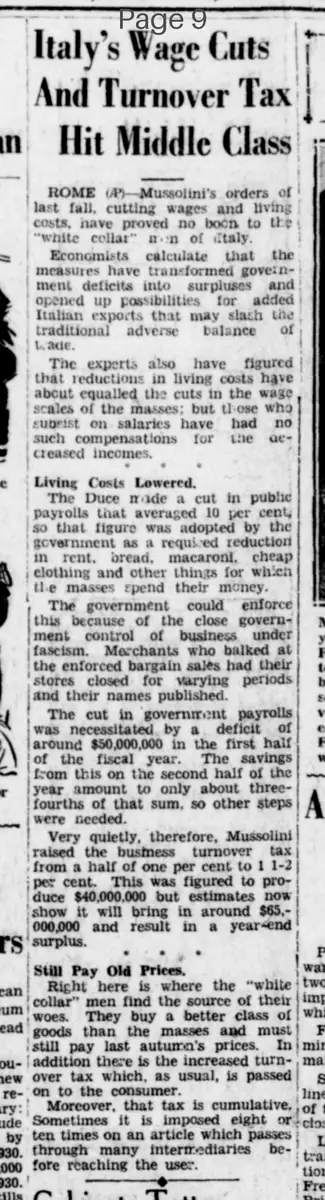
ROME (A.P.)—Mussolini's orders of last fall, cutting wages and living costs, have proved no boon to the white collar man of Italy.
Economists calculate that the measures have transformed government deficits into surpluses and opened up possibilities for added Italian exports that may slash the traditional adverse balance of trade.
The experts also have figured that reductions in living costs have about equalled the cuts in the wage scales of the masses; but those who subsist on salaries have had no such compensations for the decreased incomes.
Living Costs Lowered.
The Duce made a cut in public payrolls that averaged 10 per cent, so that figure was adopted by the government as a required reduction in rent, bread, macaroni, cheap clothing and other things for which the masses spend their money.
The government could enforce this because of the close government control of business under fascism. Merchants who balked at the enforced bargain sales had their stores closed for varying periods and their names published.
The cut in government payrolls was necessitated by a deficit of around $50,000,000 in the first half of the fiscal year. The savings from this on the second half of the year amount to only about three-fourths of that sum, so other steps were needed.
Very quietly, therefore, Mussolini raised the business turnover tax from a half of one per cent to 1 1-2 per cent. This was figured to produce $40,000,000 but estimates now show it will bring in around $65,000,000 and result in a year-end surplus.
Still Pay Old Prices.
Right here is where the "white collar" men find the source of their woes. They buy a better class of goods than the masses and must still pay last autumn's prices. In addition there is the increased turnover tax which, as usual, is passed on to the consumer.
Moreover, that tax is cumulative. Sometimes it is imposed eight or ten times on an article which passes through many intermediaries before reaching the user.
What sub-type of article is it?
What keywords are associated?
What entities or persons were involved?
Where did it happen?
Foreign News Details
Primary Location
Italy
Event Date
Last Fall
Key Persons
Outcome
government deficits transformed into surpluses; possibilities for added italian exports to slash adverse balance of trade; middle class faces decreased incomes without compensations, still paying old prices plus increased turnover tax.
Event Details
Mussolini's orders cut wages and living costs, benefiting the masses but not white-collar workers. Public payrolls cut by 10%, enforced reductions in rent, bread, macaroni, cheap clothing. Turnover tax raised from 0.5% to 1.5%, producing surplus. Middle class buys better goods at unchanged prices, affected by cumulative tax passed to consumers.