Thank you for visiting SNEWPapers!
Sign up free
Story
September 23, 1858
Monmouth Weekly Herald
Freehold, Monmouth County, New Jersey
What is this article about?
Messrs. Cutting & Bradford of Boston introduce Photo-Lithography, a new photographic process using prepared lithographic stones and glass negatives exposed to sunlight, enabling printing of detailed images like microscopic objects, revolutionizing book illustrations especially for scientific works.
Clipping
OCR Quality
95%
Excellent
Full Text
Photo-Lithography.
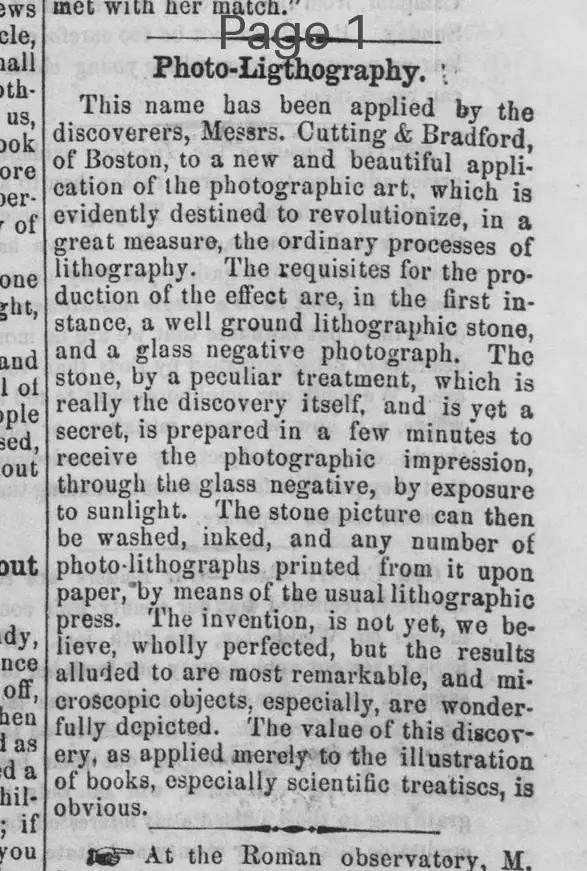
This name has been applied by the discoverers, Messrs. Cutting & Bradford, of Boston, to a new and beautiful application of the photographic art, which is evidently destined to revolutionize, in a great measure, the ordinary processes of lithography. The requisites for the production of the effect are, in the first instance, a well ground lithographic stone, and a glass negative photograph. The stone, by a peculiar treatment, which is really the discovery itself, and is yet a secret, is prepared in a few minutes to receive the photographic impression, through the glass negative, by exposure to sunlight. The stone picture can then be washed, inked, and any number of photo-lithographs printed from it upon paper, by means of the usual lithographic press. The invention is not yet, we believe, wholly perfected, but the results alluded to are most remarkable, and microscopic objects, especially, are wonderfully depicted. The value of this discovery, as applied merely to the illustration of books, especially scientific treatises, is obvious.
This name has been applied by the discoverers, Messrs. Cutting & Bradford, of Boston, to a new and beautiful application of the photographic art, which is evidently destined to revolutionize, in a great measure, the ordinary processes of lithography. The requisites for the production of the effect are, in the first instance, a well ground lithographic stone, and a glass negative photograph. The stone, by a peculiar treatment, which is really the discovery itself, and is yet a secret, is prepared in a few minutes to receive the photographic impression, through the glass negative, by exposure to sunlight. The stone picture can then be washed, inked, and any number of photo-lithographs printed from it upon paper, by means of the usual lithographic press. The invention is not yet, we believe, wholly perfected, but the results alluded to are most remarkable, and microscopic objects, especially, are wonderfully depicted. The value of this discovery, as applied merely to the illustration of books, especially scientific treatises, is obvious.
What sub-type of article is it?
Curiosity
What themes does it cover?
Triumph
What keywords are associated?
Photo Lithography
Invention
Photographic Art
Lithography
Scientific Illustration
Microscopic Depiction
What entities or persons were involved?
Messrs. Cutting & Bradford
Where did it happen?
Boston
Story Details
Key Persons
Messrs. Cutting & Bradford
Location
Boston
Story Details
Messrs. Cutting & Bradford invent Photo-Lithography, a process preparing lithographic stones to receive photographic impressions from glass negatives via sunlight exposure, allowing printing of detailed images including microscopic objects, poised to revolutionize lithography for book illustrations.