Thank you for visiting SNEWPapers!
Sign up free
Literary
November 7, 1883
The Vermont Watchman
Montpelier, Washington County, Vermont
What is this article about?
Mrs. Pritchard hosts two city slum boys, Pat and Jim, on her farm for fresh air, overcoming Aunt Nancy's reluctance. The boys explore rural life with the Pritchard sons. During a thunderstorm fire, Pat rescues Aunt Nancy, leading her to advocate for him staying permanently.
Clipping
OCR Quality
95%
Excellent
Full Text
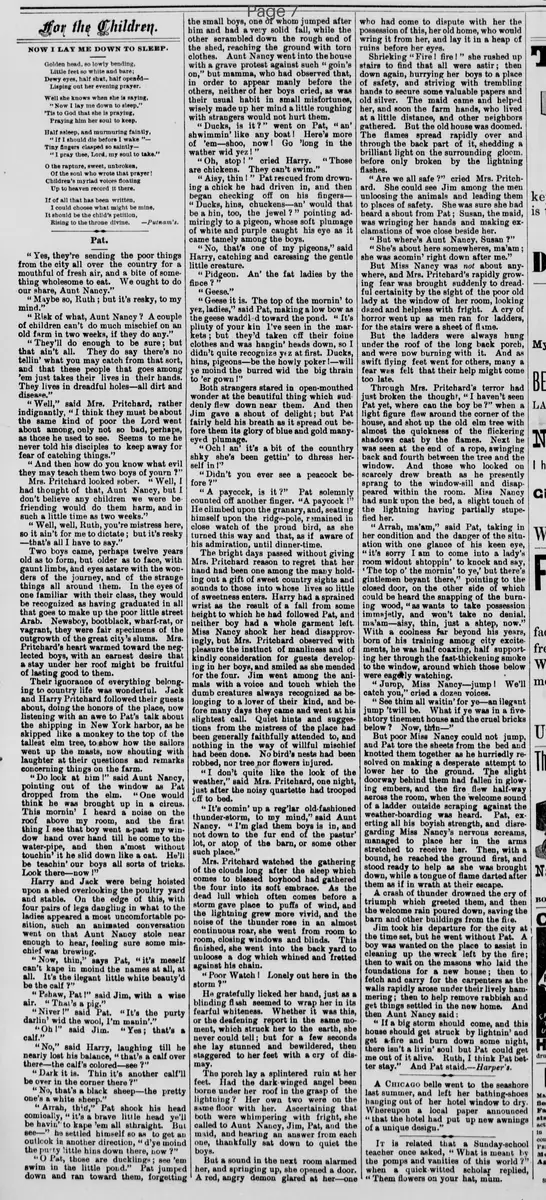
Pat.
"Yes, they're sending the poor things from the city all over the country for a mouthful of fresh air, and a bite of something wholesome to eat. We ought to do our share. Aunt Nancy."
"Maybe so, Ruth; but it's resky, to my mind."
"Risk of what, Aunt Nancy? A couple of children can't do much mischief on an old farm in two weeks, if they do any."
"They'll do enough to be sure; but that ain't all. They do say there's no tellin' what you may catch from that sort. and that these people that goes among 'em just takes their lives in their hands. They lives in dreadful holes-all dirt and disease."
"Well." said Mrs. Pritchard. rather indignantly, "I think they must be about the same kind of poor the Lord went about among, only not so bad, perhaps, as those he used to see. Seems to me he never told his disciples to keep away for fear of catching things."
"And then how do you know what evil they may teach them two boys of yourn?"
Mrs. Pritchard looked sober. "Well, I had thought of that, Aunt Nancy, but I don't believe any children we were befriending would do them harm, and in such a little time as two weeks."
"Well, well, Ruth, you're mistress here, so it ain't for me to dictate; but it's resky—that's all I have to say."
Two boys came, perhaps twelve years old as to form, but older as to face, with gaunt limbs, and eyes astare with the wonders of the journey, and of the strange things all around them. In the eyes of one familiar with their class, they would be recognized as having graduated in all that goes to make up the poor little street Arab. Newsboy, bootblack, wharf-rat, or vagrant, they were fair specimens of the outgrowth of the great city's slums. Mrs. Pritchard's heart warmed toward the neglected boys, with an earnest desire that a stay under her roof might be fruitful of lasting good to them.
Their ignorance of everything belonging to country life was wonderful. Jack and Harry Pritchard followed their guests about, doing the honors of the place, now listening with an awe to Pat's talk about the shipping in New York harbor, as he skipped like a monkey to the top of the tallest elm tree, to show how the sailors went up the masts, now shouting with laughter at their questions and remarks concerning things on the farm.
"Do look at him!" said Aunt Nancy, pointing out of the window as Pat dropped from the elm. "One would think he was brought up in a circus. This mornin' I heard a noise on the roof above my room, and the first thing I see that boy went a-past my window hand over hand till he come to the water-pipe, and then a'most without touchin' it he slid down like a cat. He'll be teachin' our boys all sorts of tricks. Look there—now!"
Harry and Jack were being hoisted upon a shed overlooking the poultry yard and stable. On the edge of this, with four pairs of legs dangling in what to the ladies appeared a most uncomfortable position, such an animated conversation went on that Aunt Nancy stole near enough to hear, feeling sure some mischief was brewing.
"Now, thin," says Pat, "it's meself can't kape in moind the names at all, at all. It's the ilegant little white beauty'd be the calf?"
"Pshaw, Pat!" said Jim, with a wise air. "That's a pig."
"Niver!" said Pat. "It's the purty darlin' wid the wool, I'm manin'."
"Oh!" said Jim. "Yes; that's a calf."
"No," said Harry, laughing till he nearly lost his balance, "that's a calf over there—the calf's colored—see?"
"Dark it is. Thin it's another calf'll be over in the corner there?"
"No, that's a black sheep—the pretty one's a white sheep."
"Arrab, thid," Pat shook his head comically, "it's a brave little head ye'll be havin' to kape 'em all sthraight. But see—" he settled himself so as to get an outlook in another direction, "d'ye moind the purty little hins down there, now?"
"O Pat, those are ducklings; see 'em swim in the little pond." Pat jumped down and ran toward them, forgetting the small boys, one of whom jumped after him and had a very solid fall, while the other scrambled down the rough end of the shed, reaching the ground with torn clothes. Aunt Nancy went into the house with a grave protest against such "goin's on," but mamma, who had observed that, in order to appear manly before the others, neither of her boys cried, as was their usual habit in small misfortunes, wisely made up her mind a little roughing with strangers would not hurt them.
"Ducks, is it?" went on Pat, "an' shwimmin' like any boat! Here's more of 'em—shoo, now! Go 'long in the wather wid yez!"
"Oh, stop!" cried Harry. "Those are chickens. They can't swim."
"Aisy, thin!" Pat rescued from drowning a chick he had driven in, and then began checking off on his fingers—"Ducks, hins, chuckens—an' would that be a hin, too, the jewel?" pointing admiringly to a pigeon, whose soft plumage of white and purple caught his eye as it came tamely among the boys.
"No, that's one of my pigeons," said Harry, catching and caressing the gentle little creature.
"Pidgeon. An' the fat ladies by the fince?"
"Geese."
"Geese it is. The top of the mornin' to yez, ladies," said Pat, making a low bow as the geese waddled toward the pond. "It's plinty of your kin I've seen in the markets: but they'd taken off their foine clothes and was hangin' heads down, so I didn't quite recognize yez at first. Ducks. hins, pigeons—be the howly poker!—will ye moind the burred wid the big thrain to 'er gown!"
Both strangers stared in open-mouthed wonder at the beautiful thing which suddenly flew down near them. And then Jim gave a shout of delight; but Pat fairly held his breath as it spread out before them its glory of blue and gold many-eyed plumage.
"Och! an' it's a bit of the counthry shky she's been gettin' to dhress herself in!"
"Didn't you ever see a peacock before?"
"A paycock, is it?" Pat solemnly counted off another finger. "A paycock!"
He climbed upon the granary, and, seating himself upon the ridge-pole, remained in close watch of the proud bird, as she turned this way and that, as if aware of his admiration, until dinner-time.
The bright days passed without giving Mrs. Pritchard reason to regret that her hand had been one among the many holding out a gift of sweet country sights and sounds to those into whose lives so little of sweetness enters. Harry had a sprained wrist as the result of a fall from some height to which he had followed Pat, and neither boy had a whole garment left. Miss Nancy shook her head disapprovingly, but Mrs. Pritchard observed with pleasure the instinct of manliness and of kindly consideration for guests developing in her boys, and smiled as she mended for the four. Jim went among the animals with a voice and touch which the dumb creatures always recognized as belonging to a lover of their kind, and before many days they came and went at his slightest call. Quiet hints and suggestions from the mistress of the place had been generally faithfully attended to, and nothing in the way of willful mischief had been done. No bird's nests had been robbed, nor tree nor flowers injured.
"I don't quite like the look of the weather," said Mrs. Pritchard, one night, just after the noisy quartette had trooped off to bed.
"It's comin' up a reg'lar old-fashioned thunder-storm, to my mind," said Aunt Nancy. "I'm glad them boys is in, and not down to the fur end of the pastur' lot, or atop of the barn, or some other such place."
Mrs. Pritchard watched the gathering of the clouds long after the sleep which comes to blessed boyhood had gathered the four into its soft embrace. As the dead lull which often comes before a storm gave place to puffs of wind, and the lightning grew more vivid, and the noise of the thunder rose in an almost continuous roar, she went from room to room, closing windows and blinds. This finished, she went into the back yard to unloose a dog which whined and fretted against his chain.
"Poor Watch! Lonely out here in the storm?"
He gratefully licked her hand, just as a blinding flash seemed to wrap her in its fearful whiteness. Whether it was this, or the deafening report in the same moment, which struck her to the earth, she never could tell; but for a few seconds she lay stunned and bewildered, then staggered to her feet with a cry of dismay.
The porch lay a splintered ruin at her feet. Had the dark-winged angel been borne under her roof in the grasp of the lightning? Her own two were on the same floor with her. Ascertaining that both were whimpering with fright, she called to Aunt Nancy, Jim, Pat, and the maid, and hearing an answer from each one, thankfully sat down to quiet the boys.
But a sound in the next room alarmed her, and springing up, she opened a door. A red, angry demon glared at her—one who had come to dispute with her the possession of this, her old home, who would wring it from her, and lay it in a heap of ruins before her eyes.
Shrieking "Fire! fire!" she rushed up stairs to find that all were astir; then down again, hurrying her boys to a place of safety, and striving with trembling hands to secure some valuable papers and old silver. The maid came and helped her, and soon the farm hands, who lived at a little distance, and other neighbors gathered. But the old house was doomed. The flames spread rapidly over and through the back part of it, shedding a brilliant light on the surrounding gloom, before only broken by the lightning flashes.
"Are we all safe?" cried Mrs. Pritchard. She could see Jim among the men unloosing the animals and leading them to places of safety. She was sure she had heard a shout from Pat: Susan, the maid, was wringing her hands and making exclamations of woe close beside her.
"But where's Aunt Nancy, Susan?"
"She's about here somewheres, ma'am; she was a-comin' right down after me."
But Miss Nancy was not about anywhere, and Mrs. Pritchard's rapidly growing fear was brought suddenly to dread. ful certainty by the sight of the poor old lady at the window of her room, looking dazed and helpless with fright. A cry of horror went up as men ran for ladders, for the stairs were a sheet of flame. But the ladders were always hung under the roof of the long back porch, and were now burning with it. And as swift flying feet went for others, many a fear was felt that their help might come too late.
Through Mrs. Pritchard's terror had just broken the thought, "I haven't seen Pat yet, where can the boy be?" when a light figure flew around the corner of the house, and shot up the old elm tree with almost the quickness of the flickering shadows cast by the flames. Next he was seen at the end of a rope, swinging back and forth between the tree and the window. And those who looked on scarcely drew breath as he presently sprang to the window-sill and disappeared within the room. Miss Nancy had sunk upon the bed, a slight touch of the lightning having partially stupefied her.
"Arrab, ma'am," said Pat, taking in her condition and the danger of the situation with one glance of his keen eye, "it's sorry I am to come into a lady's room widout shtoppin' to knock and say, 'The top o' the mornin' to ye,' but there's gintlemen beyant there," pointing to the closed door, on the other side of which could be heard the snapping of the burning wood, "as wants to take possession immajetly, and won't take no denial ma'am—aisy, thin, just a shtep, now."
With a coolness far beyond his years, born of his training among city excitements, he was half coaxing, half supporting her through the fast-thickening smoke to the window, around which those below were eagerly watching.
"Jump, Miss Nancy—jump! We'll catch you," cried a dozen voices.
"See thim all waitin' for ye—an ilegant jump 'twill be. What if ye was in a five-shtory tinement house and the cruel bricks below? Now, thin"
But poor Miss Nancy could not jump, and Pat tore the sheets from the bed and knotted them together as he hurriedly resolved on making a desperate attempt to lower her to the ground. The slight doorway behind them had fallen in glowing embers, and the fire flew half-way across the room, when the welcome sound of a ladder outside scraping against the weather-boarding was heard. Pat, exerting all his boyish strength, and disregarding Miss Nancy's nervous screams, managed to place her in the arms stretched to receive her. Then, with a bound, he reached the ground first, and stood ready to help as she was brought down, while a tongue of flame darted after them as if in wrath at their escape.
A crash of thunder drowned the cry of triumph which greeted them, and then the welcome rain poured down, saving the barn and other buildings from the fire.
Jim took his departure for the city at the time set, but he went without Pat. A boy was wanted on the place to assist in cleaning up the wreck left by the fire; then to wait on the masons who laid the foundations for a new house; then to fetch and carry for the carpenters as the walls rapidly arose under their lively hammering; then to help remove rubbish and get things settled in the new home. And then Aunt Nancy said:
"If a big storm should come, and this house should get struck by lightnin' and get a-fire and burn down some night, there isn't a livin'soul but Pat could get me out of it alive. Ruth, I think Pat better stay."
And Pat staid.—Harper's.
"Yes, they're sending the poor things from the city all over the country for a mouthful of fresh air, and a bite of something wholesome to eat. We ought to do our share. Aunt Nancy."
"Maybe so, Ruth; but it's resky, to my mind."
"Risk of what, Aunt Nancy? A couple of children can't do much mischief on an old farm in two weeks, if they do any."
"They'll do enough to be sure; but that ain't all. They do say there's no tellin' what you may catch from that sort. and that these people that goes among 'em just takes their lives in their hands. They lives in dreadful holes-all dirt and disease."
"Well." said Mrs. Pritchard. rather indignantly, "I think they must be about the same kind of poor the Lord went about among, only not so bad, perhaps, as those he used to see. Seems to me he never told his disciples to keep away for fear of catching things."
"And then how do you know what evil they may teach them two boys of yourn?"
Mrs. Pritchard looked sober. "Well, I had thought of that, Aunt Nancy, but I don't believe any children we were befriending would do them harm, and in such a little time as two weeks."
"Well, well, Ruth, you're mistress here, so it ain't for me to dictate; but it's resky—that's all I have to say."
Two boys came, perhaps twelve years old as to form, but older as to face, with gaunt limbs, and eyes astare with the wonders of the journey, and of the strange things all around them. In the eyes of one familiar with their class, they would be recognized as having graduated in all that goes to make up the poor little street Arab. Newsboy, bootblack, wharf-rat, or vagrant, they were fair specimens of the outgrowth of the great city's slums. Mrs. Pritchard's heart warmed toward the neglected boys, with an earnest desire that a stay under her roof might be fruitful of lasting good to them.
Their ignorance of everything belonging to country life was wonderful. Jack and Harry Pritchard followed their guests about, doing the honors of the place, now listening with an awe to Pat's talk about the shipping in New York harbor, as he skipped like a monkey to the top of the tallest elm tree, to show how the sailors went up the masts, now shouting with laughter at their questions and remarks concerning things on the farm.
"Do look at him!" said Aunt Nancy, pointing out of the window as Pat dropped from the elm. "One would think he was brought up in a circus. This mornin' I heard a noise on the roof above my room, and the first thing I see that boy went a-past my window hand over hand till he come to the water-pipe, and then a'most without touchin' it he slid down like a cat. He'll be teachin' our boys all sorts of tricks. Look there—now!"
Harry and Jack were being hoisted upon a shed overlooking the poultry yard and stable. On the edge of this, with four pairs of legs dangling in what to the ladies appeared a most uncomfortable position, such an animated conversation went on that Aunt Nancy stole near enough to hear, feeling sure some mischief was brewing.
"Now, thin," says Pat, "it's meself can't kape in moind the names at all, at all. It's the ilegant little white beauty'd be the calf?"
"Pshaw, Pat!" said Jim, with a wise air. "That's a pig."
"Niver!" said Pat. "It's the purty darlin' wid the wool, I'm manin'."
"Oh!" said Jim. "Yes; that's a calf."
"No," said Harry, laughing till he nearly lost his balance, "that's a calf over there—the calf's colored—see?"
"Dark it is. Thin it's another calf'll be over in the corner there?"
"No, that's a black sheep—the pretty one's a white sheep."
"Arrab, thid," Pat shook his head comically, "it's a brave little head ye'll be havin' to kape 'em all sthraight. But see—" he settled himself so as to get an outlook in another direction, "d'ye moind the purty little hins down there, now?"
"O Pat, those are ducklings; see 'em swim in the little pond." Pat jumped down and ran toward them, forgetting the small boys, one of whom jumped after him and had a very solid fall, while the other scrambled down the rough end of the shed, reaching the ground with torn clothes. Aunt Nancy went into the house with a grave protest against such "goin's on," but mamma, who had observed that, in order to appear manly before the others, neither of her boys cried, as was their usual habit in small misfortunes, wisely made up her mind a little roughing with strangers would not hurt them.
"Ducks, is it?" went on Pat, "an' shwimmin' like any boat! Here's more of 'em—shoo, now! Go 'long in the wather wid yez!"
"Oh, stop!" cried Harry. "Those are chickens. They can't swim."
"Aisy, thin!" Pat rescued from drowning a chick he had driven in, and then began checking off on his fingers—"Ducks, hins, chuckens—an' would that be a hin, too, the jewel?" pointing admiringly to a pigeon, whose soft plumage of white and purple caught his eye as it came tamely among the boys.
"No, that's one of my pigeons," said Harry, catching and caressing the gentle little creature.
"Pidgeon. An' the fat ladies by the fince?"
"Geese."
"Geese it is. The top of the mornin' to yez, ladies," said Pat, making a low bow as the geese waddled toward the pond. "It's plinty of your kin I've seen in the markets: but they'd taken off their foine clothes and was hangin' heads down, so I didn't quite recognize yez at first. Ducks. hins, pigeons—be the howly poker!—will ye moind the burred wid the big thrain to 'er gown!"
Both strangers stared in open-mouthed wonder at the beautiful thing which suddenly flew down near them. And then Jim gave a shout of delight; but Pat fairly held his breath as it spread out before them its glory of blue and gold many-eyed plumage.
"Och! an' it's a bit of the counthry shky she's been gettin' to dhress herself in!"
"Didn't you ever see a peacock before?"
"A paycock, is it?" Pat solemnly counted off another finger. "A paycock!"
He climbed upon the granary, and, seating himself upon the ridge-pole, remained in close watch of the proud bird, as she turned this way and that, as if aware of his admiration, until dinner-time.
The bright days passed without giving Mrs. Pritchard reason to regret that her hand had been one among the many holding out a gift of sweet country sights and sounds to those into whose lives so little of sweetness enters. Harry had a sprained wrist as the result of a fall from some height to which he had followed Pat, and neither boy had a whole garment left. Miss Nancy shook her head disapprovingly, but Mrs. Pritchard observed with pleasure the instinct of manliness and of kindly consideration for guests developing in her boys, and smiled as she mended for the four. Jim went among the animals with a voice and touch which the dumb creatures always recognized as belonging to a lover of their kind, and before many days they came and went at his slightest call. Quiet hints and suggestions from the mistress of the place had been generally faithfully attended to, and nothing in the way of willful mischief had been done. No bird's nests had been robbed, nor tree nor flowers injured.
"I don't quite like the look of the weather," said Mrs. Pritchard, one night, just after the noisy quartette had trooped off to bed.
"It's comin' up a reg'lar old-fashioned thunder-storm, to my mind," said Aunt Nancy. "I'm glad them boys is in, and not down to the fur end of the pastur' lot, or atop of the barn, or some other such place."
Mrs. Pritchard watched the gathering of the clouds long after the sleep which comes to blessed boyhood had gathered the four into its soft embrace. As the dead lull which often comes before a storm gave place to puffs of wind, and the lightning grew more vivid, and the noise of the thunder rose in an almost continuous roar, she went from room to room, closing windows and blinds. This finished, she went into the back yard to unloose a dog which whined and fretted against his chain.
"Poor Watch! Lonely out here in the storm?"
He gratefully licked her hand, just as a blinding flash seemed to wrap her in its fearful whiteness. Whether it was this, or the deafening report in the same moment, which struck her to the earth, she never could tell; but for a few seconds she lay stunned and bewildered, then staggered to her feet with a cry of dismay.
The porch lay a splintered ruin at her feet. Had the dark-winged angel been borne under her roof in the grasp of the lightning? Her own two were on the same floor with her. Ascertaining that both were whimpering with fright, she called to Aunt Nancy, Jim, Pat, and the maid, and hearing an answer from each one, thankfully sat down to quiet the boys.
But a sound in the next room alarmed her, and springing up, she opened a door. A red, angry demon glared at her—one who had come to dispute with her the possession of this, her old home, who would wring it from her, and lay it in a heap of ruins before her eyes.
Shrieking "Fire! fire!" she rushed up stairs to find that all were astir; then down again, hurrying her boys to a place of safety, and striving with trembling hands to secure some valuable papers and old silver. The maid came and helped her, and soon the farm hands, who lived at a little distance, and other neighbors gathered. But the old house was doomed. The flames spread rapidly over and through the back part of it, shedding a brilliant light on the surrounding gloom, before only broken by the lightning flashes.
"Are we all safe?" cried Mrs. Pritchard. She could see Jim among the men unloosing the animals and leading them to places of safety. She was sure she had heard a shout from Pat: Susan, the maid, was wringing her hands and making exclamations of woe close beside her.
"But where's Aunt Nancy, Susan?"
"She's about here somewheres, ma'am; she was a-comin' right down after me."
But Miss Nancy was not about anywhere, and Mrs. Pritchard's rapidly growing fear was brought suddenly to dread. ful certainty by the sight of the poor old lady at the window of her room, looking dazed and helpless with fright. A cry of horror went up as men ran for ladders, for the stairs were a sheet of flame. But the ladders were always hung under the roof of the long back porch, and were now burning with it. And as swift flying feet went for others, many a fear was felt that their help might come too late.
Through Mrs. Pritchard's terror had just broken the thought, "I haven't seen Pat yet, where can the boy be?" when a light figure flew around the corner of the house, and shot up the old elm tree with almost the quickness of the flickering shadows cast by the flames. Next he was seen at the end of a rope, swinging back and forth between the tree and the window. And those who looked on scarcely drew breath as he presently sprang to the window-sill and disappeared within the room. Miss Nancy had sunk upon the bed, a slight touch of the lightning having partially stupefied her.
"Arrab, ma'am," said Pat, taking in her condition and the danger of the situation with one glance of his keen eye, "it's sorry I am to come into a lady's room widout shtoppin' to knock and say, 'The top o' the mornin' to ye,' but there's gintlemen beyant there," pointing to the closed door, on the other side of which could be heard the snapping of the burning wood, "as wants to take possession immajetly, and won't take no denial ma'am—aisy, thin, just a shtep, now."
With a coolness far beyond his years, born of his training among city excitements, he was half coaxing, half supporting her through the fast-thickening smoke to the window, around which those below were eagerly watching.
"Jump, Miss Nancy—jump! We'll catch you," cried a dozen voices.
"See thim all waitin' for ye—an ilegant jump 'twill be. What if ye was in a five-shtory tinement house and the cruel bricks below? Now, thin"
But poor Miss Nancy could not jump, and Pat tore the sheets from the bed and knotted them together as he hurriedly resolved on making a desperate attempt to lower her to the ground. The slight doorway behind them had fallen in glowing embers, and the fire flew half-way across the room, when the welcome sound of a ladder outside scraping against the weather-boarding was heard. Pat, exerting all his boyish strength, and disregarding Miss Nancy's nervous screams, managed to place her in the arms stretched to receive her. Then, with a bound, he reached the ground first, and stood ready to help as she was brought down, while a tongue of flame darted after them as if in wrath at their escape.
A crash of thunder drowned the cry of triumph which greeted them, and then the welcome rain poured down, saving the barn and other buildings from the fire.
Jim took his departure for the city at the time set, but he went without Pat. A boy was wanted on the place to assist in cleaning up the wreck left by the fire; then to wait on the masons who laid the foundations for a new house; then to fetch and carry for the carpenters as the walls rapidly arose under their lively hammering; then to help remove rubbish and get things settled in the new home. And then Aunt Nancy said:
"If a big storm should come, and this house should get struck by lightnin' and get a-fire and burn down some night, there isn't a livin'soul but Pat could get me out of it alive. Ruth, I think Pat better stay."
And Pat staid.—Harper's.
What sub-type of article is it?
Prose Fiction
What themes does it cover?
Moral Virtue
Agriculture Rural
Friendship
What keywords are associated?
City Boys
Farm Life
Slum Children
Fire Rescue
Kindness To Poor
Dialect Dialogue
Thunderstorm
Heroic Boy
Literary Details
Key Lines
"Well." Said Mrs. Pritchard. Rather Indignantly, "I Think They Must Be About The Same Kind Of Poor The Lord Went About Among, Only Not So Bad, Perhaps, As Those He Used To See. Seems To Me He Never Told His Disciples To Keep Away For Fear Of Catching Things."
"Arrab, Ma'am," Said Pat, Taking In Her Condition And The Danger Of The Situation With One Glance Of His Keen Eye, "It's Sorry I Am To Come Into A Lady's Room Widout Shtoppin' To Knock And Say, 'The Top O' The Mornin' To Ye,' But There's Gintlemen Beyant There," Pointing To The Closed Door, On The Other Side Of Which Could Be Heard The Snapping Of The Burning Wood, "As Wants To Take Possession Immajetly, And Won't Take No Denial Ma'am—Aisy, Thin, Just A Shtep, Now."
"If A Big Storm Should Come, And This House Should Get Struck By Lightnin' And Get A Fire And Burn Down Some Night, There Isn't A Livin'soul But Pat Could Get Me Out Of It Alive. Ruth, I Think Pat Better Stay."