Thank you for visiting SNEWPapers!
Sign up free
Norfolk Gazette And Publick Ledger
Norfolk, Virginia
What is this article about?
The Nassau Royal Gazette publishes a letter from William Wylly, Bahamas Attorney General, refuting U.S. accusations of British sale of captured American slaves in the islands during the recent war. Wylly asserts all prize Negroes were liberated or exchanged, not sold, and cites instances of freeing smuggled slaves. Affidavits support the denial amid diplomatic tensions at Ghent.
Merged-components note: These components form a single continuous article from the Nassau Royal Gazette refuting charges regarding the sale of American slaves in the Bahamas.
Clipping
OCR Quality
Full Text
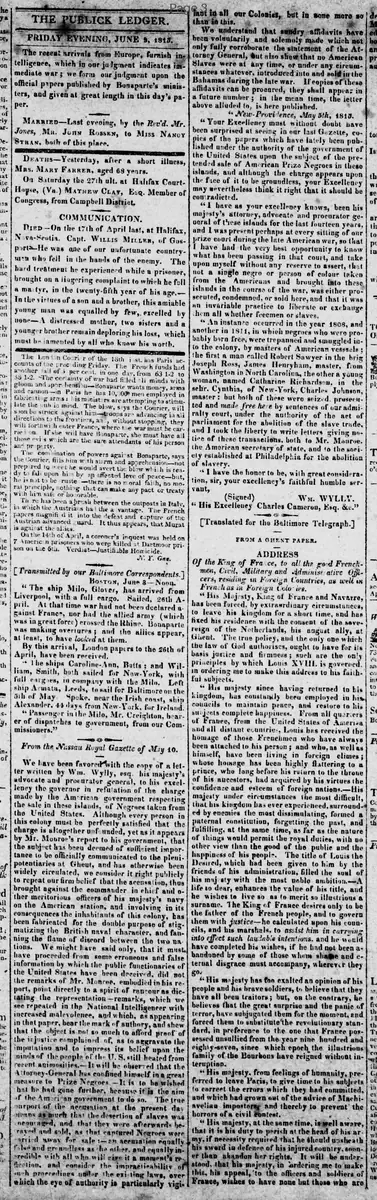
We have been favored with the copy of a letter written by Wm. Wylly, esq. his majesty's advocate and procurator general, to his excellency the governor in refutation of the charge made by the American government respecting the sale in these islands, of Negroes taken from the United States. Although every person in this colony must be perfectly satisfied that the charge is altogether unfounded, yet as it appears by Mr. Monroe's report to his government, that the subject has been deemed of sufficient importance to be officially communicated to the plenipotentiaries at Ghent, and has otherwise been widely circulated, we consider it right publicly to repeat our firm belief that the accusation, thus brought against the commander in chief and other meritorious officers of his majesty's navy on the American station, and involving in its consequences the inhabitants of this colony, has been fabricated for the double purpose of stigmatizing the British naval character, and fanning the flame of discord between the two nations. We might have said only, that it must have proceeded from some erroneous and false information by which the public functionaries of the United States have been deceived. did not the remarks of Mr. Monroe, embodied in his report, point directly to a spirit of rancour as dictating the representation--remarks, which we see repeated in the National Intelligencer with increased malevolence, and which, as appearing in that paper, bear the mark of authority, and shew that the object is not so much to afford proof of the injustice complained of, as to aggravate the imputation and to impress its belief upon the minds of the people of the U. S. still heated from recent animosities.--It will be observed that the Attorney-General has confined himself in a great measure to Prize Negroes.--It is to be wished that he had gone further, because it is the aim of the American government to do so. The true purport of the accusation at the present day means as much that the desertion of slaves was encouraged, and that they were afterwards betrayed and sold, as that captured Negroes were carried away for sale:--an accusation equally false and groundless as the other. and equally incredible--with all who will give it a moment's reflection, and consider the impracticability. of such proceedings under the existing laws, over which the eye of authority is particularly vigilant in all our Colonies, but in none more so than in this.
We understand that sundry affidavits have been voluntarily and solemnly made which not only fully corroborate the statement of the Attorney General, but also shew that no American Slaves were at any time, or under any circumstances whatever, introduced into and sold in the Bahamas during the late war. If copies of these affidavits can be procured, they shall appear in a future number; in the mean time, the letter above alluded to, is here published.
"New-Providence, May 5th, 1810.
"Your Excellency must without doubt have been surprised at seeing in our last Gazette, copies of the papers which have lately been published under the authority of the government of the United States upon the subject of the pretended sale of American Prize Negroes in these islands, and although the charge appears upon the face of it to be groundless, your Excellency may nevertheless think it right that it should be contradicted.
"I have as your excellency knows, been his majesty's attorney, advocate and procurator general of these islands for the last fourteen years, and I was present perhaps at every sitting of our prize court during the late American war, so that I have had the very best opportunity to know what has been passing in that court, and take upon myself without any reserve to assert, that not a single negro or person of colour taken from the Americans and brought into these islands in the course of the war, was either prosecuted, condemned, or sold here, and that it was an invariable practice to liberate or exchange them all whether freemen or slaves.
"An instance occurred in the year 1808, and another in 1811, in which negroes who were probably born free, were trepanned and smuggled into the colony, by masters of American vessels; the first a man called Robert Sawyer in the brig Joseph Ross, James Henryham, master, from Washington in North Carolina, the other a young woman, named Catharine Richardson, in the schr. Cynthia, of New-York. Charles Johnson, master: but both of these were seized. prosecuted and made free here by sentences of our admiralty court, under the authority of the act of parliament for the abolition of the slave trade, and I took the liberty to write letters giving notice of these transactions, both to Mr. Monroe. the American secretary of state, and to the society established at Philadelphia for the abolition of slavery.
"I have the honor to be, with great consideration, sir, your excellency's faithful humble servant,
(Signed) WM. WYLLY.
"His Excellency Charles Cameron, Esq. &c."
What sub-type of article is it?
What keywords are associated?
What entities or persons were involved?
Where did it happen?
Foreign News Details
Primary Location
New Providence, Bahamas
Event Date
May 5th, 1810
Key Persons
Outcome
no american slaves sold in bahamas; all prize negroes liberated or exchanged; smuggled slaves freed by court; accusation deemed false and fabricated.
Event Details
William Wylly writes to Governor Charles Cameron refuting U.S. government charges, reported by James Monroe, of selling American prize Negroes in the Bahamas during the late war. Wylly, present at prize court, asserts no such sales occurred; all were liberated or exchanged. Cites 1808 and 1811 cases of smuggled free Negroes freed under abolition act. Editorial notes affidavits corroborating and accuses U.S. of rancor to inflame discord.