Thank you for visiting SNEWPapers!
Sign up free
The National Intelligencer And Washington Advertiser
Washington, District Of Columbia
What is this article about?
On February 20, in the U.S. House of Representatives, Mr. G. W. Campbell delivers a speech opposing the partial repeal of the embargo in the Non-Intercourse Bill. He argues for maintaining the embargo with non-intercourse to pressure Britain and France, preserving national honor until war if needed, criticizing the measure as submission to Britain.
Merged-components note: This is a continuation of the congressional debate report from page 1 to page 2, including Mr. G. W. Campbell's speech on the non-intercourse bill. The second part was mislabeled as editorial, but it is part of the same narrative story.
Clippings
1 of 2
OCR Quality
Full Text
HOUSE OF REPRESENTATIVES.
DEBATE
ON THE NON INTERCOURSE BILL
MONDAY FEB 20.
A motion having been made to amend the bill so as to leave the embargo wholly on-
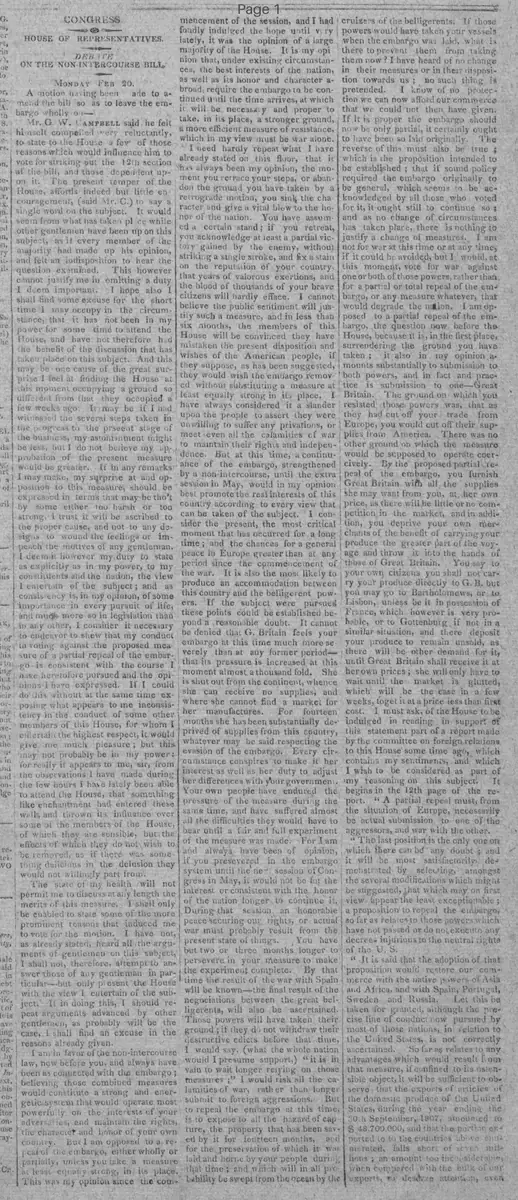
Mr. G. W. CAMPBELL said he felt himself compelled very reluctantly, to state to the House a few of those reasons which would influence him to vote for striking out the 12th section of the bill, and those dependent upon it. The present temper of the House, affords indeed but little encouragement, (said Mr. C.) to say a single word on the subject. It would seem from what has taken place while other gentlemen have been up on this subject, as if every member of the majority had made up his opinion, and felt an indisposition to hear the question examined. This however cannot justify me in omitting a duty I deem important. I hope also I shall find some excuse for the short time I may occupy in the circumstance, that it has not been in my power for some time to attend the House, and have not therefore had the benefit of the discussion that has taken place on this subject. And this may be one cause of the great surprise I feel at finding the House at this moment occupying a ground so different from that they occupied a few weeks ago: It may be if I had witnessed the several steps taken in the progress to the present stage of the business, my astonishment might be less, but I do not believe my disapprobation of the present measure would be greater. If in any remarks I may make, my surprise at and opposition to this measure, should be expressed in terms that may be thought by some either too harsh or too strong, I trust it will be ascribed to the proper cause, and not to any designs to wound the feelings or impeach the motives of any gentleman. I deem it however my duty to state as explicitly as in my power, to my constituents and the nation, the view I entertain of the subject; and as consistency is, in my opinion, of some importance in every pursuit of life, and much more so in legislation than in any other, I consider it necessary to endeavor to shew that my conduct in voting against the proposed measure of a partial repeal of the embargo is consistent with the course I have heretofore pursued and the opinions I have expressed. If I could do this without at the same time exposing what appears to me inconsistency in the conduct of some other members of this House, for whom I entertain the highest respect, it would give me much pleasure; but this may not probably be in my power. for really it appears to me, sir, from the observations I have made during the few hours I have lately been able to attend the House, that something like enchantment had entered these walls and thrown its influence over some of the members of the House, of which they are sensible, but the effects of which they do not wish to be removed, as if there was something delicious in the delusion they would not willingly part from. The state of my health will not permit me to discuss at any length the merits of this measure. I shall only be enabled to state some of the more prominent reasons that induced me to vote for the motion. I have not, as already stated, heard all the arguments of gentlemen on this subject, I shall not, therefore, attempt to answer those of any gentleman in particular—but only present the House with the view I entertain of the subject. If in doing this, I should repeat arguments advanced by other gentlemen, as probably will be the case, I shall find an excuse in the reasons already given. I am in favor of the non-intercourse law, now before you, and always have been as connected with the embargo; believing those combined measures would constitute a strong and energetic system that would operate most powerfully on the interests of your adversaries, and maintain the rights, the character and honor of your own country. But I am opposed to a repeal of the embargo, either wholly or partially, unless you take a measure at least equally strong, in its place. This was my opinion since the commencement of the session, and I had fondly indulged the hope until very lately, it was the opinion of a large majority of the House. It is my opinion that, under existing circumstances, the best interests of the nation, as well as its honor and character abroad, require the embargo to be continued until the time arrives, at which it will be necessary and proper to take, in its place, a stronger ground, a more efficient measure of resistance, which in my view must be war alone. I need hardly repeat what I have already stated on this floor, that it has always been my opinion, the moment you retrace your steps, or abandon the ground you have taken by a retrograde motion, you sink the character and give a vital blow to the honor of the nation. You have assumed a certain stand; if you retreat, you acknowledge at least a partial victory gained by the enemy, without striking a single stroke, and fix a stain on the reputation of your country, that years of valorous exertions, and the blood of thousands of your brave citizens will hardly efface. I cannot believe the public sentiment will justify such a measure, and in less than six months, the members of this House will be convinced they have mistaken the present disposition and wishes of the American people, if they suppose, as has been suggested, they would wish the embargo removed without substituting a measure at least equally strong in its place. I have always considered it a slander upon the people to assert they were unwilling to suffer any privations, or meet even all the calamities of war to maintain their rights and independence. But at this time, a continuance of the embargo, strengthened by a non intercourse, until the extra session in May, would in my opinion best promote the real interests of this country according to every view that can be taken of the subject. I consider the present, the most critical moment that has occurred for a long time: and the chances for a general peace in Europe greater than at any period since the commencement of the war. It is also the most likely to produce an accommodation between this country and the belligerent powers. If the subject were pursued these points could be established beyond a reasonable doubt, It cannot be denied that G. Britain feels your embargo at this time much more severely than at any former period- that its pressure is increased at this moment almost a thousand fold. She is shut out from the continent, whence she can receive no supplies, and where she cannot find a market for her manufactures. For fourteen months she has been substantially deprived of supplies from this country, whatever may be said respecting the evasion of the embargo. Every circumstance conspires to make it her interest as well as her duty to adjust her differences with your government. Your own people have endured the pressure of the measure during the same time, and have suffered almost all the difficulties they would have to bear until a fair and full experiment of the measure was made. For I am and always have been of opinion, if you persevered in the embargo system until the next session of Congress in May, it would not be for the interest or consistent with the honor of the nation longer to continue it. During that session, an honorable peace securing our rights, or actual war must probably result from the present state of things. You have but two or three months longer to persevere in your measure to make the experiment complete. By that time the result of the war with Spain will be known--the final result of the negociations between the great belligerents, will also be ascertained. Those powers will have taken their ground ; if they do not withdraw their destructive edicts before that time, I would say. (what the whole nation would I presume support,) "it is in vain to wait longer relying on those measures ;" I would risk all the calamities of war, rather than longer submit to foreign aggressions. But to repeal the embargo at this time. is to expose to all the hazard of capture, the property that has been saved by it for fourteen months, and for the preservation of which it was laid and borne by your people during that time; and which will in all probability be swept from the ocean by the cruizers of the belligerents. If those powers would have taken your vessels when the embargo was laid, what is there to prevent them from taking them now ? I have heard of no change in their measures or in their disposition towards us ; no such thing is pretended. I know of no protection we can now afford our commerce that we could not then have given. If it is proper the embargo should now be only partial, it certainly ought to have been so laid originally. The reverse of this must also be true ; which is the proposition intended to be established ; that if sound policy required the embargo originally to be general, which seems to be acknowledged by all those who voted for it, it ought still to continue so s and as no change of circumstances has taken place, there is nothing to justify a change of measures. I am not for war at this time or at any time, if it could be avoided, but I would, at this moment, vote for war against one or both of those powers, rather than for a partial or total repeal of the embargo, or any measure whatever, that would degrade the nation. I am opposed to a partial repeal of the embargo, the question now before the House, because it is, in the first place, surrendering the ground you have taken ; it also in my opinion amounts substantially to submission to both powers, and in fact and practice is submission to one--Great Britain. The ground on which you resisted those powers was, that as they had cut off your trade from Europe, you would cut off their supplies rom America. There was no other ground on which the measure would be supposed to operate coercively. By the proposed partial repeal of the embargo, you furnish Great Britain with all the supplies she may want from you, at, her own price, as there will be little or no competition in the market, and in addition, you deprive your own merchants of the benefit of carrying your produce the greater part of the voyage and throw it into the hands of those of Great Britain. You say to your own citizens you shall not carry your produce directly to G. B. but you may go to Bartholomew's, or to Lisbon, unless be it in possession of France, which however is very probable, or to Gottenburg if not in a similar situation, and there deposit your produce to remain unsold, as there will be other demand for it, until Great Britain shall receive it at her own prices; she will only have to wait until the market is glutted, which will be the case in a few weeks, to get it at a price less than first cost. I must ask, of the House to be indulged in reading in support of this statement part of a report made by the committee on foreign relations to this House some time ago, which contains my sentiments, and which I wish to be considered as part of my reasoning on this subject. It begins in the 12th page of the report. " A partial repeal must, from the situation of Europe, necessarily be actual submission to one of the aggressors, and war with the other. " Tho last position is the only one on which there can be any doubt ; and it will be most satisfactorily demonstrated by selecting, amongst the several modifications which might be suggested, that which may on first view appear the least exceptionable; a proposition to repeal the embargo, so far as relates to those powers which have not passed or do not execute any decrees injurious to the neutral rights of the U. S. " It is said that the adoption of that proposition would restore our commerce with the native powers of Asia and Africa, and with Spain, Portugal, Sweden and Russia. Let this be taken or granted, although the precise line of conduct now pursued by most of those nations, in relation to the United States, is not correctly ascertained. So far as relates to any advantages which would result from that measure, if confined to its ostensible object, it will be sufficient to observe that the exports of articles of the domestic produce of the United States, during the year ending the 30th September, 1807, amounted to $ 48,700,000, and that the portion exported to the countries above enumerated, falls short of seven millions ; an amount too inconsiderable when compared with the bulk of our exports, to deserve attention, even
If a question affecting the independence of the nation was to be decided by considerations of immediate profit.
But the true effect of the proposition would be to open an indirect trade with Great Britain, which through St. Bartholomew's and Havana, Lisbon, Cadiz or Gottenburg, would receive, at prices reduced by glutted markets and for want of competition, all the provisions, naval stores, raw materials or her manufactures, and other articles which she may want. Whether she would be satisfied with that favorable state of things, or whether, considering that embargo as a pledge of unqualified submission, she would according to the tenor of her orders, interrupt our scanty commerce with Russia, and occasionally, under some new pretext, capture rather than purchase the cargoes intended for her own use, is equally uncertain and unimportant. Nor can it be doubted that a measure which would supply exclusively one of the belligerents would be war with the other. Considered merely as a question of profit, it would be much more eligible at once to raise the embargo in relation to Great Britain, as we would then, at least, have the advantage of a direct market with the consumer. But the proposition can only be defended on the ground that France is the only aggressor, and, that having no just reason to complain of England, it is our duty to submit to her orders. On that inadmissible supposition, it would not only be more candid, but also a more dignified as well as more advantageous course, openly to join England, and to make war against France. The object would be clearly understood, an ally would be obtained, and the means of submission might be better palliated."
These were sentiments presented to the House about three months ago, having been agreed to by all the members of the committee who reported them except two, and considered in a great degree as the prevalent opinion of a great majority of the House. How those gentlemen have found it convenient since to change their opinions, especially those who agreed to that report, is not for me to say. What circumstances have taken place to justify a change are wholly unknown to me. But as I cannot reconcile it to myself to change my opinion without some reason for it, and believing what was then for the interest of my country, is still so, I must entertain the same opinions now I did then; and cannot justify myself to the nation in shifting my ground, when no change of circumstances has taken place, to authorize it, & saying that what was then considered dishonorable is now become honorable and proper. You will observe, sir, that when the report of the committee of foreign relations, together with the resolutions accompanying the same, was presented, in which it was stated there was no alternative but a continuance and enforcement of the present suspension of commerce, meaning the embargo, to be aided by a non intercourse or war, it never entered the head of any man as yet is known, that the non intercourse was to be considered a substitute for the embargo. And, with all due deference to the opinions of gentlemen, I can see as much reason in asserting that night is a substitute for day, as that a non-intercourse or non-importation as proposed, is a substitute for the embargo. I have another reason which operates with me to vote against a partial repeal of the embargo. The present state of things renders it more improbable we shall soon have to enter the lists of war with one or both of the belligerent powers. Your great and powerful enemy, G. Britain, has now within your territory property to the value of about twenty millions sterling. By this very measure you open a door to her to get home all her property, and in those very articles too which she most wants for her manufactures, and for supplies of provisions. In case therefore you go to war, you by this means deprive yourself of the strongest hold you could have upon your enemy. Yes, sir, you do this at the very point of time when that power which has for years been committing every species of depredation on you is evidently on the verge of suffering, and probably on the point of relinquishing, as necessary to her own interest, that unjust system which you have long been contesting: at this important moment you step forward, and instead of holding out till the result is known, you throw into her lap all she can require--you give her your trade and surrender your neutral rights and character. This will most indubitably be the result of this measure, and I might defy its friends to show that it would produce any other. At the very time which your own people are rallying round the standard of their government; when they are about to shake off that timidity, that alarm, that restless disposition, which the first pressure occasioned by the suspension of commerce naturally produced; when they are in almost every quarter of the union, declaring their determination, and solemnly pledging themselves to support your measures, to maintain the embargo or go to war, if necessary, to do any thing but submit, at that very moment, instead of being invited by a similar patriotic enthusiasm, to throw yourselves in front and lead them on to the honorable contest, you abandon the ground you have already occupied; you check their generous enthusiasm, & leave them the mortification of seeing their country disgraced, and their best interests sacrificed by a timid, temporising policy, that must, if persevered in, ruin the nation. The people already feel the reproach your measure will draw down upon them from foreign nations, they tell you in the strongest terms you have deserted your former ground, which they were ready and willing to support; and they will, sir, shortly tell you so, in a tone that will make many of the advocates of this famous non-descript measure tremble in their political seats. Sir, I once before stated on this floor, when I had no idea that I should ever have to oppose a measure of this kind, supported by those who appear now to be its friends, that such would be the very measure your bitterest enemy, Great Britain, would wish you to adopt; that if she had an agent on this floor, she could not present to this House a measure better calculated to answer her purposes, and to carry into effect her orders in council. I am still of the same opinion; or her navy will prevent in a great degree all trade to France, and thus throw into her hands all your produce, all the supplies she wants through the medium of depots, more advantageous to her, and more ruinous to you than if she had a direct trade with you. I cannot, sir, change my opinion of the measure demanded by the true interest of this country on account of the yell of insurrection, rebellion, or dismemberment of the states, however loudly vociferated in certain quarters of the union. I cannot on this account see our relations with foreign powers in a different point of view from that which they before presented to me; they still appear to me the same.
There is another reason which powerfully operates with me to oppose this part of the bill, and one which I conceive to be of much importance, though not equal to that which I have stated. It is this: that though you relieve your enemy, you do not furnish any substantial relief to your own people. No, sir; I am convinced that in less than three months from this day, should this measure succeed, produce will sink below the price which it now bears or has borne for the last year. There are but few places to which you can go, and those will naturally become glutted for want of competition, and in a short time the prices will not pay the original cost. It will therefore afford no substantial relief. The relief too which it may afford will be partial, confined to certain portions of the union and not equally beneficial to the whole. Tobacco will find no market; cotton a temporary market only--for although Great Britain will receive it, yet as we have more on hand than she will immediately want, or can make use of, and as we cannot go to France, and our trade to the continent will undoubtedly be interrupted by G. Britain, she has nothing to do but wait a few days, weeks or months, and buy it at her own price.
(Speech to be continued)
What sub-type of article is it?
What themes does it cover?
What keywords are associated?
What entities or persons were involved?
Where did it happen?
Story Details
Key Persons
Location
House Of Representatives
Event Date
Monday Feb 20
Story Details
Mr. G. W. Campbell opposes striking the 12th section of the Non-Intercourse Bill, arguing against partial repeal of the embargo without a stronger measure like war, to maintain national honor and pressure Britain and France; he cites consistency, public sentiment, and quotes a prior committee report.