Thank you for visiting SNEWPapers!
Sign up free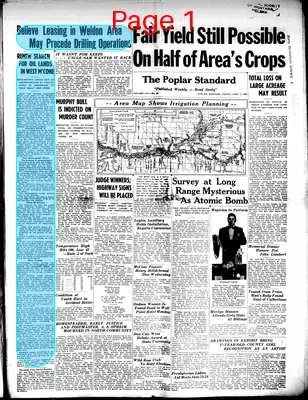
The Poplar Standard
Poplar, Roosevelt County, Montana
What is this article about?
Renewed oil exploration in northeastern Montana: leasing surges in Weldon area signaling imminent drilling; Standard Oil starts year-long gravimetric survey near Circle; independent operator H.B. Christian leases near Canadian border; Carter Oil acquires leases south of Scobey.
Clipping
OCR Quality
Full Text
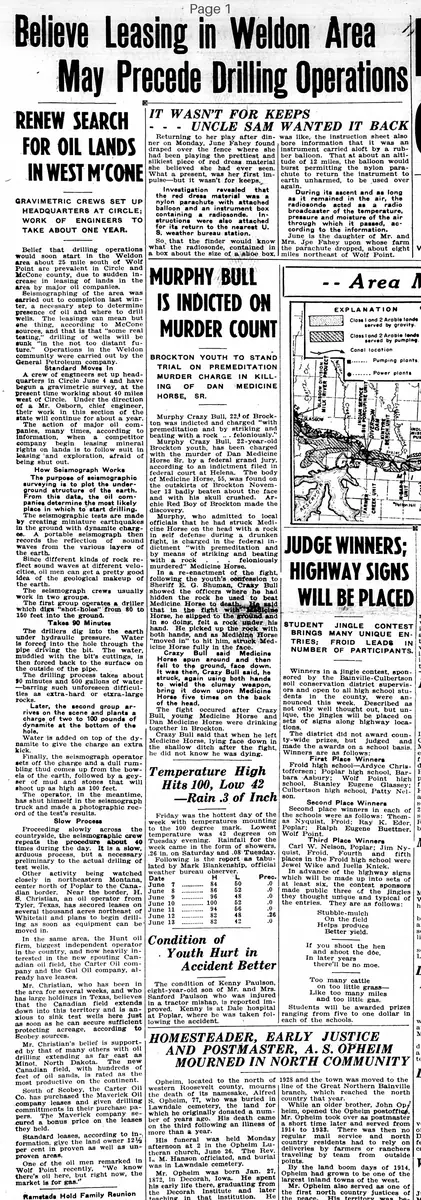
RENEW SEARCH FOR OIL LANDS IN WEST McCONE
GRAVIMETRIC CREWS SET UP HEADQUARTERS AT CIRCLE:
WORK OF ENGINEERS TO TAKE ABOUT ONE YEAR.
Belief that drilling operations would soon start in the Weldon area about 25 miles south of Wolf Point are prevalent in Circle and McCone county, due to sudden increase in leasing of lands in the area by major oil companies.
Seismographing of the area was carried out to completion last winter, a necessary step to determine presence of oil and where to drill wells. The leasings can mean but one thing, according to McCone sources, and that is that "some real testing." drilling of wells will be sunk "in the not too distant future."
Operations in the Weldon community were carried out by the General Petroleum company.
Standard Moves In
A crew of engineers set up headquarters in Circle June 4 and have begun a gravimetric survey. at the present time working about 40 miles west of Circle. Under the direction of a Mr. Osborn, chief engineer, their work in this section of the state will continue for about a year
The action of major oil companies, many times, according to information, when a competitor company begin leasing mineral rights on lands is to follow suit in leasing and exploration, afraid of being shut out.
How Seismograph Works
The purpose of seismographic surveying is to plot the underground structure of the earth.
From this data, the oil companies determine the most likely place in which to start drilling.
The seismographic tests are made by creating miniature earthquakes in the ground with dynamite charges. A portable seismograph then records the reflection of sound waves from the various layers of the earth.
Since different kinds of rock reflect sound waves at different velocities, oil men can get a pretty good idea of the geological makeup of the earth.
The seismograph crews usually work in two groups.
The first group operates a driller which digs "shot-holes" from 80 to 150 feet into the ground.
Takes 90 Minutes
The drillers dig into the earth under hydraulic pressure.
Water is forced into the hole through the pipe driving the bit. The water, muddied with the bit's cuttings, is then forced back to the surface on the outside of the pipe.
The drilling process takes about 90 minutes and 500 gallons of water -barring such unforeseen difficulties as extra-hard or extra-large rocks.
Later, the second group arrives on the scene and plants a charge of two to 100 pounds of dynamite at the bottom of the hole.
Water is added on top of the dynamite to give the charge an extra kick.
Finally. the seismograph operator sets off the charge and a dull rumbling thud comes up from the bowels of the earth, followed by a geyser of mud and stones that will shoot up as high as 100 feet.
The operator, in the meantime, has shut himself in the seismograph truck and made a photographic record of the test's results.
Slow Process
Proceeding slowly across the countryside, the seismographic crew repeats the procedure about 40 times during the day. It is a slow, arduous process, but a necessary preliminary to the actual drilling of test wells.
Other activity being watched closely in northeastern Montana, center north of Poplar to the Canadian border. Near the border. H. B. Christian. an oil operator from Tyler, Texas, has secured leases on several thousand acres northeast of Whitetail and plans to begin drilling as soon as equipment can be moved in.
In the same area. the Hunt oil firm. biggest independent operator in the country, and now heavily interested in the new spouting Canadian oil field. the Carter Oil company and the Gul Oil company. already have leases.
Mr. Christian, who has been in the area for several weeks. and who has large holdings in Texas, believes that the Canadian field extends down into this territory and is anxious to sink test wells here just as soon as he can secure sufficient protecting acreage, according to Scobey sources.
Mr. Christian's belief is supported by that of many others with oil drilling extending as far east as Minot. North Dakota. The new Canadian field. with hundreds of feet of oil sands. is rated as the most productive on the continent.
South of Scobey, the Carter Oil Co. has purchased the Maverick Oil company leases and given drilling commitments in their purchase papers. The Maverick company secured a bonus price on the leases they held.
Standard leases. according to information, give the land owner 12 1/2 per cent in proven as well as unproven areas.
One of the oil men remarked in Wolf Point recently.
"We know there's oil here. but right now, the market is for gas."
What sub-type of article is it?
What keywords are associated?
What entities or persons were involved?
Where did it happen?
Domestic News Details
Primary Location
Mccone County, Montana
Event Date
June 4
Key Persons
Event Details
Belief that drilling operations will soon start in the Weldon area due to increased leasing by major oil companies following seismographic surveys last winter by General Petroleum. Standard Oil crew begins gravimetric survey west of Circle under Mr. Osborn, to last about one year. H. B. Christian secures leases northeast of Whitetail for drilling. Carter Oil purchases Maverick Oil leases south of Scobey with drilling commitments. Other companies like Hunt and Gulf have leases near the Canadian border.