Thank you for visiting SNEWPapers!
Sign up free
Editorial
May 21, 1960
The Mississippi Enterprise
Jackson, Hinds County, Mississippi
What is this article about?
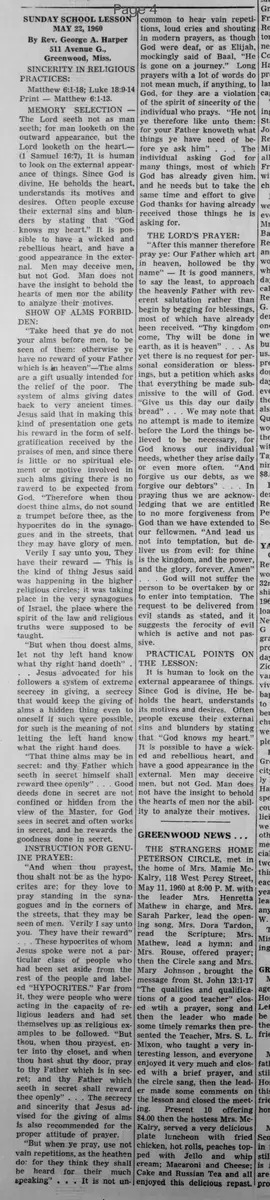
Sunday school lesson by Rev. George A. Harper from Greenwood, Miss., dated May 22, 1960, teaching on sincerity in religious practices from Matthew 6:1-18 and Luke 18:9-14, focusing on secret alms, genuine prayer without show, and explication of the Lord's Prayer.
Clipping
OCR Quality
98%
Excellent
Full Text
SUNDAY SCHOOL LESSON
MAY 22, 1960
By Rev. George A. Harper
511 Avenue G.,
Greenwood, Miss.
SINCERITY IN RELIGIOUS
PRACTICES:
Matthew 6:1-18: Luke 18:9-14
Print - Matthew 6:1-13.
MEMORY SELECTION-
The Lord seeth not as man
seeth; for man looketh on the
outward appearance, but the
Lord looketh on the heart.—
(1 Samuel 16:7), It is human
to look on the external appear-
ance of things. Since God is
divine, He beholds the heart,
understands its motives and
desires. Often people excuse
their external sins and blun-
ders by stating that "God
knows my heart." It is pos-
sible to have a wicked and
rebellious heart, and have a
good appearance in the exter-
nal. Men may deceive men,
but not God. Man does not
have the insight to behold the
hearts of men nor the ability
to analyze their motives.
SHOW OF ALMS FORBID-
DEN:
"Take heed that ye do not
your alms before men, to be
seen of them: otherwise ye
have no reward of your Father
which is in heaven"—The alms
are a gift usually intended for
the relief of the poor. The
system of alms giving dates
back to very ancient times.
Jesus said that in making this
kind of presentation one gets
his reward in the form of self-
gratification received by the
praises of men, and since there
is little or no spiritual ele-
ment or motive involved in
such alms giving there is no
reward to be expected from
God. "Therefore when thou
doest thine alms, do not sound
a trumpet before thee, as the
hypocrites do in the synago-
gues and in the streets, that
they may have glory of men.
Verily I say unto you, They
have their reward - This is
the kind of thing Jesus said
was happening in the higher
religious circles; it was taking
place in the very synagogues
of Israel, the place where the
spirit of the law and religious
truths were supposed to be
taught.
"But when thou doest alms,
let not thy left hand know
what thy right hand doeth" .
. Jesus advocated for his
followers a system of extreme
secrecy in giving, a secrecy
that would keep the giving of
alms a hidden thing even to
oneself if such were possible,
for such is the meaning of not
letting the left hand know
what the right hand does.
"That thine alms may be in
secret: and thy Father which
seeth in secret himself shall
reward thee openly" . . . Good
deeds done in secret are not
confined or hidden from the
view of the Master, for God
sees in secret and often works
in secret, and he rewards the
goodness done in secret.
INSTRUCTION FOR GENU-
INE PRAYER:
"And when thou prayest,
Thou shalt not be as the hypo-
crites are; for they love to
pray standing in the syna-
gogues and in the corners of
the streets, that they may be
seen of men. Verily I say unto
you. They have their reward"
. . . These hypocrites of whom
Jesus spoke were not a par-
ticular class of people who
had been set aside from the
rest of the people and label-
ed "HYPOCRITES." Far from
it, they were people who were
acting in the capacity of re-
ligious leaders and had set
themselves up as religious ex-
amples to be followed. "But
thou, when thou prayest, en-
ter into thy closet, and when
thou hast shut thy door, pray
to thy Father which is in sec-
ret; and thy Father which
seeth in secret shall reward
thee openly" . . . The secrecy
and sincerity that Jesus ad-
vised for the giving of alms
is also recommended for the
proper attitude of prayer.
"But when ye pray, use not
vain repetitions, as the heathen
do: for they think they shall
be heard for. their much
speaking" It is not un-
common to hear vain repeti
tions, loud cries and shouting
in modern prayers, as though
God were deaf, or as Elijah,
mockingly said of Baal, He
is gone on a journey." Long
prayers with a lot of words do
not mean much, if anything, to
God, for they are a violation
of the spirit of sincerity of the
individual who prays. "Be not
ye therefore like unto them:
for your Father knoweth what
things ye have need of be-
fore ye ask him" . . . The
individual asking God for
many things, most of which
God has already given him.
and he needs but to take the
same time and effort to give
God thanks for having already
received those things he is
asking for.
THE LORD'S PRAYER:
"After this manner therefore
pray ye: Our Father which art
in heaven, hallowed be thy
name" - It is good manners,
to say the least, to approach
the heavenly Father with rey-
erent salutation rather than
begin by begging for blessings,
most of which have already
been received. "Thy kingdom
come, Thy will be done in
earth, as it is heaven" . . . As
yet there is no request for per-
sonal consideration or bless-
ings, but a petition which asks
that everything be made sub-
missive to the will of God.
"Give us this day our daily
bread" . . . We may note that
no attempt is made to itemize
before the Lord the things be-
lieved to be necessary, for
God knows our individual
needs, whether they arise daily
or even more often. "And
forgive us our debts, as we
forgive our debtors" . , , In
praying thus we are acknow-
ledging that we are entitled
to no more forgiveness from
God than we have extended to
our fellowmen. "And lead us
not into temptation, but de-
liver us from evil: for thine
is the kingdom, and the power,
and the glory, forever. Amen"
.. . God will not suffer the
person to be overtaken by or
to enter into temptation. The
request to be delivered from
evil stands as stated, and it
suggests the ferocity of evil
which is active and not pas-
sive.
PRACTICAL POINTS ON
THE LESSON:
It is human to look on the
external appearance of things.
Since God is divine. He be-
holds the heart, understands
its motives and desires. Often
people excuse their external
sins and blunders by stating
that "God knows my heart."
It is possible to have a wick-
ed and rebellious heart. and
have a good appearance in the
external. Men may deceive
men, but not God. Man does
not have the insight to behold
the hearts of men nor the abil-
ity to analyze their motives.
MAY 22, 1960
By Rev. George A. Harper
511 Avenue G.,
Greenwood, Miss.
SINCERITY IN RELIGIOUS
PRACTICES:
Matthew 6:1-18: Luke 18:9-14
Print - Matthew 6:1-13.
MEMORY SELECTION-
The Lord seeth not as man
seeth; for man looketh on the
outward appearance, but the
Lord looketh on the heart.—
(1 Samuel 16:7), It is human
to look on the external appear-
ance of things. Since God is
divine, He beholds the heart,
understands its motives and
desires. Often people excuse
their external sins and blun-
ders by stating that "God
knows my heart." It is pos-
sible to have a wicked and
rebellious heart, and have a
good appearance in the exter-
nal. Men may deceive men,
but not God. Man does not
have the insight to behold the
hearts of men nor the ability
to analyze their motives.
SHOW OF ALMS FORBID-
DEN:
"Take heed that ye do not
your alms before men, to be
seen of them: otherwise ye
have no reward of your Father
which is in heaven"—The alms
are a gift usually intended for
the relief of the poor. The
system of alms giving dates
back to very ancient times.
Jesus said that in making this
kind of presentation one gets
his reward in the form of self-
gratification received by the
praises of men, and since there
is little or no spiritual ele-
ment or motive involved in
such alms giving there is no
reward to be expected from
God. "Therefore when thou
doest thine alms, do not sound
a trumpet before thee, as the
hypocrites do in the synago-
gues and in the streets, that
they may have glory of men.
Verily I say unto you, They
have their reward - This is
the kind of thing Jesus said
was happening in the higher
religious circles; it was taking
place in the very synagogues
of Israel, the place where the
spirit of the law and religious
truths were supposed to be
taught.
"But when thou doest alms,
let not thy left hand know
what thy right hand doeth" .
. Jesus advocated for his
followers a system of extreme
secrecy in giving, a secrecy
that would keep the giving of
alms a hidden thing even to
oneself if such were possible,
for such is the meaning of not
letting the left hand know
what the right hand does.
"That thine alms may be in
secret: and thy Father which
seeth in secret himself shall
reward thee openly" . . . Good
deeds done in secret are not
confined or hidden from the
view of the Master, for God
sees in secret and often works
in secret, and he rewards the
goodness done in secret.
INSTRUCTION FOR GENU-
INE PRAYER:
"And when thou prayest,
Thou shalt not be as the hypo-
crites are; for they love to
pray standing in the syna-
gogues and in the corners of
the streets, that they may be
seen of men. Verily I say unto
you. They have their reward"
. . . These hypocrites of whom
Jesus spoke were not a par-
ticular class of people who
had been set aside from the
rest of the people and label-
ed "HYPOCRITES." Far from
it, they were people who were
acting in the capacity of re-
ligious leaders and had set
themselves up as religious ex-
amples to be followed. "But
thou, when thou prayest, en-
ter into thy closet, and when
thou hast shut thy door, pray
to thy Father which is in sec-
ret; and thy Father which
seeth in secret shall reward
thee openly" . . . The secrecy
and sincerity that Jesus ad-
vised for the giving of alms
is also recommended for the
proper attitude of prayer.
"But when ye pray, use not
vain repetitions, as the heathen
do: for they think they shall
be heard for. their much
speaking" It is not un-
common to hear vain repeti
tions, loud cries and shouting
in modern prayers, as though
God were deaf, or as Elijah,
mockingly said of Baal, He
is gone on a journey." Long
prayers with a lot of words do
not mean much, if anything, to
God, for they are a violation
of the spirit of sincerity of the
individual who prays. "Be not
ye therefore like unto them:
for your Father knoweth what
things ye have need of be-
fore ye ask him" . . . The
individual asking God for
many things, most of which
God has already given him.
and he needs but to take the
same time and effort to give
God thanks for having already
received those things he is
asking for.
THE LORD'S PRAYER:
"After this manner therefore
pray ye: Our Father which art
in heaven, hallowed be thy
name" - It is good manners,
to say the least, to approach
the heavenly Father with rey-
erent salutation rather than
begin by begging for blessings,
most of which have already
been received. "Thy kingdom
come, Thy will be done in
earth, as it is heaven" . . . As
yet there is no request for per-
sonal consideration or bless-
ings, but a petition which asks
that everything be made sub-
missive to the will of God.
"Give us this day our daily
bread" . . . We may note that
no attempt is made to itemize
before the Lord the things be-
lieved to be necessary, for
God knows our individual
needs, whether they arise daily
or even more often. "And
forgive us our debts, as we
forgive our debtors" . , , In
praying thus we are acknow-
ledging that we are entitled
to no more forgiveness from
God than we have extended to
our fellowmen. "And lead us
not into temptation, but de-
liver us from evil: for thine
is the kingdom, and the power,
and the glory, forever. Amen"
.. . God will not suffer the
person to be overtaken by or
to enter into temptation. The
request to be delivered from
evil stands as stated, and it
suggests the ferocity of evil
which is active and not pas-
sive.
PRACTICAL POINTS ON
THE LESSON:
It is human to look on the
external appearance of things.
Since God is divine. He be-
holds the heart, understands
its motives and desires. Often
people excuse their external
sins and blunders by stating
that "God knows my heart."
It is possible to have a wick-
ed and rebellious heart. and
have a good appearance in the
external. Men may deceive
men, but not God. Man does
not have the insight to behold
the hearts of men nor the abil-
ity to analyze their motives.
What sub-type of article is it?
Moral Or Religious
What keywords are associated?
Sunday School Lesson
Sincerity Religion
Alms Giving
Genuine Prayer
Lord's Prayer
Matthew 6
Secret Giving
Hypocrites
What entities or persons were involved?
Jesus
God
Hypocrites
Rev. George A. Harper
Editorial Details
Primary Topic
Sincerity In Religious Practices
Stance / Tone
Instructional And Exhortative
Key Figures
Jesus
God
Hypocrites
Rev. George A. Harper
Key Arguments
God Beholds The Heart And Motives, Not Outward Appearance
Alms Should Be Given In Secret, Not For Show
Prayer Should Be Sincere And Private, Avoiding Vain Repetitions
The Lord's Prayer Emphasizes Reverence, Submission To God's Will, Daily Needs, Forgiveness, And Deliverance From Evil