Thank you for visiting SNEWPapers!
Sign up free
Editorial
June 23, 1863
Daily Democrat And News
Davenport, Scott County, Iowa
What is this article about?
This editorial harshly criticizes President Lincoln's administration for arbitrary arrests, military trials, and banishments, focusing on the unjust treatment of Clement Vallandigham for anti-war speech, while accusing Lincoln of hypocrisy for tolerating similar views from Fernando Wood. It highlights abuses in Indiana under General Hascall.
Clipping
OCR Quality
95%
Excellent
Full Text
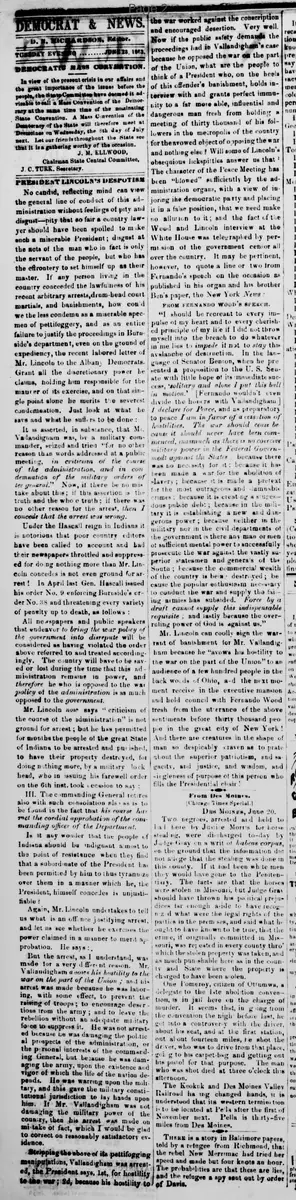
PRESIDENT LINCOLN'S DESPOTISM
No candid, reflecting mind can view the general line of conduct of this administration without feelings of pity and disgust—pity that so fair a country lawyer should have been spoiled to make such a miserable President; disgust at the acts of the man who in fact is only the servant of the people, but who has the effrontery to set himself up as their master. If any person living in the country conceded the lawfulness of his recent arbitrary arrests, drum-head court martials, and banishments, how could we the less condemn as a miserable specimen of pettifoggery, and as an entire failure to justify the proceedings in Burnside's department, even on the ground of expediency, the recent labored letter of Mr. Lincoln to the Albany Democrats. Grant all the discretionary power he claims, holding him responsible for the manner of its exercise, and on that single point alone he merits the severest condemnation. Just look at what he says and what he suffers to be done:
It is asserted, in substance, that Mr. Vallandigham was, by a military commander, seized and tried "for no other reason than words addressed at a public meeting, in criticism of the course of the administration, and in condemnation of the military orders of the general." Now, if there be no mistake about this; if this assertion is the truth and the whole truth; if there was no other reason for the arrest, then I concede that the arrest was wrong. Under the Hascall reign in Indiana it is notorious that poor country editors have been called to account and had their newspapers throttled and suppressed for doing nothing more than Mr. Lincoln concedes is not even ground for arrest! In April last Gen. Hascall issued his order No. 9 enforcing Burnside's order No. 38 and threatening every variety of penalty up to death, as follows:
All newspapers and public speakers that endeavor to bring the war policy of the government into disrepute will be considered as having violated the order above referred to and treated accordingly. The country will have to be saved or lost during the time that this administration remains in power, and therefore he who is opposed to the war policy of the administration is as much opposed to the government.
Mr. Lincoln now says "criticism of the course of the administration" is not ground for arrest; but he has permitted for months the people of the great State of Indiana to be arrested and punished, to have their property destroyed, for doing nothing more, by a military lock-step head, who in issuing his farewell order on the 6th inst. took occasion to say:
III. The commanding General retires also with such consolation as is to be found in the fact that his course has met the cordial approbation of the commanding officer of the Department.
Is it any wonder that the people of Indiana should be indignant almost to the point of resistance when they find that a subordinate of the President has been permitted by him to thus tyrannize over them in a manner which he, the President, himself concedes is unjustifiable?
Again, Mr. Lincoln undertakes to tell us what is an offence justifying arrest, and let us see whether he exercises the power claimed in a manner to merit approbation. He says:
But the arrest, as I understand, was made for a very different reason. Mr. Vallandigham avows his hostility to the war on the part of the Union; and his arrest was made because he was laboring, with some effect, to prevent the raising of troops; to encourage desertions from the army; and to leave the rebellion without an adequate military force to suppress it. He was not arrested because he was damaging the political prospects of the administration, or the personal interests of the commanding General, but because he was damaging the army, upon the existence and vigor of which the life of the nation depends. He was warring upon the military, and this gave the military constitutional jurisdiction to lay hands upon him. If Mr. Vallandigham was not damaging the military power of the country, then his arrest was made on mistake of fact, which I would be glad to correct on reasonably satisfactory evidence.
Stripping the above of its pettifogging manipulations, Vallandigham was arrested, the President says, 1st, for hostility to the war; 2d, because his hostility to the war worked against the conscription and encouraged desertion. Very well. Now if the public safety demands the proceedings had in Vallandigham's case because he opposed the war on the part of the Union, what are the people to think of a President who, on the heels of this offender's banishment, holds interview with and grants perfect immunity to a far more able, influential and dangerous man fresh from holding meeting of thirty thousand of his followers in the metropolis of the country for the avowed object of opposing the war and nothing else! Will some of Lincoln's obsequious lickspittles answer us that:
The character of the Peace Meeting has been "blowed" sufficiently by the administration organs, with a view of injuring the democratic party and placing it in a false position, that we need make no allusion to it; and the fact of the Wood and Lincoln interview at the White House was telegraphed by permission of the government censor all over the country. It may be pertinent, however, to quote a line or two from Fernando's speech on the occasion as published in his organ and his brother Ben's paper, the New York News:
FROM FERNANDO WOOD'S SPEECH.
"I should be recreant to every impulse of my heart and to every cherished principle of my life if I did not throw myself into the breach to do whatever in me lies to impede if not to stay this avalanche of destruction. In the language of Senator Benton, when he presented a proposition to the U. S. Senate with little hope of its immediate success, 'solitary and alone I put this ball in motion.' Fernando wouldn't even divide the honors with Vallandigham. I declare for Peace, and as preparatory to peace I am in favor of a cessation of hostilities. The war should cease because it should never have been commenced, inasmuch as there is no coercive military power in the Federal Government against the States; because there was no necessity for it; because it has been made a war for the abolition of slavery; because it is made a pretext for the most outrageous and shameful crimes; because it is creating a stupendous public debt; because in the military it is establishing a new and dangerous power; because neither in the military nor in the civil departments of the government is there any man or men of sufficient mental power to successfully prosecute the war against the vastly superior statesmen and generals of the South; because the commercial wealth of the country is being destroyed; because the popular enthusiasm necessary to conduct the war and supply the failing armies has subsided. Force by a draft cannot supply this indispensable requisite; and lastly because the overruling power of God is against us."
Mr. Lincoln can coolly sign the warrant of banishment for Mr. Vallandigham because he "avows his hostility to the war on the part of the Union" to an audience of a few hundred people in the back woods of Ohio, and the next moment receive in the executive mansion and hold council with Fernando Wood fresh from the utterance of the above sentiments before thirty thousand people in the great city of New York! And there are creatures in the shape of man so despicably craven as to prate about the superior patriotism, and sagacity, and justice, and wisdom, and singleness of purpose of this person who fills the Presidential chair.
No candid, reflecting mind can view the general line of conduct of this administration without feelings of pity and disgust—pity that so fair a country lawyer should have been spoiled to make such a miserable President; disgust at the acts of the man who in fact is only the servant of the people, but who has the effrontery to set himself up as their master. If any person living in the country conceded the lawfulness of his recent arbitrary arrests, drum-head court martials, and banishments, how could we the less condemn as a miserable specimen of pettifoggery, and as an entire failure to justify the proceedings in Burnside's department, even on the ground of expediency, the recent labored letter of Mr. Lincoln to the Albany Democrats. Grant all the discretionary power he claims, holding him responsible for the manner of its exercise, and on that single point alone he merits the severest condemnation. Just look at what he says and what he suffers to be done:
It is asserted, in substance, that Mr. Vallandigham was, by a military commander, seized and tried "for no other reason than words addressed at a public meeting, in criticism of the course of the administration, and in condemnation of the military orders of the general." Now, if there be no mistake about this; if this assertion is the truth and the whole truth; if there was no other reason for the arrest, then I concede that the arrest was wrong. Under the Hascall reign in Indiana it is notorious that poor country editors have been called to account and had their newspapers throttled and suppressed for doing nothing more than Mr. Lincoln concedes is not even ground for arrest! In April last Gen. Hascall issued his order No. 9 enforcing Burnside's order No. 38 and threatening every variety of penalty up to death, as follows:
All newspapers and public speakers that endeavor to bring the war policy of the government into disrepute will be considered as having violated the order above referred to and treated accordingly. The country will have to be saved or lost during the time that this administration remains in power, and therefore he who is opposed to the war policy of the administration is as much opposed to the government.
Mr. Lincoln now says "criticism of the course of the administration" is not ground for arrest; but he has permitted for months the people of the great State of Indiana to be arrested and punished, to have their property destroyed, for doing nothing more, by a military lock-step head, who in issuing his farewell order on the 6th inst. took occasion to say:
III. The commanding General retires also with such consolation as is to be found in the fact that his course has met the cordial approbation of the commanding officer of the Department.
Is it any wonder that the people of Indiana should be indignant almost to the point of resistance when they find that a subordinate of the President has been permitted by him to thus tyrannize over them in a manner which he, the President, himself concedes is unjustifiable?
Again, Mr. Lincoln undertakes to tell us what is an offence justifying arrest, and let us see whether he exercises the power claimed in a manner to merit approbation. He says:
But the arrest, as I understand, was made for a very different reason. Mr. Vallandigham avows his hostility to the war on the part of the Union; and his arrest was made because he was laboring, with some effect, to prevent the raising of troops; to encourage desertions from the army; and to leave the rebellion without an adequate military force to suppress it. He was not arrested because he was damaging the political prospects of the administration, or the personal interests of the commanding General, but because he was damaging the army, upon the existence and vigor of which the life of the nation depends. He was warring upon the military, and this gave the military constitutional jurisdiction to lay hands upon him. If Mr. Vallandigham was not damaging the military power of the country, then his arrest was made on mistake of fact, which I would be glad to correct on reasonably satisfactory evidence.
Stripping the above of its pettifogging manipulations, Vallandigham was arrested, the President says, 1st, for hostility to the war; 2d, because his hostility to the war worked against the conscription and encouraged desertion. Very well. Now if the public safety demands the proceedings had in Vallandigham's case because he opposed the war on the part of the Union, what are the people to think of a President who, on the heels of this offender's banishment, holds interview with and grants perfect immunity to a far more able, influential and dangerous man fresh from holding meeting of thirty thousand of his followers in the metropolis of the country for the avowed object of opposing the war and nothing else! Will some of Lincoln's obsequious lickspittles answer us that:
The character of the Peace Meeting has been "blowed" sufficiently by the administration organs, with a view of injuring the democratic party and placing it in a false position, that we need make no allusion to it; and the fact of the Wood and Lincoln interview at the White House was telegraphed by permission of the government censor all over the country. It may be pertinent, however, to quote a line or two from Fernando's speech on the occasion as published in his organ and his brother Ben's paper, the New York News:
FROM FERNANDO WOOD'S SPEECH.
"I should be recreant to every impulse of my heart and to every cherished principle of my life if I did not throw myself into the breach to do whatever in me lies to impede if not to stay this avalanche of destruction. In the language of Senator Benton, when he presented a proposition to the U. S. Senate with little hope of its immediate success, 'solitary and alone I put this ball in motion.' Fernando wouldn't even divide the honors with Vallandigham. I declare for Peace, and as preparatory to peace I am in favor of a cessation of hostilities. The war should cease because it should never have been commenced, inasmuch as there is no coercive military power in the Federal Government against the States; because there was no necessity for it; because it has been made a war for the abolition of slavery; because it is made a pretext for the most outrageous and shameful crimes; because it is creating a stupendous public debt; because in the military it is establishing a new and dangerous power; because neither in the military nor in the civil departments of the government is there any man or men of sufficient mental power to successfully prosecute the war against the vastly superior statesmen and generals of the South; because the commercial wealth of the country is being destroyed; because the popular enthusiasm necessary to conduct the war and supply the failing armies has subsided. Force by a draft cannot supply this indispensable requisite; and lastly because the overruling power of God is against us."
Mr. Lincoln can coolly sign the warrant of banishment for Mr. Vallandigham because he "avows his hostility to the war on the part of the Union" to an audience of a few hundred people in the back woods of Ohio, and the next moment receive in the executive mansion and hold council with Fernando Wood fresh from the utterance of the above sentiments before thirty thousand people in the great city of New York! And there are creatures in the shape of man so despicably craven as to prate about the superior patriotism, and sagacity, and justice, and wisdom, and singleness of purpose of this person who fills the Presidential chair.
What sub-type of article is it?
Constitutional
Partisan Politics
War Or Peace
What keywords are associated?
Lincoln Despotism
Vallandigham Arrest
Arbitrary Arrests
Civil War Criticism
Fernando Wood
Peace Movement
Military Tyranny
Indiana Suppression
What entities or persons were involved?
President Lincoln
Mr. Vallandigham
Gen. Burnside
Gen. Hascall
Fernando Wood
Albany Democrats
Editorial Details
Primary Topic
Criticism Of Lincoln's Arbitrary Arrests And Hypocrisy Toward War Opponents
Stance / Tone
Strongly Anti Lincoln, Accusatory Of Despotism And Hypocrisy
Key Figures
President Lincoln
Mr. Vallandigham
Gen. Burnside
Gen. Hascall
Fernando Wood
Albany Democrats
Key Arguments
Lincoln's Arbitrary Arrests And Military Trials Are Unjustifiable Even On Grounds Of Expediency
Arrest Of Vallandigham For Anti War Speech Contradicts Lincoln's Own Concessions
Hypocrisy In Punishing Indiana Critics While Tolerating Fernando Wood's Larger Peace Advocacy
Lincoln Permits Subordinates Like Hascall To Tyrannize Over Citizens Unjustly
Vallandigham's Arrest For Damaging Military Efforts, Yet Wood Receives Immunity Despite Similar Actions