Thank you for visiting SNEWPapers!
Sign up free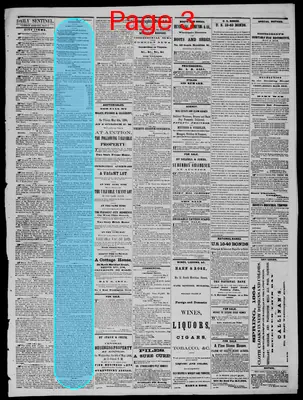
Poem
May 3, 1864
Daily State Sentinel
Indianapolis, Marion County, Indiana
What is this article about?
A lyrical poem envisioning a utopian 'millennial morrow' of abundance, joy, and moral triumph through faith, contrasting with present-day sorrows and urging perseverance for the right. Followed by unrelated 1864 Indianapolis city council proceedings and local news.
Clipping

OCR Quality
75%
Good
Full Text
"For the soul belied,
Oh, we more elect to come
That ever is to come:
What hope sings contented upon to-day's nest,
Nor seeks another home?
The vineyards purple, in this fruitful morrow,
With globes of royal wine;
The fields grow ripe without our care to harrow,
With food that is divine.
We sing our sweetest songs for this to-morrow,
We weave our gayest dreams;
Our duties better done when night has shaken
The dew-drops from his wings.
So happy we when dawns the glad to-morrow!
And stronger for the fight:
Then faith shall all the clouds of error scatter,
We live but for the right.
But when shall dawn this glad millennial morrow?
Oh! not to you or I,
While we are crushed by each day's load of sorrow,
But hope the next to fly
City Council.
INDIANAPOLIS,
Monday Evening, May 2, 1864.
Council met last night. His Honor and a quorum were present.
The Chairman of the Finance Committee reported an ordinance appropriating money in payment of sundry claims against the City of Indianapolis. The sums appropriated were as follows:
Fire Department..... $2,041 41
Percentage to Treasurer..... 2,027 18
Interest paid on orders..... 1,584 97
Police..... 1,390 00
Jail expenses..... 434 60
Specific..... 219 75
Street improvements..... 91 35
Gas fixtures..... 60 59
Pest House..... 81 50
Street repairs..... 49 00
Printing..... 26 50
Books and stationery..... 11 00
Total..... $8,017 85
Read three times and passed.
Mr. Allen presented a petition from the City Assessor for an extension of the time within which to complete his work. Referred.
A petition was presented from members of the Fire Department for an increase of wages. Referred.
A like petition was presented from members of the Hose Department, which was referred, with instructions to inquire into the expediency of inquiring into the pay of the Chief Fire Engineer.
The Indiana Central Railroad Company petitioned for the privilege of laying an additional track across Virginia avenue in the vicinity of their freight depot.
Also, a remonstrance to same, was presented.
Remonstrance and petition referred to the Committee on Streets and Alleys.
A petition was presented, asking for the vacation of an alley on the west half of block 98. Referred.
Another petition was presented, asking for the grading and graveling of Lockerbie street. Referred.
The Chairman of the Judiciary Committee reported relative to the claim of John Brennan for damage done to his house on Benton street. The law was not so well settled as to show that the city was not liable. Justice demanded that he should have something, and the sum of $125 was recommended to be paid him. Tabled.
The City Clerk was directed to issue warrants to pay the clerks and judges in the recent special elections in the 4th and 9th wards—amounting to $55.
Mr. Jameson, from Committee on Revision of ordinances, reported against further legislation on the regulations governing hack hire. Concurred in.
The Committee on Market Houses was instructed to confer with Gen. Stone in reference to putting the west market house in the condition it was before the taking possession of it for military purposes.
The Committee on Streets and Alleys reported in favor of a contract for grading and graveling Delaware street between St. Clair street and the Corporation line, with H. Zimmerman, at 42 cents per cubic yard for grading, and $1.55 for graveling; also, with John Stump, for grading and bowldering Delaware between Washington street and Pogue Run. Concurred in.
Also, an ordinance to grade and gravel Lockerbie street, and curbing the outer edge with white oak plank. Laid over.
Also, an ordinance to provide for the grading and graveling of the first alley west of East street and running east and west through square 21. Read twice and laid over.
Also, an ordinance authorizing the vacation of an alley between lots 6 and 7 in Vanblaricum's subdivision of out lot 14. Laid over.
Also, a remonstrance against vacating alley running north and south near the German Catholic Church on Maryland street. Tabled.
Sundry contracts for street improvements, gas fixtures, &c., were opened and read.
An ordinance relative to the bonds and malfeasance in office of all officers in the service of the City of Indianapolis, was read and laid over for amendment.
A resolution relative to trying policemen by the Council on any charges preferred, was adopted.
A resolution was adopted, authorizing the Mayor by proclamation to call upon citizens to assemble in their respective wards, in order to petition the Council to levy a special tax for bounties to one hundred day men. Under the law, this tax cannot be levied, unless by the action indicated on the part of the people. The Mayor will proclaim at an early day.
After the transaction of further business, the Council adjourned.
Extortion of Gas Companies—Under this head the New York Herald of Thursday, has the following comments upon the extortions of the gas companies of that city. The remarks of the Herald will apply with equal force to the extortions of the Gas Company of Indianapolis. At the price which it has charged for gas, $5.75 per thousand feet, it has made exorbitant profits. Out of its earnings it has built splendid works, and laid hundreds of miles of pipe. And now, when it should exhibit generosity to the people for the profitable privileges it has received, it proposes to add to their burdens by increasing the price of gas, so as to continue the numerous profits of the company. There are capitalists who are willing to enter establish another company, if they can obtain the privilege, and furnish gas at the old price. If the City Council has the power to do so, it can not do it better service than to grant the authority. Competition will not only keep down the price to a remunerative profit, but also improve the quality. Gas at $3.75 per thousand is a dear light, but its convenience at a higher cost is the consideration in favor of its use.
We copy the Herald's remarks with the hope that it may call public attention to the matter, and lead to some remedy to defeat the extortions of speculators.
From evidence recently given before a committee of the British House of Commons it appears that, although the maximum price of gas furnished by the thirteen London companies is only a dollar and a half per thousand feet, the average dividend paid by them is ten per cent. In Liverpool the price ranges under a dollar, and the average dividend is also ten per cent. It is the same in Birmingham, Manchester, Bristol and Wolverhampton. In some places the price runs as low as fifty-eight cents. Making due allowance for differences in the price of coal, transportation, &c., there is no just reason why gas should cost with us two dollars and a half, and in some places three dollars a thousand. The gas companies lay in their stock of coal at low prices; their facilities of manufacture are as great as, if not greater than, those of the London companies, and the competition is less. There is not a company in operation in any of our seacoast cities which is not in a position to furnish gas as cheaply, and pay as large dividends as the London companies. If it were not for the corrupt influences prevailing at Albany we might now be in the enjoyment of cheap light without interfering with the just profits of the capital embarked in these speculations. It is disgraceful that the consumer should be compelled to pay for his supply more than double what it is worth by the shutting out of competition. We trust that in the next Legislature some one will be found honest and energetic enough to expose the combinations by which the price of this indispensable article is kept up, and to introduce a measure by which they may be defeated.
Masonic Hall—We are pleased to learn that the celebrated Commodore Foote (our well known friend Charley Nestle) and his charming little sister, who is indeed a little fairy, assisted by Col. Small and a first-class musical company, intend to favor this city with a series of their delightful entertainments, opening at Masonic Hall next Friday evening. Everything heretofore exhibited in the way of little people is thrown entirely into the shade by these wonderful curiosities. Commodore Foote is a thorough scholar; and as a comedian, actor, orator and dancer, he has no equals; while his elfin sister is very intelligent and refined in her conversation and deportment, and sings and dances in the most charming manner. The proficiency in the polite arts acquired by these little wonders, under the kind instruction of one of the most talented musicians in America, (Miss M. C. Ellinger) is truly surprising. The Commodore and his little sister will be assisted by the justly celebrated pianist and vocalist, Miss Ellinger; by Col. Small, the Female Character Dancer; our old friends, the Continental Vocalists, Franklin and Smith; and by Prof. G. H. Brooks, the Blind Pianist and Violinist. These constitute a combination which for curiosity and talent cannot be excelled.
Attention is called to the fact that on Friday, May 6, 1864, Walker, McKernan & Goldsberry will offer for sale at auction the residence on North Illinois street adjoining Cunningham's Confectionery on the north, and opposite the Governor's mansion. The house is a two story frame, new, and contains twelve rooms. The lot is 71½ feet front by 120 feet deep, and has a good assortment of fruit trees, shrubbery, &c., well, cistern, stable and carriage house. At the same time will be sold the vacant lot adjoining the above, on the south: 30 feet front by 120 feet deep.
At the same time, will be sold the vacant lot adjoining the above named lot, on the north. Size, 23 feet front by 120 feet deep.
The three lots together have a front of 124½ feet, and separately or together constitute one of the most desirable localities in the city. The sale should be attended by all who contemplate an investment in city property.
m3-2
Oh, we more elect to come
That ever is to come:
What hope sings contented upon to-day's nest,
Nor seeks another home?
The vineyards purple, in this fruitful morrow,
With globes of royal wine;
The fields grow ripe without our care to harrow,
With food that is divine.
We sing our sweetest songs for this to-morrow,
We weave our gayest dreams;
Our duties better done when night has shaken
The dew-drops from his wings.
So happy we when dawns the glad to-morrow!
And stronger for the fight:
Then faith shall all the clouds of error scatter,
We live but for the right.
But when shall dawn this glad millennial morrow?
Oh! not to you or I,
While we are crushed by each day's load of sorrow,
But hope the next to fly
City Council.
INDIANAPOLIS,
Monday Evening, May 2, 1864.
Council met last night. His Honor and a quorum were present.
The Chairman of the Finance Committee reported an ordinance appropriating money in payment of sundry claims against the City of Indianapolis. The sums appropriated were as follows:
Fire Department..... $2,041 41
Percentage to Treasurer..... 2,027 18
Interest paid on orders..... 1,584 97
Police..... 1,390 00
Jail expenses..... 434 60
Specific..... 219 75
Street improvements..... 91 35
Gas fixtures..... 60 59
Pest House..... 81 50
Street repairs..... 49 00
Printing..... 26 50
Books and stationery..... 11 00
Total..... $8,017 85
Read three times and passed.
Mr. Allen presented a petition from the City Assessor for an extension of the time within which to complete his work. Referred.
A petition was presented from members of the Fire Department for an increase of wages. Referred.
A like petition was presented from members of the Hose Department, which was referred, with instructions to inquire into the expediency of inquiring into the pay of the Chief Fire Engineer.
The Indiana Central Railroad Company petitioned for the privilege of laying an additional track across Virginia avenue in the vicinity of their freight depot.
Also, a remonstrance to same, was presented.
Remonstrance and petition referred to the Committee on Streets and Alleys.
A petition was presented, asking for the vacation of an alley on the west half of block 98. Referred.
Another petition was presented, asking for the grading and graveling of Lockerbie street. Referred.
The Chairman of the Judiciary Committee reported relative to the claim of John Brennan for damage done to his house on Benton street. The law was not so well settled as to show that the city was not liable. Justice demanded that he should have something, and the sum of $125 was recommended to be paid him. Tabled.
The City Clerk was directed to issue warrants to pay the clerks and judges in the recent special elections in the 4th and 9th wards—amounting to $55.
Mr. Jameson, from Committee on Revision of ordinances, reported against further legislation on the regulations governing hack hire. Concurred in.
The Committee on Market Houses was instructed to confer with Gen. Stone in reference to putting the west market house in the condition it was before the taking possession of it for military purposes.
The Committee on Streets and Alleys reported in favor of a contract for grading and graveling Delaware street between St. Clair street and the Corporation line, with H. Zimmerman, at 42 cents per cubic yard for grading, and $1.55 for graveling; also, with John Stump, for grading and bowldering Delaware between Washington street and Pogue Run. Concurred in.
Also, an ordinance to grade and gravel Lockerbie street, and curbing the outer edge with white oak plank. Laid over.
Also, an ordinance to provide for the grading and graveling of the first alley west of East street and running east and west through square 21. Read twice and laid over.
Also, an ordinance authorizing the vacation of an alley between lots 6 and 7 in Vanblaricum's subdivision of out lot 14. Laid over.
Also, a remonstrance against vacating alley running north and south near the German Catholic Church on Maryland street. Tabled.
Sundry contracts for street improvements, gas fixtures, &c., were opened and read.
An ordinance relative to the bonds and malfeasance in office of all officers in the service of the City of Indianapolis, was read and laid over for amendment.
A resolution relative to trying policemen by the Council on any charges preferred, was adopted.
A resolution was adopted, authorizing the Mayor by proclamation to call upon citizens to assemble in their respective wards, in order to petition the Council to levy a special tax for bounties to one hundred day men. Under the law, this tax cannot be levied, unless by the action indicated on the part of the people. The Mayor will proclaim at an early day.
After the transaction of further business, the Council adjourned.
Extortion of Gas Companies—Under this head the New York Herald of Thursday, has the following comments upon the extortions of the gas companies of that city. The remarks of the Herald will apply with equal force to the extortions of the Gas Company of Indianapolis. At the price which it has charged for gas, $5.75 per thousand feet, it has made exorbitant profits. Out of its earnings it has built splendid works, and laid hundreds of miles of pipe. And now, when it should exhibit generosity to the people for the profitable privileges it has received, it proposes to add to their burdens by increasing the price of gas, so as to continue the numerous profits of the company. There are capitalists who are willing to enter establish another company, if they can obtain the privilege, and furnish gas at the old price. If the City Council has the power to do so, it can not do it better service than to grant the authority. Competition will not only keep down the price to a remunerative profit, but also improve the quality. Gas at $3.75 per thousand is a dear light, but its convenience at a higher cost is the consideration in favor of its use.
We copy the Herald's remarks with the hope that it may call public attention to the matter, and lead to some remedy to defeat the extortions of speculators.
From evidence recently given before a committee of the British House of Commons it appears that, although the maximum price of gas furnished by the thirteen London companies is only a dollar and a half per thousand feet, the average dividend paid by them is ten per cent. In Liverpool the price ranges under a dollar, and the average dividend is also ten per cent. It is the same in Birmingham, Manchester, Bristol and Wolverhampton. In some places the price runs as low as fifty-eight cents. Making due allowance for differences in the price of coal, transportation, &c., there is no just reason why gas should cost with us two dollars and a half, and in some places three dollars a thousand. The gas companies lay in their stock of coal at low prices; their facilities of manufacture are as great as, if not greater than, those of the London companies, and the competition is less. There is not a company in operation in any of our seacoast cities which is not in a position to furnish gas as cheaply, and pay as large dividends as the London companies. If it were not for the corrupt influences prevailing at Albany we might now be in the enjoyment of cheap light without interfering with the just profits of the capital embarked in these speculations. It is disgraceful that the consumer should be compelled to pay for his supply more than double what it is worth by the shutting out of competition. We trust that in the next Legislature some one will be found honest and energetic enough to expose the combinations by which the price of this indispensable article is kept up, and to introduce a measure by which they may be defeated.
Masonic Hall—We are pleased to learn that the celebrated Commodore Foote (our well known friend Charley Nestle) and his charming little sister, who is indeed a little fairy, assisted by Col. Small and a first-class musical company, intend to favor this city with a series of their delightful entertainments, opening at Masonic Hall next Friday evening. Everything heretofore exhibited in the way of little people is thrown entirely into the shade by these wonderful curiosities. Commodore Foote is a thorough scholar; and as a comedian, actor, orator and dancer, he has no equals; while his elfin sister is very intelligent and refined in her conversation and deportment, and sings and dances in the most charming manner. The proficiency in the polite arts acquired by these little wonders, under the kind instruction of one of the most talented musicians in America, (Miss M. C. Ellinger) is truly surprising. The Commodore and his little sister will be assisted by the justly celebrated pianist and vocalist, Miss Ellinger; by Col. Small, the Female Character Dancer; our old friends, the Continental Vocalists, Franklin and Smith; and by Prof. G. H. Brooks, the Blind Pianist and Violinist. These constitute a combination which for curiosity and talent cannot be excelled.
Attention is called to the fact that on Friday, May 6, 1864, Walker, McKernan & Goldsberry will offer for sale at auction the residence on North Illinois street adjoining Cunningham's Confectionery on the north, and opposite the Governor's mansion. The house is a two story frame, new, and contains twelve rooms. The lot is 71½ feet front by 120 feet deep, and has a good assortment of fruit trees, shrubbery, &c., well, cistern, stable and carriage house. At the same time will be sold the vacant lot adjoining the above, on the south: 30 feet front by 120 feet deep.
At the same time, will be sold the vacant lot adjoining the above named lot, on the north. Size, 23 feet front by 120 feet deep.
The three lots together have a front of 124½ feet, and separately or together constitute one of the most desirable localities in the city. The sale should be attended by all who contemplate an investment in city property.
m3-2
What sub-type of article is it?
Ode
What themes does it cover?
Moral Virtue
Religious Faith
What keywords are associated?
Tomorrow
Hope
Millennial
Faith
Error
Right
Sorrow
Poem Details
Subject
Hope For The Millennial Tomorrow
Form / Style
Rhymed Stanzas
Key Lines
So Happy We When Dawns The Glad To Morrow!
And Stronger For The Fight:
Then Faith Shall All The Clouds Of Error Scatter,
We Live But For The Right.
But When Shall Dawn This Glad Millennial Morrow?
Oh! Not To You Or I,