Thank you for visiting SNEWPapers!
Sign up free
The Gazette
Cleveland, Cuyahoga County, Ohio
What is this article about?
Article describes the circus as a geographic marvel, drawing international performers and animals from every continent, highlighting famous figures like Will Rogers and Mabel Stark, animal care, logistics of travel, and historical beginnings in 1785.
Merged-components note: Continuation of circus article across columns, including overlapping image
Clipping
OCR Quality
Full Text
Heralds
Coming
Circus
Much Actual Geography Seen
in Sawdust Ring.
(Prepared by the United States Department
of Agriculture.)—WNU Service.
THE circus, land of sawdust and
spangles, pink lemonade and peanuts,
is about to emerge from
winter quarters. The magic rum-
ble of red wagons and the footsteps of
circusdom's spangled battalions have
echoed down the corridors of many
summers; yet few really know the
phantom white city, a nomadic world,
a geographic marvel and a mystery
from beginning to end.
There is more actual geography
within the narrow borders of Span-
gleland than in any similar space on
the face of the earth. From the shores
of the seven seas come its citizens,
their faces turned toward the open
road where lies the winding trail of
the big tops. Dainty equestriennes
from France and handsome Russians
from the steppes; pink-cheeked athletes
from Great Britain and Scandinavia;
flashing brunettes from Italy, Argen-
tina, Mexico, and sunny Spain; blond
Germans with iron bodies; suave,
charming Austrians; almond-eyed
maids from Yokohama, Tokyo, and
Nagasaki and from the seething land
of the dragon; sun-tanned sheiks from
the shifting sands of Araby; whip-
crackers from Australia and hard-rid-
ing cowboys from the western plains;
clowns, acrobats, aerialists, riders,
staff executives and laborers from ev-
ery state in the Union—all owe alle-
giance to the transient country of
tents.
A game of checkers in the circus
"backyard" between a genial young
Japanese tumbler, heir to half a mil-
lion dollars, and an old clown who
ran away from his home in the Middle
West long ago, lured by the spangled
Pied Piper and his steel-throated cal-
liope, shows how the big top draws
together the ends of the earth. Such
is the population of Spangleland,
where people from nearly every coun-
try under the sun are fed into the hop-
per of a highly organized machine to
emerge firmly woven into the brilliant
mosaics of a fast-moving performance,
subscribing without reservation to the
one supreme law of the trouper—"The
show must go on."
The circus is organized socially, but
a trouper's geographical background
has nothing to do with his qualification
for membership in the circus golf club,
baseball team, clown society, women's
clubs, or circus chapter of the Ameri-
can Red Cross. Above all else, the
population of this nomadic melting pot
learns tolerance, and it's what a per-
son is rather than where he came from
that counts most.
Got Start in Circus.
Circusdom has been a springboard
from which men have vaulted to prom-
inence in other fields. Will Rogers was
the "Cherokee Kid" with Wirth's cir-
cus in 1904. Al G. Fields, the minstrel
king, started trouping as a Shake-
spearean clown. Fred Stone wore
spangles before the footlights claimed
him, and some of his best antics were
born back in "Clown Alley" during
his circus days.
Many persons still look upon circus
trouping as something akin to robbing
a bank, which accounts for the inter-
esting fact that many present-day cir-
cus stars had to run away from home
to join. Take Mabel Stark, for ex-
ample. Her relatives virtually dis-
owned her when she laid aside the
crisp, white uniform of the trained
urse to expose herself to the maul-
ing of "big, striped tomcats," as she
affectionately refers to her tigers. But
the call of the calliope and the magic
of the midway were in her ears and she
immigrated to Spangleland, there to
become the only woman in the world
who breaks, trains, and works tigers.
She has more scars on her body than
a giraffe has spots, and her exciting
career has fed newspaper columns for
years.
The almost unlimited geographical
aspects of the circus are nowhere more
in evidence than in the wild-animal
menagerie. To this traveling college
of zoology belong animals from every
continent, each a splendid physical
specimen, receiving the utmost care
from the animal attendants. Zoologi-
cal experts from leading universities
never cease to marvel at the excep-
tionally fine condition of the circus
animals, despite the fact that they are
moved from city to city almost every
day. Variation in climate in different
sections of the country presents a se-
rious problem for circus animal at-
tendants, who often pass hours in a
cage with a sick jungle charge, so fond
are they of their animals. Seldom does
a beast die while the circus is on the
road.
Under a single spread of canvas are
gathered hundreds of animals and
birds—tigers from Bengal, Sumatra,
and Siberia; lions and leopards from
Africa's tangled jungles; tall, silent
giraffes from the open stretches of
Ethiopia; nilgai, black buck, aoudad,
tapir, and gemsbok antelope. In the
same circus colony are Russian brown
bears, huge black fellows from Alaska,
and polar bears from Greenland's icy
slopes. But the circus animal popula-
tion does not end here. There are hip-
popotamuses from north of the Trans-
vaal; orang utans from Borneo; tiny
rhesus monkeys with pathetic faces,
affectionate dispositions, and delicate
lungs; llamas from the mountains of
Peru; pumas from North and South
America; macaws from Mexico; sea
lions from California; a sea elephant
from the Antarctic wastes; wise
friendly elephants and a curious ar-
mored rhinoceros from India; the
more familiar rhino from Africa, to-
gether with hyenas, dromedaries, ze-
bras, and water buffaloes. Australia
contributes the kangaroo.
The rhinoceros, despite his perpet-
ual grouch and his amazing ugliness,
is one of the most valuable beasts in
the circus, costing about $10,000 by
the time he has been purchased from
an exporter and raised to maturity.
While the more impressive rhino hails
from India, a dwindling species, the
African, is a formidable fellow of
steam-roller disposition. Rhinoceros,
elephant, or water buffalo can whip
a tiger or at least discourage him in
most instances. In contrast to the
evil-tempered pachyderm, with the
deadly horn and the tiny, piglike eyes,
is the good-natured hippopotamus, as
genial as he is fat.
Elephants From India.
Circus elephants, almost without ex-
ception, come from India. Their Afri-
can cousins, though larger, are much
harder to handle and have proved pret-
ty generally useless in circuses except
for display purposes. Jumbo was an
African and he was stubborn, like the
rest of his four-footed countrymen.
One night years ago, in St. Thomas,
Ont., Jumbo got into an argument with
a freight train on the wrong track,
with the result that his funeral was
held the following morning.
Indian elephants are natural actors
and enjoy doing tricks in the big show.
They are quick to learn, once they
realize what is expected of them, and
their ears are tuned to applause like
those of a born trouper. Most of them
are surprisingly good-natured, and they
are so anxious about a firm footing
that in most cases they will not vol-
untarily step on a man. Giraffes are
captured by means of a lasso, and oft-
en an Africa-born giraffe will be seen
to have about two inches of hair miss-
ing from his stubby mane—evidence
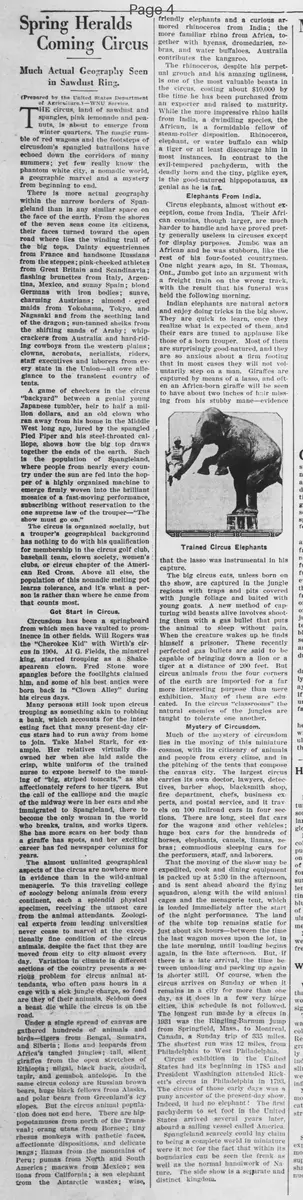
Trained Circus Elephants
that the lasso was instrumental in his
capture.
The big circus cats, unless born on
the show, are captured in the jungle
regions with traps and pits covered
with jungle foliage and baited with
young goats. A new method of cap-
turing wild beasts alive involves shoot-
ing them with a gas bullet that puts
the animal to sleep without pain.
When the creature wakes up he finds
himself a prisoner. These recently
perfected gas bullets are said to be
capable of bringing down a lion or a
tiger at a distance of 200 feet. But
circus animals from the four corners
of the earth are imported for a far
more interesting purpose than mere
exhibition. Many of them are edu-
cated. In the circus "classrooms" the
natural enemies of the jungles are
taught to tolerate one another.
Mystery of Circusdom.
Much of the mystery of circusdom
lies in the moving of this miniature
cosmos, with its citizenry of animals
and people from every clime, and in
the pitching of the tents that compose
the canvas city. The largest circus
carries its own doctor, lawyers, detec-
tives, barber shop, blacksmith shop,
fire department, chefs, business ex-
perts, and postal service, and it trav-
els on 100 railroad cars in four sec-
tions. There are long, steel flat cars
for the wagons and other vehicles;
huge box cars for the hundreds of
horses, elephants, camels, llamas, ze-
bras; commodious sleeping cars for
the performers, staff, and laborers.
That the moving of the show may be
expedited, cook and dining equipment
is packed up at 5:30 in the afternoon,
and is sent ahead aboard the flying
squadron, along with the wild animal
cages and the menagerie tent, which
is loaded immediately after the start
of the night performance. The land
of the white top remains static for
just about six hours—between the time
the last wagon moves upon the lot, in
the late morning, until loading begins
again, in the late afternoon. But, if
there is a late arrival, the time be-
tween unloading and packing up again
is shorter still. Of course, when the
circus arrives on Sunday or when it
remains in a city for more than one
day, as it does in a few very large
cities, this schedule is not followed.
The longest run made by a circus in
1931 was the Ringling-Barnum jump
from Springfield, Mass., to Montreal,
Canada, a Sunday trip of 335 miles.
The shortest run was 12 miles, from
Philadelphia to West Philadelphia.
Circus exhibition in the United
States had its beginning in 1785 and
President Washington attended Rick-
etts circus in Philadelphia in 1793.
The circus of those early days was a
puny ancestor of the present-day show.
Indeed, it had no elephant! The first
pachyderm to set foot in the United
States arrived several years later,
aboard a sailing vessel called America.
Spangleland scarcely could lay claim
to being a complete world in miniature
were it not for the fact that within its
boundaries can be seen the freak as
well as the normal handiwork of Na-
ture. The side show is a separate and
distinct kingdom.
What sub-type of article is it?
What themes does it cover?
What keywords are associated?
What entities or persons were involved?
Where did it happen?
Story Details
Key Persons
Location
United States
Event Date
1931
Story Details
The circus is portrayed as a nomadic world uniting performers and animals from around the globe, with diverse international acts, exotic beasts from every continent, famous troupers' origins, animal care challenges, and logistical feats of travel and setup, emphasizing tolerance and the show must go on ethos.