Thank you for visiting SNEWPapers!
Sign up free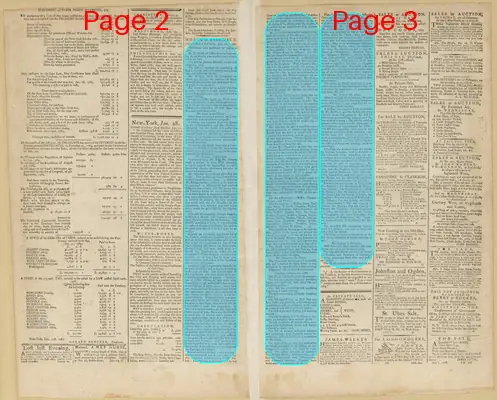
The Daily Advertiser
New York, New York County, New York
What is this article about?
Proceedings of the New York House of Assembly in Poughkeepsie on January 21-22, 1788, covering bills on forcible entries, beef/pork repacking, exportation of flour, relief for Treasurer Benjamin Michau, and others; debate on Michau's robbery loss; election of delegates to Congress including Hamilton, Benson, and Gansevoort.
Merged-components note: Merged continuation of the House of Assembly proceedings report across pages 2 and 3 into a single domestic news story; relabeled to domestic_news for consistency with local legislative content.
Clippings

1 of 2
OCR Quality
Full Text
POUGHKEPSIE, Jan. 21, 1788.
The House met pursuant to adjournment.
Mr. N. Smith, of Ulster County, appearing in the House, was qualified and admitted to his seat.
The Bill to prevent forcible entries and detainers, and,
The Bill to regulate the repacking of beef and pork, were respectively read a third time and passed the House.
Mr. Dongan, from the Committee to whom was referred the petition of Mary Elmendorph reported, that the prayer thereof ought to be granted.
Mr. Jones, agreeable to a Law, for that purpose, brought in several revised Laws, which were read a first time and ordered a second reading.
On motion of Mr. Sands, the House went into a Committee on the Bill supplementary to the act for regulating the exportation of flour, &c. extending the said Law to Rye and buckwheat meal,
Mr. Low in the Chair.
After some time spent thereon, the Committee rose and reported the progress.
A message was received from the Senate by Mr. L'Hommedieu, and Mr. Hoffman, informing that the Senate had passed the Bill for preventing abuses and delays in actions of replevin: the Bill for preventing and punishing champerty and maintenance: and the Bill for the prevention and punishment of extortion.
On motion the House went into a Committee on the Bill to enable the supervisors to raise a certain sum of money for the purposes therein mentioned.
Mr. Strange in the Chair.
In proceeding in the Bill, Mr. Dongan made a motion to have it so amended, as not to compel the supervisors to raise the money therein mentioned, but that it should remain optional.
Mr. Sylvester then rose and addressed the Chair. Two questions presented themselves to the Committee as to facts. I. Whether Mr. Michau had been robbed, as set forth in his petition? 2. Whether he had not had sufficient time to have paid this money into the Treasury before he was robbed—
As to these points it required investigation. But, upon presumption that the facts were as stated in his petition, the only question that could arise for the discussion of the Committee, was, whether any, and what relief could be given him by the Legislature?
This case he compared, in some measure, to that of a Sheriff, who receives recompence by way of fees for his services. The Sheriff, according to Law, is not relievable in cases of escapes of prisoners, but where the gaol takes fire, or is broken open by an enemy.
Suppose an inundation had swept away the house in which the Treasurer was: Suppose an earthquake had swallowed it up, or that it had been consumed by fire, or that in sending the money to New-York, the ferry-boat had been sunk with it:
Should the Treasurer in either case be chargeable? These things it would be said were the act of God: but in what does this secondary cause differ, if the Treasurer was no way delinquent.
Courts of Law are generally supposed to be determined by, and to decide according to the rules of Law. But it is the right of the Legislature, and they ought to be governed by principles of equity. The situation of public officers, he said, who were compellable to act, as the public have a right to the services of every citizen, was a hard one, particularly as the compensation which was made them, was no ways adequate to any risques, nor did he suppose it was intended to be so. If the allowance was more than adequate to the trouble, and proportionably to the risque, there would then be some reason to make him chargeable. In cases of a private nature, all that Law and reason required was, that a man should take as much care of another man's money or thing trusted to him, as he does of his own.
If therefore the Treasurer could make it appear that he had done his duty, he was of opinion that he ought to be relieved. If officers ever so diligent and faithful shall be answerable against all events and casualties that may happen, it will be very difficult to get good officers, and more so, that they procure good security; who have been hitherto supposed to be only answerable for the honesty of the officers, and to indemnify the State against failures.
It was however, he said, maxim in Law, that an individual had better suffer, than that a general inconveniency should follow: but this was to be controuled by the
Law not imposing impossibilities and absurdities. It was therefore in his opinion, better for the public to contribute to the relief of one of its officers, than that he should be ruined for an accident no way imputable to him.
Mr. Jones thought himself obliged to oppose the motion of Mr. Dongan;—he could never agree to say anything of that kind, let it appear in what shape it would. If it was to be left to the people, there was no necessity of passing a Law to compel them to do as they pleased. He was of opinion that Mr. Michau should be relieved; and that the loss should be supported by the county; as the money could not be considered the property of the State, till it was receipted for in the Treasury. With respect to leaving it to the people to raise the money, if they saw fit, he confessed he did not think it was fair: for, as they were interested in the decision, Mr. Michau's prospect for relief would be a very bad one. He dwelt a short time on the subject, and concluded with some observations, tending to explain the importance of the question: and the propriety of giving Mr. Michau the relief he had prayed for.
Mr. Benson said he had no doubt that the robbery had been committed. The only question was who should bear the loss? The Treasurer, if the facts stated in the petition were true, ought certainly to be exonerated. It was therefore right that the Bill should stand without alteration. He was not however clear in his opinion, whether the State or the County should bear the loss. This was a question on which he wished the opinion of the Committee.
Mr. Sylvester thought it would be a dangerous precedent, to declare that the State should bear the loss; it would make the Counties less attentive, and be productive of bad consequences. On putting this abstract question, it was determined that the State should not bear the loss.
It was Mr. Harrison's opinion that the Treasurer should be relieved, and that it was very proper the County should bear the loss, inasmuch as it would tend to prevent robberies in future, independent of the consideration that the money was not the actual property of the State till it was received at the Treasury. He used some very good arguments to support his opinion: but it would be too lengthy for us to detail the whole of the debate on this occasion.
Mr. Dongan thought the people ought to be left at liberty to determine whether they would relieve Mr. Michau; and after having observed the extreme hardship of compelling the County of Richmond to pay twice the same tax; called for a division on his motion.
For the affirmative.—Messrs. Carman, Dongan, and Winant.
For the negative.—Messrs. Jones, Taulman, Niven, J. Smith, Doughty, Wykoff, Sylvester, Gansevoort, Baker, Patterson, De Witt, Gilbert, Speaker, Frey, Van Ingen, Gordon, Powers, Webster, Savage, Bruyne, Bloom, Benson, Hedges, Osborn, Graham, Sands, Low, Verplank, Wyner, Sickles, Younglove, Clinton, Thompson, Lewis, Harrison, Havens, N. Smith. 37
The Committee having gone through the Bill, agreed to the same, and altered the title so as to read 'An act for the relief of Benjamin Michau, late Treasurer of Richmond County,' rose and reported the same, when it was ordered to be engrossed.
The House went into a Committee on the Bill to relieve Cities and Towns, from such charges as may arise from bastard children, born within the same,
Mr. Havens in the Chair.
The Committee having agreed to the Bill, rose and reported the same, when it was ordered to be engrossed for a third reading.
Adjourned till 10 o'clock to-morrow.
Tuesday, January 22, 1788.
The House met pursuant to adjournment.
The Bill for apprehending and punishing rogues and vagabonds, and other idle and disorderly persons:
The Bill for preventing and punishing forgery, and counterfeiting:
The Bill concerning prisoners breaking prison:
The Bill against such as shall levy any fine, suffer any recovery, acknowledge any recognizance, bill, or judgment, in the name or names of any other person or persons:
The Bill to prevent stealing and avoiding records:
The Bill declaring it to be felony in servants to embezzle their masters' goods:
The bill to restrain all persons from marrying until their former wives and former husbands be dead; and,
The Bill to prevent malicious maiming and wounding, were severally read a second time, and committed to a committee of the whole.
The order of the day was then read, when the House proceeded to the election of five delegates to represent this State in Congress. On calling the roll, it appeared that Egbert Benson, Abraham Yates, jun. Leonard Gansevoort, Ezra L'Hommedieu, and Alexander Hamilton, Esquires, were nominated by a plurality of voices.
Then the Senate attended in the Assembly Chamber to compare the lists of the nomination of both Houses; and it appearing that the two Houses were unanimous in the nomination of Mr. Yates, Mr. Hamilton, Mr. L'Hommedieu, and Mr. Benson: and that it was necessary to ballot for a fifth person, either Mr. Floyd, who had been nominated by the Senate, or Mr. Gansevoort, who had been nominated by the Assembly; they were accordingly ballotted for by both Houses, when, on collecting the votes, Mr. Gansevoort had 36, and Mr. Floyd 28.—Whereupon, Abraham Yates, jun. Alexander Hamilton, Egbert Benson, Ezra L'Hommedieu, and Leonard Gansevoort, Esquires, were declared to be duly elected to represent this State in Congress till the first Monday in November next, and until ten days after the first subsequent meeting of the Legislature thereafter; provided that the time they represent this State does not exceed one year from the time of their appointment.
On motion the House went into a committee on the bill supplementary to the act to prevent the exportation of unmerchantable flour, &c. &c.
Mr. Low in the chair.
After some time spent thereon, the committee rose and reported that they had agreed to the Bill, when it was ordered to be engrossed for a third reading.
A message was received from the Senate, by Mr. Hoffman, and Mr. Ruel, informing that the Senate had agreed to the Bill for preventing and punishing perjury, and subornation of perjury: The Bill for enabling grantees of reversions to take advantage of the conditions to be performed by lessees: The Bill for compelling joint tenants and tenants in common to make partition; and for the more easy obtaining partition of lands in coparcenary, joint-tenancy and tenancy in common; and the Bill to regulate the culling of staves and heading, without amendment.
A message was received from the Senate, by General Schuyler, with a resolution of that honorable Body, requesting the appointment of a committee of both Houses, to devise a more equitable mode of taxation; and that in case of concurrence, Mr. L'Hommedieu, General Schuyler, Mr. Hoffman, and Mr. Hopkins, be the committee on the part of the Senate. The said resolution having been read, was agreed to by the House, and the following gentlemen appointed a committee for that purpose:
For the City and County of New-York, Mr. Harrison: For the County of Albany, Gen. Gordon: For the County of Suffolk, Mr. Havens: For the County of Queen's, Mr. Jones: For the County of King's, Mr. Doughty: For the County of Westchester, Mr. Gilbert: For the County of Ulster, Mr. Schoonmaker: For the County of Dutchess, Mr. Benson: For the County of Orange, Mr. Thompson: For the County of Columbia, Mr. Sylvester: For the County of Montgomery, Mr. James Livingston: For the County of Washington, Mr. Tear: and for the County of Richmond, Mr. Winant.
The engrossed Bill concerning amendments and jeofails, was read a third time and passed the House.
The House went into a committee on the Bill for the limitation of actions and suits at law
Mr. Carman in the chair.
After some time spent thereon, the committee rose and reported the progress.
The engrossed Bill for the relief of Benjamin Michau, late Treasurer of Richmond County, was read a third time and passed the House.
The House adjourned till ten o'clock to-morrow.
What sub-type of article is it?
What keywords are associated?
What entities or persons were involved?
Where did it happen?
Domestic News Details
Primary Location
Poughkeepsie
Event Date
Jan. 21 And 22, 1788
Key Persons
Outcome
bills passed including relief for benjamin michau borne by richmond county; election of five delegates to congress: yates, hamilton, benson, l'hommedieu, gansevoort (gansevoort 36 votes, floyd 28); committee appointed for equitable taxation mode.
Event Details
The House of Assembly met on Jan. 21, admitted Mr. N. Smith, passed bills on forcible entries, beef/pork repacking; committee reported favorably on Mary Elmendorph's petition; revised laws introduced; committee on flour exportation bill; Senate messages on bills passed. Debate on bill for supervisors raising money, focusing on relieving Treasurer Michau after robbery, with speeches by Sylvester, Jones, Benson, Harrison, Dongan; motion to make raising money optional defeated 3-37; bill agreed for Michau's relief. Committee on bastard children charges. Adjourned. On Jan. 22, several bills read second time and committed; election of Congress delegates conducted, with unanimous for four, ballot for fifth won by Gansevoort; committee on flour bill agreed; Senate messages on bills agreed; Senate resolution for taxation committee concurred, members appointed by county; bill on amendments passed; committee on limitation of actions; Michau relief bill passed.