Thank you for visiting SNEWPapers!
Sign up free
Washington Telegraph
Washington, Hempstead County, Arkansas
What is this article about?
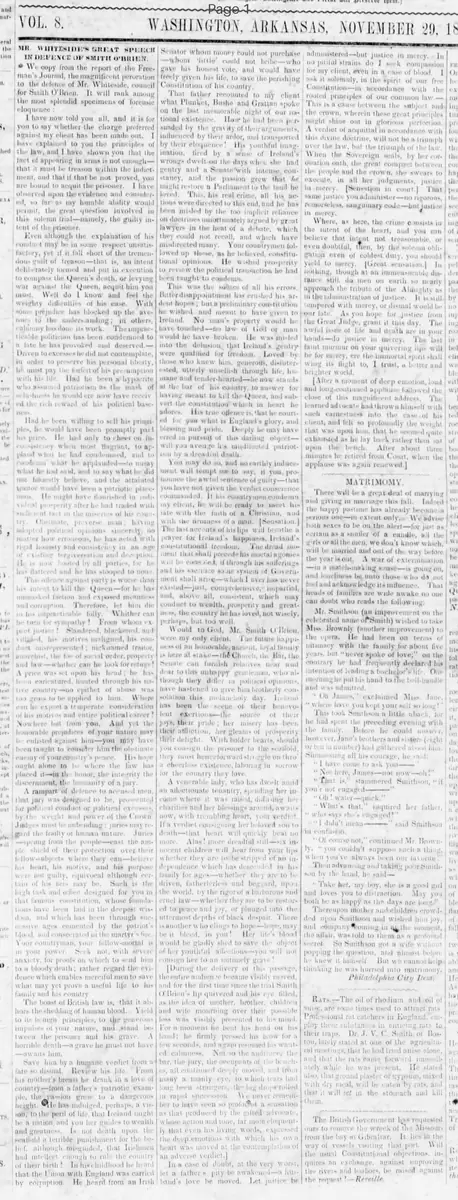
Report of Mr. Whiteside's eloquent defense speech for Smith O'Brien in his treason trial, arguing against guilty intent, highlighting his patriotic motives rooted in Irish history, and appealing to the jury's mercy to spare his life, family, and legacy.
Merged-components note: These components form a single continuous article on the defense speech for Smith O'Brien, spanning adjacent columns with sequential reading order.
Clipping
OCR Quality
Full Text
Mk.
wiTIsiDrx GRi:At sPeEC
IN DEFENCE OF SMITI OBRIEN.
We copy from the report of the Free-
man's Journal, the magnificent peroration
to the defence of Mr. Whiteside, counsel
for Smith O'Brien. It will rank among
the most splendid specimens of forensic
eloquence:
I have now told you all, and it is for
you to say whether the charge preferred
against my client has been made out. I
have explained to you the principles of
the law, and I have shown you that the
fact of appearing in arms is not enough—
that it must be treason within the indict-
ment, and that if that be not proved, you
are bound to acquit the prisoner. I have
observed upon the evidence and consider-
ed, so far as my humble ability would
permit, the great question involved in
this solemn trial-namely, the guilty in-
tent of the prisoner.
Even although the explanation of his
conduct may be in some respect unsatis-
factory, yet if it fall short of the tremen-
dous guilt of treason-that is, an intent
deliberately formed and put in execution
to compass the Queen's death, or levying
war against the Queen, acquit him you
must. Well do I know and feel the
weighty difficulties of his case. With
some prejudice has blocked up the ave-
nues to the understanding; in others,
calumny has done its work. The imprac-
ticable politician has been condemned to
death he has provoked and deserved -
Driven to excesses he did not contemplate,
in order to preserve his personal liberty.
He must pay the forfeit of his presumption
with his life. Had he been a hypocrite
who assumed patriotism as the mask of
selfishness he would ere now have received the rich reward of his political base-
ness.
Had he been willing to sell his princi-
ples, he would have been promptly par-
taken his price. He had only to cheer on in-
consistency when most flagrant, to ap-
plaud what he had condemned, and to
condemn what he applauded-to unsay
what he had said, and to say what he did
not honestly believe, and the attainted
traitor would have been a patriotic place-
man. He might have flourished in indi-
vidual prosperity after he had traded with
studied tact in the miseries of his coun-
try. Uncompromising, perverse man: having
adopted political opinions sincerely, no
matter how erroneous. he has acted with
rigid honesty and consistency in an age
of casting tergiversation and deception.
He is now hooted by all parties, for he
has flattered none and he has stooped to none.
The offence against party is worse than
his intent to kill the Queen-for he has
unmasked Faction and exposed meanness
and corruption. Therefore, let him die
in his impracticable folly. Whither can
he turn for sympathy? From whom ex-
pect justice? Slandered, blackened, and
vilified, his motives maligned, his con-
duct misrepresented; nicknamed traitor.
parricide, the foe of social order, property
and law- whither can he look for refuge?
A price was set upon his head; he has
been caricatured, hunted through his na-
tive country-no epithet of abuse was
too gross to be applied to him. Where
can he expect a temperate consideration
of his motives and entire political career?
Nowhere but from you. And yet the
honourable prejudices of your nature may
be enlisted against him-you may have
been taught to consider him the obstinate
enemy of your country's peace. His hope
ought alone to be where the law has
placed it-in the honour, the integrity the
discernment, the humanity of a jury.
A rampart of defence to accused men.
that jury was designed to be, prosecuted
for political conduct or political excesses,
by the weight and power of the Crown.
Judges must be unbending: juries may re-
gard the frailty of human nature. Juries-
passing from the people-cast the am-
ple shield of their protection over their
fellow-subjects where they can-believe
this heart, this motive, and this purpose
were not guilty, equivocal although cer-
tain of his act- may be. Such is the
high task and office designed for you in
that famous constitution, whose founda-
tions have been laid in the deepest wis-
dom, and which has been through suc-
cessive ages cemented by the patriot's
blood, and consecrated in the martyr's fire.
Your countryman, Your fellow-mortal is
in your power. Seek not, with severe
anxiety, for proofs on which to send him
to a bloody death: rather regard the evi-
dence which enables merciful men to save
what may yet prove a useful life to his
family and his country.
The boast of British law is, that it ab-
hors the shedding of human blood. Yield
to its benign principles, to the generous
impulses of your nature, and stand be-
tween the prisoner and his grave. A
horrible death-a grave he must not have-
awaits him.
Save him by a humane verdict from a
fate so dismal. Review his life. From
his mother's breast he drank in a love of
country-from a father's patriot exam-
ple, the passion grew to a dangerous
height. He has indulged, perhaps, a vis-
ion, to the peril of life. that Ireland might
be a nation and you her guides to wealth
and greatness. Is not death upon the
scaffold a terrible punishment for the be-
lief, although misguided, that Irishmen
had mettle enough to rule the country
of their birth? In his childhood he heard
that the Union with England was carried
by corruption. He heard from an Irish
Senator whom money could not purchase
-whom title could not bribe-who
gave his honest vote, and would have
freely given his life, to save the perishing
Constitution of his country.
That father recounted to my client
what Plunket, Bushe and Grattan spoke
on the last memorable night of our na-
tional existence. How he had been per-
suaded by the gravity of their arguments,
influenced by their ardor, and transported
by their eloquence! His youthful imagi-
nation, fired by a sense of Ireland's
wrongs dwelt on the days when: she had
gentry and a Senate with intense con-
stancy, and the passion grew that he
might restore a Parliament to the land he
loved. This, his real crime, all his ac-
tions were directed to this end, and he has
been misled by the too implicit reliance
on doctrines unfortunately argued by great
lawyers in the heat of a debate, which
they could not recall. and which have
misdirected many. Your countrymen fol-
lowed up these, as he believed, constitu-
tional opinions. He wished prosperity
to review the political transaction he had
been taught to condemn.
This was the source of all his errors.
Bitter disappointment has crushed his ar-
dent hopes; but a preliminary constitu-
tion he wished and meant to have given to
Ireland. No man's property would he
have touched-no law of God or man
would he have broken. He was misled
into the delusion that Ireland's gentry
were qualified for freedom. Loved by
those who knew him, generous, disin-
terested, utterly unselfish through life, hu-
mane and tender-hearted--he now stands
at the bar of his country, to answer for
having meant to kill the Queen, and sub-
vert the constitution which in heart he
adores. His true offence is, that he courted for you what is England's glory, and
blessing and pride. Deeply he may have
erred in pursuit of this daring object--
will you avenge his misdirected patriot-
ism by a dreadful death?
You may do so, and no earthly induce-
ment will tempt me to say, if you pro-
nounce the guilty sentence-that
you have not given the verdict conscience
commanded. If his countrymen condemn
my client, he will be ready to meet his
fate with the faith of a Christian. and
with the firmness of a man. [Sensation.
The last accents of his lips will breathe a
prayer for Ireland's happiness. Ireland's
constitutional freedom. The dread mo-
ment that shall precede his mortal agonies
will be consoled, if through his sufferings
and his sentence some system of Govern-
ment shall arise-which I aver has never
existed-just, comprehensive, impartial.
and, above all, consistent, which may
conduct to wealth, prosperity and great-
ness, the country he has loved, not wisely.
perhaps, but too well.
Would to God, Mr. Smith O'Brien,
were my only client. The future happi-
ness of an honorable, ancient, loyal family
is here at stake-the Church, the Bar, the
Senate can furnish relatives near and
dear to this unhappy gentleman, who al-
though they differ in political opinions,
have hastened to give him brotherly con-
solation this melancholy day. Ireland
has been the scene of their benevolent
exertions--the source of their
joys, their pride: her misery has been
their affliction. her gleams of prosperity
their delight. With bolder hearts, should
you consign the prisoner to the scaffold.
they must henceforth struggle on through
a cheerless existence. Laboring in sorrow
for the country they love.
A venerable lady, who has dwelt amid
an affectionate tenantry, spending her in-
come where it was raised, diffusing her
charities and her blessings around, awaits
now, with trembling heart, Your verdict.
If a verdict consigning her beloved son to
death-that heart will quickly beat no
more. Alas: more dreadful still-six in-
nocent children will hear from your lips
whether they are to be stripped of an in-
dependence which has descended in his
family for ages-whether they are to be
driven, fatherless and beggared, upon
the world, by the rigor of a barbarous and
cruel law-whether they are to be restored
to peace and joy. or plunged into the
uttermost depths of black despair. There
is another who clings to hope-hope, may
be, ill-based, in you. Her life's blood
would be gladly shed to save the object
of her youthful affections--you will not
consign her to an untimely grave.
[During the delivery of this passage,
the entire audience became visibly moved.
and for the first time since the trial Smith
O'Brien's lip quivered and his eye filled,
as the idea of mother, brother, children
and wife mourning over their possible
loss was visibly presented to his mind.
For a moment he bent his head on his
hand; he firmly pressed his brow for a
few seconds. and again resumed his wan-
ted calmness. Not so the audience, the
bar, the jury. the occupants of the benches,
all continued deeply moved, and from
many a manly eye, to which tears had
long been strangers, the big drops rolled
in rapid succession. We never remem-
ber to have seen so profound a sensation
as that produced by the gifted advocate,
whose action and tone, far more eloquently than even his living words, expressed
the deep emotions with which his own
heart was moved at the contemplation of
an adverse verdict.
In a case of doubt, at the very worst,
let a father's pity be awakened—a hus-
band's love be moved. Let justice be
administered-but justice in mercy. In
no pitiful strains do I seek compassion
for my client, even in a case of blood I
ask it solemnly, in the spirit of our free
Constitution-in accordance with the
rooted principles of our common law-
This is a cause between the subject and
the crown, wherein these great principles
might shine out in glorious perfection.
A verdict of acquittal in accordance with
this divine doctrine, will not be a triumph
over the law, but the triumph of the law.
When the Sovereign seals, by her cor-
onation oath, the great compact between
the people and the crown, she swears to
execute, in all her judgments, justice
in mercy. [Sensation in court.] That
same justice you administer-no rigorous,
remorseless, sanguinary code-but justice
in mercy.
Where, as here, the crime consists in
the intent of the heart, and you can
believe that intent not treasonable, or
even doubtful, then, by the solemn obli-
gation even of coldest duty, you should
yield to mercy. [Great sensation.] In
nothing, though at an immeasurably dis-
tance still. do men on earth so nearly
approach the attribute of the Almighty as
in the administration of justice. It is still
tempered with mercy, or dismal would be
our fate. As you hope for justice from
the Great Judge, grant it this day. The
awful issue of life and death are in your
hands-do justice in mercy. The last
faint murmur on your quivering lips will
be for mercy, ere the immortal spirit shall
wing its flight to. I trust, a better and
brighter world.
[After a moment of deep emotion, loud
and long-continued applause followed the
close of this magnificent address. The
learned advocate had thrown himself with
such earnestness into the case of his
client, and felt so profoundly the weight
that was upon him, that he seemed quite
exhausted as he lay back rather than sat
upon the bench. After about three
minutes he retired from Court, when the
applause was again renewed.
What sub-type of article is it?
What keywords are associated?
What entities or persons were involved?
Where did it happen?
Foreign News Details
Primary Location
Ireland
Key Persons
Outcome
defense speech pleads for acquittal to avoid death penalty; emotional impact on audience, jury, and o'brien; no verdict reported.
Event Details
Mr. Whiteside delivers a passionate peroration in defense of Smith O'Brien, accused of treason for appearing in arms and intent to levy war against the Queen. He argues lack of guilty intent, portrays O'Brien as sincere patriot misled by constitutional opinions aiming to restore Irish Parliament, influenced by historical figures and family. Appeals to jury's mercy considering O'Brien's family, emphasizing British law's abhorrence of bloodshed and justice tempered with mercy. Speech causes profound emotion in court.